Persephone, the queen of the underworld, is a pivotal figure in Odysseus's journey to the land of the dead, where she controls the access of ghosts to the sacrificial blood and thus enables the prophecy that guides his return.
Pirithous is a legendary king of the Lapiths, a companion of Theseus, and a figure whose attempted abduction of Persephone from the underworld is briefly glimpsed in Odysseus's catalogue of the dead during his nekyia. Though he never appears in the living action of the Odyssey, his name marks the boundary of Odysseus's own descent narrative and serves as a foil for the hero's restraint and piety.
Pisander, son of Polyctor, is a minor suitor from Ithaca who participates in the contest of the bow and is killed by the stockman Philoetius during the slaughter of the suitors. His brief appearance underscores the collective guilt and violent end of those who wasted Odysseus's estate and courted Penelope against her will.
Pollux, the mighty boxer and son of Tyndareus and Leda, appears in the Odyssey only as a name in Odysseus's catalogue of famous women he saw in the Underworld, where he and his brother Castor are described as lying under the earth yet still alive, alternating between death and life every other day by a special dispensation of Zeus, and holding the rank of gods.
Pontonous is a herald and cupbearer in the court of King Alcinous of the Phaeacians, a minor but precisely defined functionary whose repeated appearances in the banquet scenes of Books 7, 8, and 13 establish the ritual order of Phaeacian hospitality and the formal framework within which Odysseus tells his story and receives his escort.
Tyndareus is the Spartan king whose daughter Helen's marriage to Menelaus set in motion the Trojan War, and whose other daughter Clytemnestra's adultery with Aegisthus led to the murder of Agamemnon. Though he appears only in the underworld catalogue and in retrospective accounts, his household embodies the two great betrayals that frame the Odyssey's meditation on fidelity and vengeance.
Cythera is a small island off the southern coast of the Peloponnese that appears in the Odyssey as a geographical marker of Odysseus's disastrous course deviation, a sacred site associated with Aphrodite, and a symbolic threshold between the known Greek world and the realm of dangerous, unknown seas.
Mount Parnassus is the sacred mountain in central Greece where Odysseus, as a young man, received the scar from a wild boar during a hunt with his grandfather Autolycus and his sons, a wound that later becomes the decisive token of his identity when Euryclea recognizes him by touch upon his return to Ithaca.
The relationship between Eumaeus and Odysseus is the poem's most fully developed master-servant bond, defined by unwavering loyalty, mutual trust, and a shared history of suffering that transforms a swineherd into the king's indispensable ally in the slaughter of the suitors.
The relationship between Odysseus and Calypso is a central captivity narrative in the Odyssey, defined by the goddess's forced detention of the hero on her island of Ogygia for seven years, her desire to make him immortal and her husband, and his unyielding longing for his mortal wife Penelope and home. It dramatizes the conflict between divine desire and human will, and serves as the catalyst for the poem's second half, as the gods finally intervene to compel Calypso to release him.
Daniel Nugent is a minor but pivotal witness in the trial of Justine Moritz and the subsequent investigation into the murder of Henry Clerval. His testimony, along with that of other fishermen, helps establish the timeline and circumstances surrounding Clerval's death, indirectly contributing to Victor Frankenstein's exoneration. Though a peripheral figure, Nugent's account is crucial to the novel's legal and moral machinery, highlighting the role of circumstantial evidence in the pursuit of justice.
CHOAM, the Combine Honnete Ober Advancer Mercantiles, is the universal development corporation that serves as the economic engine of the Imperium in Frank Herbert's Dune. It is the primary instrument through which the Padishah Emperor, the Great Houses of the Landsraad, and the Spacing Guild exercise power, with its directorships representing the true measure of political influence. The novel's central conflict over Arrakis is fundamentally a struggle for control of CHOAM's most valuable commodity, the spice melange, making the corporation the unseen force that shapes the fate of House Atreides and the entire universe.
Mattai is a minor Atreides soldier who appears only in the aftermath of the Battle of Arrakeen, dying of wounds among the survivors who take refuge with the smuggler Staban Tuek. His sole function in the narrative is to request a specific song from Gurney Halleck as a deathbed wish, a moment that crystallizes the emotional cost of the Atreides defeat and the bond between the troubadour-warrior and his men.
Shishakli is a Fedaykin squad leader among the Fremen who serves Paul-Muad'Dib during the desert war on Arrakis. He is introduced at the moment of Paul's sandrider test, where he presents his personal maker hooks to the young duke, and later appears in the Cave of Birds during the Sardaukar uprising, where his failure to fully search the disguised Imperial soldiers leads to a deadly breach. His role illustrates the trust and ritual obligations that bind the Fremen death commandos to their leader.
Soo-Soo is a minor but revealing character in Frank Herbert's Dune, a Guild Bank representative and financial adviser to the Water Peddlers Union on Arrakis. He appears at the dinner hosted by Duke Leto Atreides in the Arrakeen Residency, where his conversation and behavior expose the political tensions of the evening. His nickname, derived from the water-sellers' cry, and his subtle provocations mark him as a Harkonnen agent, a detail that Lady Jessica detects through her Bene Gesserit training. Soo-Soo's presence and actions illustrate the pervasive intrigue and the threat of betrayal that surround the Atreides on Arrakis.
Wanna Marcus is the deceased Bene Gesserit wife of Dr. Wellington Yueh, whose memory and fate drive the doctor's betrayal of Duke Leto Atreides. Though she never appears alive in the narrative, her presence is felt through Yueh's grief, his hatred of the Harkonnens, and the tragic bargain that leads to the fall of House Atreides.
The Sandworm (Shai-Hulud) is the colossal, worm-like creature native to the desert planet Arrakis, central to its ecology, economy, and the Fremen culture. It is the source of the spice melange, the most valuable substance in the universe, and its lifecycle is intertwined with the planet's terraforming potential. The Sandworm is both a fearsome predator and a revered deity, and its mastery is a rite of passage for the Fremen, including Paul Atreides.
Cecil Jacobs is a schoolmate of Scout Finch who serves as a primary conduit for the town's racist hostility toward Atticus Finch's defense of Tom Robinson, and whose taunts and challenges force Scout to confront the social consequences of her father's principled stand.
Braddock is the head desk clerk at the Overlook Hotel, a minor but sharply drawn figure whose relief at the season's end and whose silent, knowing grin at Stuart Ullman's back reveal the petty tyranny that governs the hotel's staff hierarchy.
Dr. Bill Edmonds is the young general practitioner in Sidewinder who examines Danny Torrance after the wasp attack and the bathroom trance, offering a rational, medical interpretation of Danny's psychic abilities that the Torrance parents desperately want to believe but that the novel's events ultimately undermine.
Roger is a minor but symbolically charged figure in the Overlook Hotel's supernatural masquerade, appearing as a man in a dog costume during the hotel's ghostly party. His degraded, humiliating performance—barking, rolling over, and being mocked by Horace Derwent—embodies the hotel's power to reduce human beings to abject, animalistic playthings, and foreshadows the fate that awaits Jack Torrance if he surrenders fully to the hotel's will.
Xandra Terrell is the girlfriend of Theo Decker's father, Larry, who takes Theo to live with them in Las Vegas after his mother's death. A brash, hard-drinking bar manager with a taste for cocaine and a pragmatic, often abrasive manner, she embodies the chaotic, morally ambiguous world Theo enters after leaving New York. Her relationship with Theo is fraught with tension, resentment, and a grudging, unspoken understanding, making her a complex figure in his adolescence.
M. de Boville is the inspector of prisons in Marseilles who holds a 200,000-franc debt from Morrel & Son, and whose financial desperation leads him to sell the debt to the Count of Monte Cristo (disguised as an English clerk), thereby enabling the count to access Dantes' prison records and learn the full extent of Villefort's betrayal.
Penelon is the old, loyal quartermaster of the Pharaon who becomes the Morrel family's devoted gardener after the shipwreck, and whose testimony to the shipowner about the vessel's loss is a key moment in the family's ruin and eventual salvation.
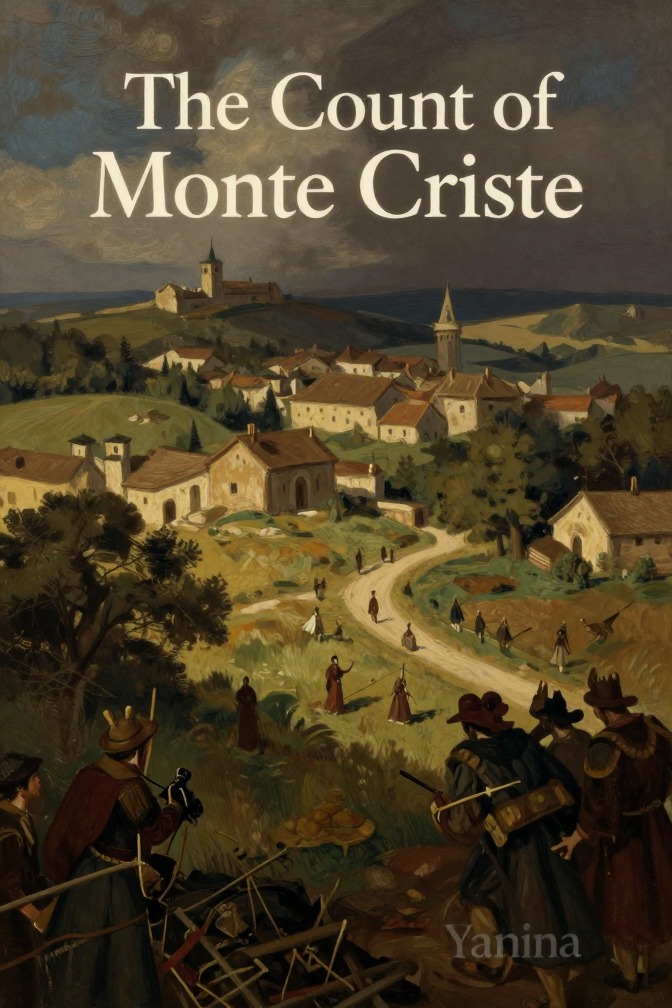
Yanina (modern Ioannina, Greece) is the city in Epirus where Ali Pasha Tepelini ruled as an autonomous Ottoman vassal until his betrayal and death in 1822. In The Count of Monte Cristo, Yanina functions as the geographical and moral pivot of the Morcerf family's hidden crime: it was there that Fernand Mondego, then a French officer in Ali's service, surrendered the castle to the Turks, sold Ali's wife and daughter into slavery, and thereby laid the foundation of his own fortune and title. The revelation of this treachery, first through newspaper articles and then through the testimony of Ali's daughter Haidee, destroys the Count of Morcerf's public honor, drives him to suicide, and forces his son Albert to renounce the family name.
The poisoned lemonade is the instrument by which Heloise de Villefort attempts to murder her stepdaughter Valentine, and which accidentally kills the servant Barrois. It is a key piece of physical evidence in the novel's chain of poisonings, linking the poisoner to her crimes and ultimately leading to her exposure and suicide.
The Bonapartists are the political faction in France loyal to Napoleon Bonaparte and his imperial legacy, serving as the primary ideological enemy of the royalist establishment in the novel. Their presence drives the false accusation that lands Edmond Dantes in the Chateau d'If, and their fluctuating fortunes during the Hundred Days and the Restoration shape the careers of characters such as Villefort, Danglars, and Morrel. The novel uses the Bonapartist label as a weapon of political persecution, a test of loyalty, and a marker of the deep ideological divisions that pervade French society from 1815 through the 1830s.
The engagement between Albert de Morcerf and Eugénie Danglars is a central, yet ultimately broken, social contract in Alexandre Dumas's The Count of Monte Cristo. Arranged by their fathers, the Comte de Morcerf and Baron Danglars, the match is a calculated alliance of aristocratic name and banking fortune. However, it is undermined from the start by the personal indifference of the prospective couple, the secret enmity of the Count of Monte Cristo, and the revelation of Morcerf's treacherous past, which leads to its dramatic dissolution and contributes to the ruin of both families.
The enmity between Edmond Dantes and Gerard de Villefort originates in Villefort's self-serving decision to condemn an innocent man to life imprisonment in the Chateau d'If in order to protect his own political career and family secrets, and culminates in Monte Cristo's systematic destruction of Villefort's family, reputation, and sanity.
The love between Valentine de Villefort and Maximilian Morrel is a central romantic thread in the second half of The Count of Monte Cristo, defined by its clandestine meetings, the mortal threat of Valentine's arranged marriage to Franz d'Epinay, and the systematic poisoning orchestrated by her stepmother, Heloise de Villefort. Their relationship, sustained through secret correspondence and furtive encounters at the garden gate of the Villefort mansion, becomes the primary emotional counterweight to Monte Cristo's schemes of vengeance, and ultimately serves as the vehicle for the count's final act of redemption.