Wartime censorship and repression
1919Wartime censorship and repression is presented not as a single prohibition but as a system that reaches from the front and the newsroom to ships, streets, meeting halls, and holding rooms. Military restrictions on reporting, police scrutiny of documents, draft registration, and the disruption of labor and political gatherings all make speech and movement conditional. The recurring contrast is between official claims of order and the pressure those claims place on people trying to tell what they have seen or assemble around what they believe.
Reporting Under Military Control
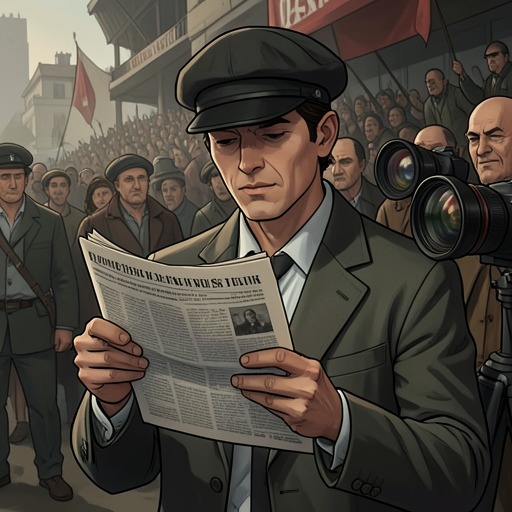
Jack Reed’s career embodies the conflict between reporting and censorship. The narrative describes him as a war correspondent who evaded restrictions and risked himself to obtain stories. His articles covered the German front and Saloniki, as well as events behind the lines in the unstable Russian Empire, where he evaded secret police and was jailed in Cholm. Reporting is therefore shown as both a means of making war visible and an activity exposed to surveillance and punishment.
The military’s refusal to let Reed go to France is explained through an accusation about his conduct in German trenches: officials claimed that he had joked with a German gun crew and pulled the string on a gun aimed toward France. The narrative presents the charge as an excuse that reduces a complex war to a question of which side’s weapon was fired. Reed’s identification with people being killed across national lines stands against the authorities’ narrower demand for acceptable conduct. His work matters precisely because it attends to the human cost that military restrictions and official allegiances risk obscuring.
The account then shifts from reporting to political activity. Reed appears as a delegate amid indictments, the Masses trial, and the Wobbly trial, while Wilson’s administration is associated with filling jails. Forged passports, speeches, secret documents, journeys across a cordon sanitaire, and hiding in steamboat bunkers convey the practical hazards of political travel and communication. In Finland, Reed is jailed and loses all his papers. The loss of documents is not incidental: papers that enable movement and work can also be seized by the institutions that police them.
Surveillance and the Policing of Identity
Joe Williams’s detention shows how suspicion becomes a sequence of ordinary procedures. A policeman wakes him aboard the Argyle and orders him ashore before he can wash or say goodbye to his shipmates. He is taken away without being paid off, then questioned by officials who inspect the photographs, stamps, and newspaper clippings kept in his cigar box. His clothes and belongings are searched, and his answers are tested against the presumption that he may be concealing information. The encounter makes the possession of papers and personal effects grounds for scrutiny rather than reliable proof of identity.
The inspector invokes the Defence of the Realm Act and warns Joe that the consequences could be serious if he does not cooperate. Questions about his name, birthplace, parents, and ships are followed by questions in German, although Joe says he does not know the language. The procedure treats uncertainty as suspicion: Joe’s inability to answer a question does not end the interrogation but becomes part of an encounter in which the officials claim already to know about him. The scene makes legal authority tangible through a statute, a desk, an inspection, and the threat of prolonged confinement.
Draft registration extends this paperwork-driven scrutiny to the street. After returning to New York City, Joe is stopped near Wall Street and asked for his registration card. He explains that he is a merchant seaman, has only just returned, and believes he is exempt; the policeman nevertheless sends him to a judge. He is marched with others through a crowd whose clerks and passersby jeer at them as slackers. At the Custom House, the group is held for the day in crowded basement rooms, without permission to telephone and with access to a single guarded toilet. The official demand to register applies even to men who are exempt, making the registration card a test of legibility to the state as well as a document of military status.
Labor Organizing and Public-Space Restrictions
The novel also connects repression to labor disputes. In a New Jersey mill town, Webb Cruthers and the young woman called Daughter encounter a strike organized amid police presence and armed special deputies. At the strike headquarters, publicity work and the distribution of handbills show an organized effort to communicate with workers; the meeting itself, however, is held in another town because the mills control the local space and no hall can be hired there. When mounted police declare the hall full, thousands of workers and their families are left outside in sleet.
Ben Compton responds by addressing the crowd from a lamppost, describing the exclusion as an insult to working people. Police drag him away, and the crowd begins to withdraw under pressure from mounted officers. Webb then climbs onto a hydrant and protests that the meeting had been permitted and the hall hired. The episode contrasts the formal existence of a permit with the practical power to prevent people from using the space they have arranged. The following morning, Daughter joins Webb on a picket line where police are already breaking up the front of the line. She is arrested after intervening when officers attack a fallen striker. The narrative links the restriction of meetings to the policing of collective presence outside the mills: both the hall and the street become contested sites of organizing.
The conflict takes a more organized and dangerous form in Everett. After reading in Solidarity about the shingleweavers’ strike and the free-speech fight, Ben Compton and Bram Hicks travel to help. At the dock, armed deputies arrest members of the Industrial Workers of the World as they step off the boat and herd them together. The group is then transported out of town, where deputies and local officials discuss what to do with them. The stated aim of the visitors is to exercise free speech, but the sequence shows authorities using arrest, transport, and armed control to prevent that public activity.
Political Meetings and Conditional Release
The Empire Casino meeting in the Bronx is organized to send greetings to the workers’ government in Russia, but it takes place under intense surveillance. Federal agents sit in the front row with a stenographer, police close the doors after only a few hundred people have entered, and officers break up the crowd outside. Soldiers and sailors in uniform enter the gallery and watch the speakers. The meeting proceeds, and the audience rises to cheer the resolution; its public character is inseparable from the government presence recording and containing it.
When Ben speaks, he acknowledges the government observers and criticizes a war he says benefits bankers and munitions makers. The intervention from the gallery signals the meeting’s abrupt end: soldiers and sailors move people out, police converge on the speakers, and Ben is arrested before he can speak to Helen Mauer. Men of conscription age are required to show their registration cards before leaving. Political speech, assembly, and draft administration converge in the same room, turning exit from a meeting into another opportunity for official inspection.
Ben’s detention continues the pattern of pressure through both coercion and negotiated conditions. He is held for three days without food or drink and repeatedly questioned by detectives; one group threatens violence but instead brings him water and sandwiches. In a later interview, Morris Stein tells him that charges can be quashed if Ben promises to report for military training, since his number has been called. Ben refuses to abandon his opposition to the war. He is released on substantial bail, with Morris’s assurance that he will not agitate before trial. The release restores his freedom of movement only under terms that constrain his political activity; the Steins do not tell him who provided the bail.
The Pattern and Its Limits
Across these episodes, repression works through more than censorship of printed material. It blocks a correspondent’s access to a front, monitors political meetings, treats papers as instruments for sorting and detaining people, and limits labor organizing through control of halls, streets, and transport. Procedure and force repeatedly reinforce one another: an act or registration requirement supplies an official basis for intervention, while police and military personnel determine how narrowly the rules are applied.
Yet the same scenes record continued efforts to communicate and organize. Reed writes and travels despite surveillance; workers assemble outside a closed hall and form picket lines; the Industrial Workers of the World members go to Everett to speak; Ben addresses the Empire Casino audience despite the agents recording him and the soldiers watching. These attempts do not erase the consequences—detention, arrest, surveillance, and restrictions on activity—but they prevent repression from appearing as a complete silencing. The state’s power is shown in the conditions it imposes, while the narrative’s repeated return to speech and assembly preserves the dissent those conditions seek to contain.