Paris Peace Conference impasse
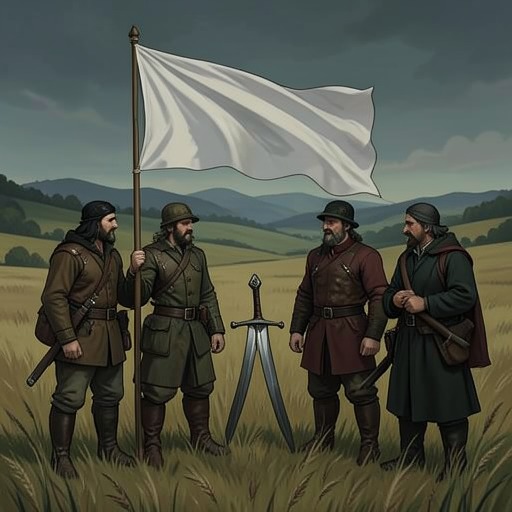
1919Paris Peace Conference impasse is the novel’s account of peace remaining unsettled after the fighting ends: negotiations appear to stall, military obligations continue, and revolution is treated as a possible consequence of the failed settlement or as war in another form. Rather than explain the conference through diplomatic clauses, the narrative makes its uncertainty visible in the lives of people waiting to leave the army, in arguments over what revolution means, and in the gap between public confidence and private distress.
A Peace That Does Not Arrive
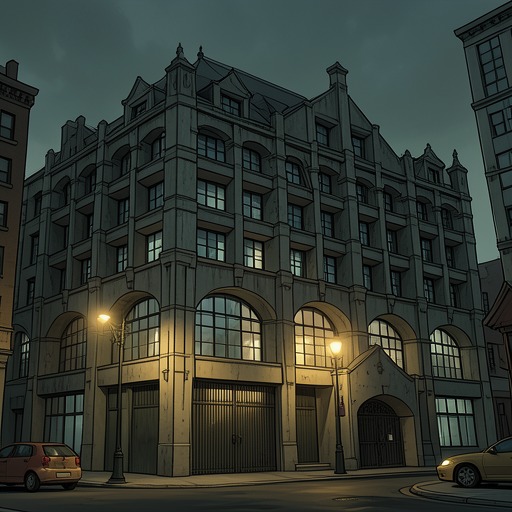
At the Hôtel de Crillon, where J. Ward Moorehouse’s suite is crowded with uniforms, messengers, civilian experts, and the sound of typewriters, Eleanor Stoddard takes Dick Savage by the arm and asks what the restless activity means. Dick answers that it does not mean peace. The scene gives the impasse a physical setting: the conference’s administrative machinery is busy, but its activity offers no assurance that a settlement is near. The corridors seem to promise decision while Dick’s brief reply denies that promise.
The unresolved negotiations also shape Dick’s sense of time and obligation. During a spring outing with Eleanor, J. Ward Moorehouse, and others, he asks whether she knows when peace will be signed. Eleanor answers that it looks as if nobody will ever sign, adding that the Italians will not, and mentions a recent statement by d’Annunzio. Dick says that the day peace is signed he will take off his military uniform; since joining the army, time has seemed to drag. His remark makes the political delay personal: the uncertain timetable keeps him in a life he wants to leave, without giving him a clear next one.
That waiting is not simply a matter of inconvenience. Dick has no settled plan for what follows his service. In conversation with Ripley, he wonders whether he will find work or return to Columbia University, and admits that he does not know what he wants. The prospect of peace therefore opens onto uncertainty rather than a confident homecoming. The conference’s delay prolongs the interval in which military duty is definite but civilian purpose is not.
Revolution as Continuation of War
On the train to Paris, Ed Schuyler describes a chain of possible revolutions: workers may seize factories in Italy, Hungary and Bavaria have already gone red, and upheaval could spread through Austria, Prussia, and France. He also reports that American troops sent against the Russians in Archangel have mutinied. To Ed, these developments belong to a world revolution and make the present an exhilarating, dangerous time. His map of events is expansive, moving from one country to the next as though political transformation might sweep across Europe.
Dick rejects Ed’s confidence that revolutionary change offers a way out. He argues that the Allies have matters in hand and that the war is over; the revolutions, in his view, are the war turned inside out. Shooting opponents cannot end war, he insists, but only reproduce it. Their quarrel is not over whether Europe is in crisis, but over whether revolutionary violence can resolve the crisis or merely perpetuate it. Ed’s own politics have shifted: he says that seeing the King of Italy changed his former royalism, and he now favors a dictator, the man on a white horse. The exchange refuses a simple division between a settled peace and a revolutionary alternative. Both characters see political violence continuing; they differ over what form it will take and whether it can be stopped.
Wilsonian Idealism and the Strain of Waiting
The conference also appears through G. H. Barrow’s account of Woodrow Wilson. Taking Anne Elizabeth Trent to lunch, Barrow speaks at length about the President’s fight to preserve his principles against secret treaties and experienced political manipulators. He presents Wilson and his supporters as defending decency, fair play, and good sense, and casts the conference as a crusade whose success could improve the world. In his account, failure would leave it to Bolshevism and despair. He even repeats a rumor that someone tried to poison the President at the Hôtel Murat. These claims are Barrow’s fervent interpretation, delivered as though he were rehearsing a speech; they do not settle what the conference will achieve.
Anne Elizabeth hears his political performance at a remove. As Barrow talks, the Paris streets, spring flowers, flags, and crowds seem distant to her, and she cannot taste the meal. She has turned to him because she is troubled and fears losing her job and going home in disgrace, but the scale of her immediate distress does not fit the grand language of a world-saving crusade. When she tells him she is in serious trouble, his attention shifts from his account of the conference to her predicament. The scene places private vulnerability beside public rhetoric without making them equivalent: Barrow’s confidence in Wilsonian purpose cannot resolve Anne Elizabeth’s uncertainty.
The contrast sharpens when Anne Elizabeth reveals that she has quarrelled with Dick and that they became engaged. Barrow’s political language has surrounded a conversation in which she is trying to make sense of her relationships and employment, while the conference itself remains the remote subject of his speeches. Her reaction does not disprove his hopes, but it shows how little those hopes can do, in the moment, to organize an individual life. The promised peace remains an abstraction beside the concrete fear of having to leave Paris under a cloud.
Unsettled Politics Beyond the Conference
The novel sets the conference’s elite rooms against other scenes of political conflict without presenting them as direct results of its negotiations. In New Jersey, Webb Cruthers brings Anne Elizabeth to a textile strike where mill owners control the town and a meeting hall is closed to the workers. Ben Compton speaks to the crowd, is arrested, and the strikers are pressed away by mounted police. On a later picket line, Anne Elizabeth witnesses police violence and is taken into custody. These episodes locate social conflict in workplaces and streets rather than conference chambers. They show why the end of military fighting cannot, by itself, be taken as proof that public life has become peaceful.
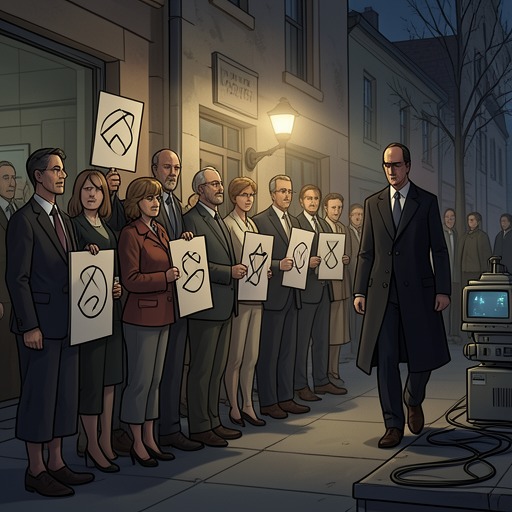
A related pattern appears in the account of the Industrial Workers of the World in Seattle and Everett. Ben Compton and Bram Hicks join workers travelling to Everett, where deputies arrest and beat members of the group as they leave the boat. Later, at a Bronx meeting organized to send greetings to the Russian workers’ government, police and federal agents monitor the gathering; the meeting is broken up, Ben is arrested, and conscription-age men must show their registration cards before leaving. When an official offers to quash the charges if Ben will report for military training, Ben refuses to promise silence about opposing capitalist war. He is released on bail under an agreement not to agitate before trial. These events are not accounts of the Paris negotiations, but they give the postwar political landscape a coercive dimension: dissent, labor organizing, and antiwar speech remain subject to surveillance and restraint.
Meaning of the Impasse
Across these episodes, the impasse is not a single failed vote or a clearly stated diplomatic deadlock. It is a persistent mismatch between the language of settlement and the conditions people inhabit. Conference corridors are active without guaranteeing peace; Wilson’s ideals are described in sweeping terms while the outcome remains uncertain; military service continues to delay Dick’s departure; and revolutionary hopes coexist with repression and the prospect of renewed violence.
The novel therefore treats peace less as a settled condition than as a disputed promise. Ed sees revolution as a chance to end the old war, while Dick fears that it will reproduce war by other means. Barrow invests the conference with a moral mission, but Anne Elizabeth remains absorbed by troubles that its rhetoric cannot relieve. Around them, workers and organizers confront employers and authorities directly. The result is a layered portrait of a world in which the official end of war has not yet reconciled political ideals, individual futures, and continuing conflict.