Tengo et Fukaéri — collaboration littéraire
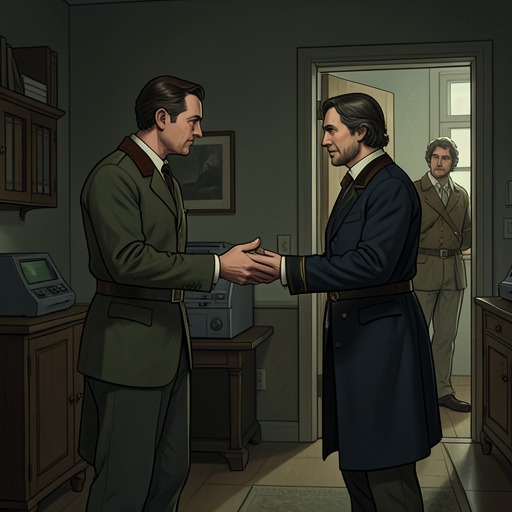
1Q84Tengo and Fukaéri’s literary collaboration is both a creative partnership and a relationship neither can neatly interpret or leave behind. Tengo helps reshape Fukaéri’s story into a published bestseller, yet regards the work as hers and himself as its concealed craftsperson. Her overnight stay, his unspoken response to her sleeping face, and her later recording addressed to him by name reveal an attachment that exceeds the literary arrangement while remaining uncertain in its meaning.## Creative Work and Unequal Credit The collaboration’s public result is La Chrysalide de l’air, which, after appearing as a book, remains on the bestseller list for a second week and leads the literary-sales category for a third consecutive week. Newspaper advertisements pair its cover with a photograph of Fukaéri, then seventeen: her straight hair falls to her shoulders, and her dark, direct gaze seems to reach something concealed in readers. Tengo follows the book’s rise through newspapers in the teachers’ room, but its public success does not make him feel like its owner.
Komatsu mails Tengo two copies. He leaves them unopened, still wrapped in plastic, and puts them out of sight on a shelf. Although his writing has appeared in book form for the first time, he feels no joy: the story, in his view, remains exclusively Fukaéri’s, brought forth from within her. He understands his own part as that of a modest, hidden craftsman whose work is finished. The contrast is sharp: the book’s visibility grows, while Tengo chooses not to look at the copies that contain his labor.
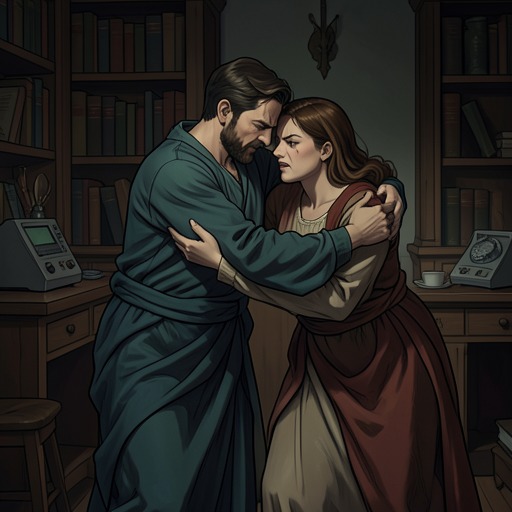
His sense of authorship is therefore deliberately divided. He contributed to the making of the novel, but refuses to treat that contribution as possession or as a claim on Fukaéri’s story. Even as the book’s success makes their work a public fact, he tells himself that he is no longer concerned with its fate—and, more insistently, that he must not be.## Intimacy After the Book After Fukaéri has slept at his apartment, Tengo finds her asleep and quietly closes the book he has been reading. He sets it beside the bed, turns out the light, and looks once more at her face: she lies facing the ceiling, her mouth closed in a single line. In the morning she is gone. Her borrowed pyjamas lie crumpled in the washing machine, while a note on a page from his notebook says she is going home. Tengo folds the page and hides it in his desk because his girlfriend is expected at eleven and might be upset to find it.
The departure leaves behind no explanation of their relationship, but Tengo discovers that it has affected him. While making breakfast, he realizes that what weighs on his chest is the calm face he saw in her sleep. He wonders whether he is in love with her, then rejects the label, acknowledging instead that something in her can physically unsettle him. He also finds himself concerned that she wore his pyjamas and admits that he has taken them in his hands and breathed in their scent. These gestures register an intimacy he cannot comfortably translate into a settled feeling.
The episode changes the texture of his ordinary life. Tengo continues his own novel, writes anonymous paid articles, and teaches mathematics three times a week; for a time, Fukaéri does not contact him, and he takes her silence to mean that she is probably not in trouble. He tries to push aside what concerns him by retreating further into mathematics. In class, he teaches logical proof with unusual eloquence and recognizes that he can attract the attention of seventeen- and eighteen-year-old students through his performance. Yet since meeting Fukaéri, he has lost sexual interest in them. He makes the contrast concrete by recalling that he would never have imagined breathing the scent of their pyjamas.
A Message He Cannot Decode
Tengo thinks of Fukaéri as uniquely significant to him, unlike any other young woman. She seems to embody a message addressed to him, but he cannot decipher it. Reason tells him to withdraw: the book, the uncertain thoughts of Professor Ébisuno, the religious group surrounded by troubling mysteries, and even Komatsu all seem to lead toward increasingly perilous territory. But Tengo also knows that withdrawal may no longer be possible. He entered the undertaking knowingly, and now imagines himself as an essential gear in a mechanism already in motion, its stubborn force perceptible within him.
The worry becomes concrete when he learns that Fukaéri has been missing for three days. She left Okutama for Tokyo on a Wednesday morning with Professor Ébisuno, who accompanied her to the station. She did not say where she was going. Later she told him by telephone that she would not return to the mountains and would sleep at the apartment in Shinanomachi. Ébisuno’s daughter was there that day, but Fukaéri never arrived; since then, there has been no contact. The account gives Tengo no place to search and no resolution, only the knowledge that the person he has tried to put at a distance is now absent and unaccounted for.
When Fukaéri’s recording finally reaches him, its form matters: she explains that writing a letter is difficult for her, so she has made a cassette instead, because it is easier than talking on the telephone when someone might be listening. Before the message, she says Tengo’s name as if testing her voice; he remembers this as the first time she has addressed him by name. The recording turns their connection into a direct, private address, but its delay and uncertain circumstances preserve the question of where she is and whether he can see her again.
Fukaéri’s Account and the Limits of Understanding
Fukaéri thanks Tengo for letting her sleep at his home and for reading a book to her. She says it was necessary to know him too, and recalls that the Gilyaks touched her heart: they walk away from broad roads, along muddy paths through the forest. Roads are practical, but walking on them requires learning from the beginning, including learning how to walk and change. She says she does not want to live like the Gilyaks, yet also dislikes broad roads; she says she hates being beaten by men and rejects a life she describes as dirty and full of worms. Her message gives Tengo a more personal account of what lies behind her affinity with the Gilyaks, without turning that disclosure into a full explanation of her history.
She also describes the forest as a place requiring care. The Master has great strength and deep intelligence, she says, but the Little People possess those qualities too. Important things are in the forest; to cross it safely, a person must find what the Little People do not have, so that they will not cause harm. Tengo hears her deliver this almost in one breath, then take a deep breath close to the microphone. The voice, the effort of speaking, and the distant sounds around the recording make the message feel immediate, while its account of the forest’s rules remains elusive.
Near the end, Fukaéri says her voice is hoarse and thanks Tengo for worrying about her. She recognizes that he looked at the shape of her chest, that he let her sleep in his room, and that he lent her his pyjamas. She says she may not be able to see him for a while. Because she and the Little People have made writings together, they may be angry, she suggests, but she is accustomed to the forest. Then she says goodbye and the recording ends. The statement joins their shared literary work to a danger she does not explain, leaving Tengo with a clear sense of the message’s essentials but no means of resolving its mysteries.
The Relationship’s Unfinished Shape
The collaboration moves beyond the ordinary division between writer and editor: Tengo has helped bring Fukaéri’s story into print, but he declines the recognition of authorship, while the published novel’s success keeps its consequences visible to him. He tries to separate himself from the book and the people around it, yet his private response to Fukaéri and his awareness that he has become part of an operating mechanism make detachment increasingly doubtful.
Neither the overnight stay nor the cassette settles what the relationship is. Tengo questions his own feelings rather than naming them, and Fukaéri’s recording combines gratitude and intimate observation with distance: she tells him she may not see him again for a while, then ends the message without specifying when or whether they will meet. Their bond is therefore marked by a striking asymmetry. Tengo tries to interpret it as a message he cannot read; Fukaéri speaks directly to him but places their shared work within a forest-world whose rules remain uncertain. The book can be published and sold, but what binds its two makers remains open.