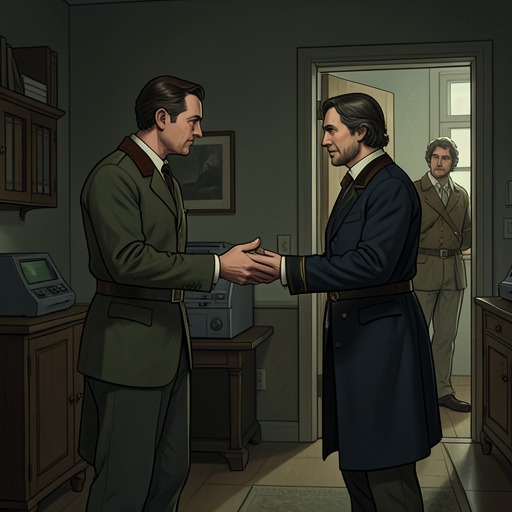
Tengo—Fukaéri
1Q84Tengo and Fukaéri’s relationship takes the form of a concealed literary collaboration over La Chrysalide de l’air: she gives him permission to revise the novel, while he promises to preserve her story and public authorship. Their compact rests on a clear division of roles—Fukaéri remains the creator and named author, Tengo supplies technical revision, and Komatsu acts as editor—but also requires them to lie about their involvement. The exchange turns Tengo’s private attraction to the project into a shared decision, with secrecy as its lasting condition.
From editorial proposal to personal consent
Tengo tells Fukaéri that Komatsu has read the novel and admired it, but thinks its style is too weak for the strength of its story. Komatsu has proposed that Tengo rewrite it to improve its chances in a newcomer’s prize competition. Tengo has not yet agreed: he tells her he does not know whether accepting would be right and asks what she thinks, insisting that he cannot decide without her agreement and collaboration.
Fukaéri’s answer is brief and decisive. While eating a small tomato, she tells him to do it and says he may write as he likes. When Tengo suggests taking more time because the matter is important, she shakes her head. Her spare assent does not erase the ethical weight he has raised; it makes her consent the point from which he can proceed.
Authorship and the terms of collaboration
Tengo explains that he intends to reinforce the style without changing the story, though important revisions may be necessary. He distinguishes the labor of rewriting from the authorship of the novel: it will remain the work of Fukaéri, a seventeen-year-old girl, and if it wins the prize she alone will be the laureate. If it is published as a book, only her name will appear.
He describes the working arrangement as a team of three: Fukaéri, Tengo, and Komatsu as editor. Yet the public credit will not reflect that shared labor. Tengo and Komatsu will remain hidden, like stagehands behind a theatrical production, while Fukaéri stands as the sole author. Fukaéri indicates that she understands. Tengo returns to the same boundary in more fundamental terms: the story came from her, and he cannot make it his own; he can help only with technical aspects.
Secrecy and unequal visibility
The arrangement demands more than concealed credit. Tengo tells Fukaéri that she must stay silent about his assistance and that they will have to lie to everyone about their complicity. He recognizes that keeping the secret indefinitely may not be easy. Her answer—if he wants—leaves the burden of the decision with him while accepting its terms.
This asymmetry defines their partnership. Fukaéri’s story and public identity as its author are to be protected, while Tengo’s actual contribution is deliberately erased from view. The concealment is not incidental: it is built into the plan from the beginning, alongside the promise not to replace her story with his own. Their collaboration therefore joins technical intervention to a lasting public falsehood about how the novel was made.
Tengo’s desire and his commitment
During a silence over the meal, Tengo recalls that his first response to Komatsu’s telephone call was to think the proposal absurd and intend to refuse. After reflecting on it at home, however, he increasingly wanted to try. Setting aside whether the project was morally right, he describes a spontaneous desire to give Fukaéri’s novel a new form. His own interior qualification makes that account less comfortable: he suspects that what he feels may be closer to greed than desire, as Komatsu had predicted, and that the greed is becoming harder to suppress.
That tension remains part of the relationship even after Fukaéri consents. Her neutral, intent gaze gives Tengo no easy emotional reassurance; he imagines her trying to grasp the words he is forming. He nonetheless makes his choice explicit: he wants to begin rewriting La Chrysalide de l’air the following day. Fukaéri says that he should meet someone, and he replies that he will. Their agreement thus moves beyond a hypothetical offer to a definite next step, while the exact limits of Tengo’s desire and the implications of the secret remain unresolved.
Significance of the partnership
The collaboration is founded on two claims that pull against each other: Tengo intends to reshape the novel, yet insists the story remains Fukaéri’s; he and Komatsu will help bring it forward, yet must conceal that help from the public. The relationship is therefore both creative and ethically uneasy. Fukaéri’s consent enables the revision, but it does not dissolve the difference between the source of the story and the person who will alter its style—or Tengo’s own suspicion that his eagerness exceeds a purely technical wish to assist.
The meal’s small gestures accompany a consequential negotiation: Fukaéri eats tomatoes and celery while Tengo explains authorship, secrecy, and his own uncertainty. Her concise assent contrasts with his extended effort to define what the agreement means. By the end, their bond has acquired a concrete shared objective and a rule of silence. The novel may change in form, but their stated arrangement preserves Fukaéri’s sole credit and requires both collaborators to keep Tengo’s role hidden.