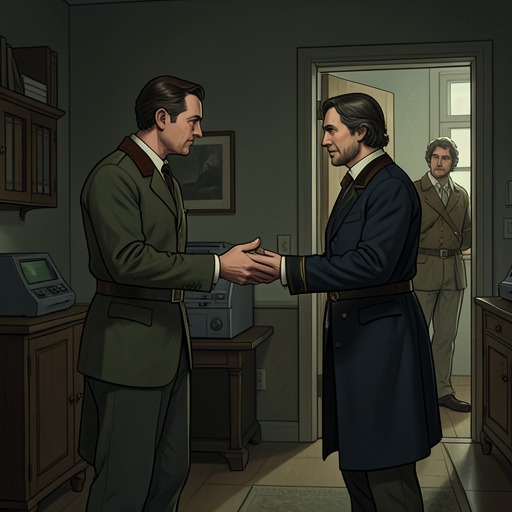
Tengo meets the Maître
1Q84Tengo meets the Maître, Professor Ébisuno, at his remote mountain home to discuss the proposed rewriting of Fukaéri’s La Chrysalide de l’air. Their conversation turns a clandestine literary plan into a question of trust and responsibility: Tengo is drawn to the manuscript itself, while Ébisuno insists that the possible cost of exposure must be measured against the wishes and vulnerability of the seventeen-year-old whose name will appear on it.
The visitor and the meeting
After a long, nearly wordless wait beside Fukaéri, Tengo sees a thin, energetic man enter the salon without warning. The man is about sixty-five and short, but carries himself upright and moves with tightly controlled precision. His broad black glasses, thick eyebrows, and unflinching, camera-like gaze give him an imposing presence. He wears an old dark-green sweater over a white shirt and worn gray wool trousers, clothes that seem to have served him for years.
The Maître quickly directs Tengo to remain seated and takes the chair opposite him. He speaks with the practiced logic of someone long accustomed to addressing a large audience. His first concern is practical: circumstances have kept him in this remote place, so Tengo had to make the journey himself. Their exchange of names is equally plain; neither has a business card. The scene’s measured entrance, sharp contrast with the preceding silence, and the Maître’s attentive scrutiny establish a meeting in which Tengo’s intentions will be examined rather than merely approved.
The rewrite and Tengo’s reason for joining
The Maître frames the proposal directly: Tengo is to rework the novel written by seventeen-year-old Éri, make it more finished, and submit it to a magazine’s newcomer prize while presenting Éri as its author. Tengo accepts the outline but carefully limits his own role. Komatsu devised the project, he says, and he does not know whether it will go forward or whether it is morally right. His own contribution, as he describes it, is technical—the revision of La Chrysalide de l’air—while Komatsu bears responsibility for the larger scheme.
That distinction does not mean Tengo is indifferent to the project’s deception or risk. Asked why he has not withdrawn, he admits that for eight days he has been asking himself the same question. His usual caution, reason, and instinct all told him to leave; he does not think of himself as a gambler or adventurer, and calls himself fearful in such matters. Yet he could not refuse Komatsu this time, for the simple reason that the manuscript had captivated him. With any other manuscript, he says, he would have declined immediately. The meeting thus clarifies that the work’s literary pull—not money or fame—is what has kept him involved, without resolving the ethical uncertainty he acknowledges.
Ébisuno’s warning and Fukaéri’s decision
Ébisuno recognizes that Tengo and Komatsu have distinct motives, neither apparently financial nor a pursuit of celebrity, but does not let good intentions settle the question. The project remains dangerous: if the truth comes out at any stage, the public scandal would not fall only on the two men. His greatest concern is that Éri, still seventeen, could be hurt irreparably. Tengo agrees that the concern is justified.
The Maître then turns from the men’s plans to Fukaéri herself and asks what she thinks. She looks toward an unspecified point and gives a brief assent. When Ébisuno warns that the project could bring trouble, she does not answer; instead, she pulls the collar of her cardigan more tightly around her neck. Her clenched fists and the gesture make her resolve legible without an extended declaration. Ébisuno accepts that she has made her choice, though his resigned response leaves the danger intact rather than diminishing it.
Dyslexia, trust, and what the meeting opens
Ébisuno identifies a concrete complication for the proposed publication: Fukaéri is dyslexic. Tengo had partly inferred the reading difficulty on the train, but the Maître explains its history and significance. He believes the condition is congenital; at school, it led people to regard her as intellectually delayed. In his account, that judgment was mistaken: she is in fact highly intelligent and full of ideas. The distinction matters to the project, because a disability that has been misunderstood by others may have consequences for a plan built around her written work and public authorship.
The Maître does not claim to know why Fukaéri trusts Tengo. He does, however, say that he trusts her, and therefore accepts her decision to entrust her work to him. His consent is conditional in a meaningful sense: if Tengo and Komatsu truly intend to complete the project, they need to understand the circumstances of Éri’s childhood and why he took responsibility for her education. He calls that history long; Tengo agrees to listen, and Fukaéri adjusts her position beside him, still holding her collar. The meeting consequently ends not with the manuscript’s risks resolved, but with a new obligation: before the rewrite can be understood, Tengo must hear the history behind its young author and the guardian who has chosen to trust her judgment.