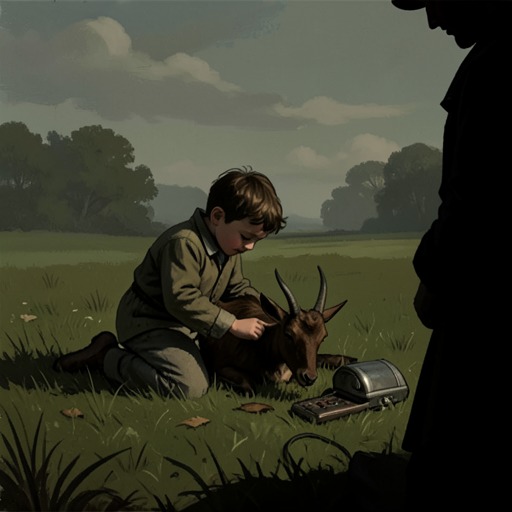
Fukaeri dictates Air Chrysalis to Azami
1Q84Fukaeri’s account of how Air Chrysalis came into being overturns Tengo’s assumption that she wrote it herself. She says she did not compose the text in writing: she narrated her story, and Azami, a girl two years younger, typed and printed it. The exchange establishes the work’s oral origin and a division of labor between teller and recorder, while leaving some details of its publication history uncertain.
The disclosure to Tengo
The revelation emerges through a sequence of short questions and pauses. Tengo asks whether Fukaeri may have been unable to write Air Chrysalis herself; she answers plainly that she did not write it. After several heavy seconds, he asks who did. Her reply is Azami. The name initially tells Tengo almost nothing, so he asks who Azami is and learns only that she is two years younger than Fukaeri.
The scene makes the discovery gradual rather than presenting it as a complete explanation. Fukaeri’s shoulders draw in to signal agreement before Tengo asks his first question, and his response to her answer is to pause and rearrange his understanding. The physical gesture and the silences frame the exchange as a cautious clarification, not a confident account delivered all at once.
Oral composition and transcription
Tengo tests his emerging interpretation: Fukaeri told her story, while Azami wrote it down. Fukaeri corrects his wording. Azami did not simply write; she typed and printed the account. That correction specifies the practical means by which the story became a manuscript, distinguishing Fukaeri’s oral telling from Azami’s work of producing a written, printed text.
The collaboration therefore has two identifiable roles. Fukaeri supplied the narrated story, while Azami transformed that narration into a document. The scene does not say whether Azami altered the story as she typed, how their sessions were organized, or what either girl understood their respective contributions to mean. It supports a shared process, but not a fuller account of its creative decisions.
Submission, title, and uncertainty
Once he has assembled the basic sequence, Tengo infers that Azami submitted the printed text to a literary magazine for a newcomer’s prize and probably chose the title Air Chrysalis without telling Fukaeri. The inference connects the private act of narration and transcription to the work’s public appearance. It also identifies Azami as potentially responsible not only for making the text readable but for presenting it under its title.
Fukaeri inclines her head, but the gesture does not establish whether she agrees or disagrees. The narration indicates that she is not refuting Tengo and that his account is probably correct in broad outline. The distinction matters: her words confirm that Azami typed and printed her story, while the details of the submission and the naming remain Tengo’s reconstruction rather than an explicit confirmation from Fukaeri.
Significance of the collaboration
The disclosure separates the voice that tells Air Chrysalis from the hands that give it a printed form. Fukaeri is not presented as the text’s sole maker in the ordinary sense of writing it down, but neither is Azami identified as the source of the story: the scene assigns them different, complementary functions. Authorship appears as a process involving narration, transcription, and possibly the decisions that carry a manuscript into publication.
For Tengo, this new information changes the question from whether Fukaeri wrote the work to how it was made and who acted on it. The scene leaves the partnership’s personal character unresolved at this point: after reconstructing Azami’s role, Tengo asks whether she is a friend. The unanswered question preserves a gap between the practical facts of collaboration and the relationship that made it possible.