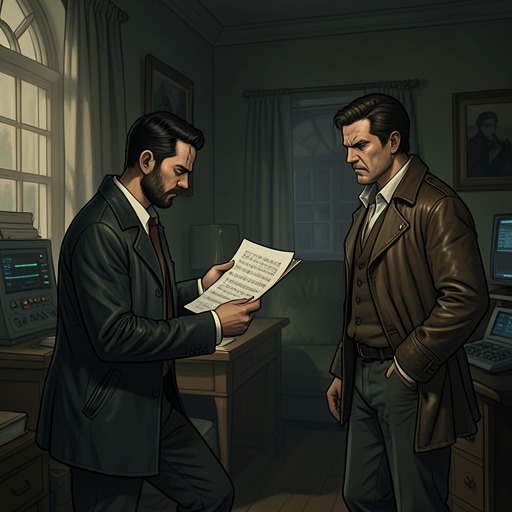
Mozart and Salieri Meet for the First Time
AmadeusThe first meeting of Wolfgang Amadeus Mozart and Antonio Salieri at Schönbrunn Palace turns a formal court welcome into an unintended musical contest. Ordered to present a march for Mozart, Salieri offers a decorous, banal composition; Mozart then reproduces and reshapes it from memory, revealing a virtuosity that unsettles the very composer whose music he has just been invited to admire.
Court Commission and First Encounter
The encounter takes place amid a dispute over the kind of opera the court should support. Johann von Strack announces that Joseph II wants a comic opera in German, part of the Emperor’s ambition to establish a national opera and hear works in the language. Count Orsini-Rosemberg objects to the choice of German, insisting on Italian’s primacy in opera, while Gottfried van Swieten questions whether music should aim to make people laugh. The commission therefore arrives already charged with competing ideas about language, genre, and the purpose of music.
When Strack announces Mozart, Joseph II signals Salieri to go quickly to the pianoforte. Salieri plays his welcome march as Mozart enters in an exceptionally showy coat and formal sword. The Emperor stops Mozart and directs him to listen. The assembled figures remain motionless through the performance, which ends in applause. Joseph praises Salieri’s work and introduces Mozart to him as the composer of the march. Salieri dismisses it as a trifle, but the public compliment makes his music the first point of contact between the two composers.
The March Becomes a Test
Mozart accepts the welcome effusively, then turns immediately to the court’s commission. He says he has received it, promises the best spectacle ever offered to a monarch, and reports that he has already found a libretto. The confidence is public and expansive; the musical demonstration that follows gives it a more concrete basis.
Salieri offers Mozart the march’s manuscript. Mozart tosses it onto the pianoforte lid, where it is outside his sight, and sits down to play the piece entirely from memory. He begins slowly, as though recalling it, then repeats the melody much faster. Salieri acknowledges his remarkable memory. Mozart goes back over the opening bars, pauses at a fourth interval, and judges that it does not work. He tries a third above instead, smiles at the result, and begins developing the altered figure.
The change is not simply a correction made in passing. Mozart repeats the new interval, then joins it to a military trumpet arpeggio and works his way, note by note, into a melody recognizable as the march associated with The Marriage of Figaro. His playing grows increasingly exhibitionistic, with flourishes and triumphant chords at the close. The stage direction makes the contrast pointed: Mozart delights in the discovery and remains unaware of the affront, while Salieri watches with an appropriately composed smile. An uncomfortable pause follows. Salieri excuses himself; Mozart, still at the keyboard, invites him to try a variation of his own.
A Professional and Artistic Contrast
The scene sets Salieri’s courtly position against Mozart’s conspicuous ease at the instrument. Salieri has been introduced as a chamber composer whose welcome march receives the Emperor’s approval. Mozart, by contrast, treats that ceremonial piece as material he can absorb, examine, and remake on the spot. The difference is dramatized through observable actions rather than a declared contest: the manuscript is put out of sight, the music is recalled, one interval is rejected, and a new one opens into a larger tune.
The contrast does not depend on Mozart deliberately trying to humiliate Salieri. The scene explicitly presents him as unconscious of the offence, which gives the performance its sting: his pleasure in solving a musical problem and Salieri’s controlled response occupy the same moment but carry opposite emotional weight. The first meeting is therefore both a court introduction and a demonstration of an imbalance that the formal courtesies cannot conceal.
The Encounter’s Wider Artistic Stakes
The later dispute over The Marriage of Figaro develops concerns already present in the court’s commission. Gottfried van Swieten condemns the opera as a vulgar farce and objects to its depiction of real people and intimate domestic life. Mozart defends its use of a real setting and ordinary, bodily details. These arguments extend the earlier disagreement about comic opera: what the court considers an appropriate subject for music, and whether comedy can be serious artistic work, remain matters of institutional judgment as well as taste.
That tension becomes visible again when Joseph II encounters the ballet music cut from The Marriage of Figaro. The performance reaches the censored passage and stops, leaving the dancers to move without music. The Emperor asks whether the interruption is modern; when Mozart says it is not, Joseph orders the music restored despite Count Orsini-Rosemberg’s objection. This later decision does not change the first meeting, but it shows the larger court environment in which the composers’ art is judged: musical ideas pass through the hands of officials, and the Emperor’s authority can determine whether they are heard. Against that background, Salieri’s small welcome march acquires an enduring dramatic function. It is the polished ceremony of the court, transformed in Mozart’s hands into evidence of a musical power the ceremony cannot contain.