Mozart Receives the Requiem Commission
AmadeusMozart Receives the Requiem Commission begins as a frightening account of an encounter Mozart cannot tell whether to classify as a waking event or an experience of his own mind. Its decisive reversal comes later: the gray, masked visitor was real, and the commission was part of Walsegg’s attempt to pass Mozart’s Requiem off as his own. The episode binds an urgent artistic task to uncertainty, concealment, and the question of who will receive credit for the work.
The Apparition and Its Demand
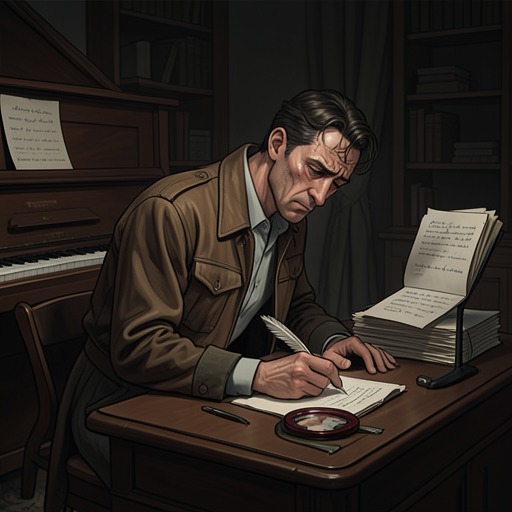
Mozart tells Antonio Salieri that the previous night he saw again the figure from his dreams, but this time he was awake. The visitor stood in front of his desk, dressed entirely in gray, with a gray face still hidden by a mask. It addressed him by name and commanded him to write a Requiem Mass. The scene’s details make the commission feel at once specific and unreal: Mozart is given a concrete task, but the messenger’s concealed face and dreamlike return leave its source uncertain.
Mozart says he asked who had died. The visitor did not answer that question; instead, it gave a deadline, requiring the work to be finished by their next meeting. It then turned and left the room. The unanswered question and imposed deadline set the terms of the commission without explaining its purpose. Mozart has been told what to write and when to finish, but not for whom, or in whose name the music will be heard.
Doubt, Fear, and Immediate Consequences
Salieri responds by calling the account an unhealthy fantasy and addressing Mozart as a friend. His dismissal meets Mozart’s uncertainty but does not resolve it. Mozart insists that the encounter had the force of something real, while admitting that he cannot tell whether it happened inside his head or outside it. The exchange therefore presents the visitor’s reality as an open question for the characters before the later revelation settles it for the audience.
Mozart connects the episode to a consequence in his domestic life: he believes Constanze Mozart has left because he frightened her, and says that she will now be unable to see the vaudeville. His disordered account of the visitor is not merely private apprehension; in his understanding, it has already disturbed his relationship with his wife and displaced an ordinary shared plan. The episode places the commission beside this small, immediate loss, contrasting the mysterious demand for a solemn religious work with the missed entertainment Mozart had expected.
The Hidden Patron Revealed
Later, Antonio Salieri reveals that the masked figure was not something Mozart had dreamed. An eccentric nobleman, Walsegg, wanted to be regarded as a composer and secretly sent his steward to Mozart’s home in disguise to commission the Requiem. The explanation transforms the visitor’s concealment from an apparent feature of a nightmare into a practical disguise: the messenger’s hidden identity served the secrecy of the transaction.
The commission’s purpose was also concealed from Mozart in the encounter as he recounts it. Walsegg intended to claim the resulting work as his own. The deadline, the refusal to identify the deceased, and the masked intermediary thus belong to a commission whose real stakes are not disclosed to the composer at the outset. Salieri’s later explanation supplies the missing human motive, but it does not make the initial meeting less unsettling: the commission was genuine, while its apparent supernatural form arose from deliberate secrecy.
Afterlife of the Commission
Salieri states that after Mozart’s death the Requiem was indeed performed as Walsegg’s work, and that Salieri himself conducted it. The disguise therefore achieves its intended result at the level of public attribution: music Mozart had been commissioned to write is presented under the nobleman’s name. The commission’s consequences extend beyond the meeting and the composition, into the work’s first stated public identity.
Salieri’s account also places him inside that afterlife. He says that he presided over Vienna’s major musical events in those days and presents conducting the Requiem as one example of his position. In retrospect, the encounter is more than an enigmatic call to compose: it begins a chain in which Mozart receives the task, Walsegg’s authorship scheme is carried out after Mozart’s death, and Salieri becomes the conductor of the work as it is credited to someone else.