The Marriage of Figaro Ballet Music Is Cut, Then Restored
AmadeusThe cutting and restoration of the ballet music in Wolfgang Amadeus Mozart’s The Marriage of Figaro turns a dispute over one passage into a test of who may interpret imperial rules and what an opera is meant to do. Count Orsini-Rosemberg removes the pages under Joseph II’s prohibition on ballet in opera; at rehearsal, the resulting silent dance makes the cost of that decision visible to the Emperor, who orders Mozart’s music put back. Antonio Salieri observes the confrontation from the dark and later presents the reversal as an unexplained coincidence, leaving his account shadowed by his own interest in the outcome.
Commission and Artistic Dispute
The episode grows from a commission meant to establish an Austrian national opera. Johann von Strack conveys the Emperor’s request to Count Orsini-Rosemberg: Mozart is to write a comic opera in German. Strack explains that Joseph II wants works in pure German. Rosemberg objects to abandoning Italian, which he considers the only possible language for opera, while Gottfried van Swieten questions the comic form itself, arguing that music should not make people laugh. These objections frame Mozart’s commission as more than a new work: it challenges expectations about language, genre, and the purpose of court opera.
When Joseph II asks Mozart whether he has received the commission, Mozart confirms it enthusiastically and says he has already found a libretto. The chosen subject, The Marriage of Figaro, sharpens the disagreement. Van Swieten condemns Beaumarchais’s play as an embarrassing, vulgar farce, objecting to its nobles pursuing maids and its wives appearing in disguises. Mozart defends a different artistic principle: he wants to make a work about real people in a real place. His deliberately concrete account of a boudoir, with discarded intimate clothing, warm bed sheets, and a full chamber pot beneath the bed, rejects decorous distance in favor of the physical circumstances of ordinary life. The dispute over ballet takes place within this larger argument over whether opera should preserve established decorum or stage human life in its unruly particulars.
The Pages Removed
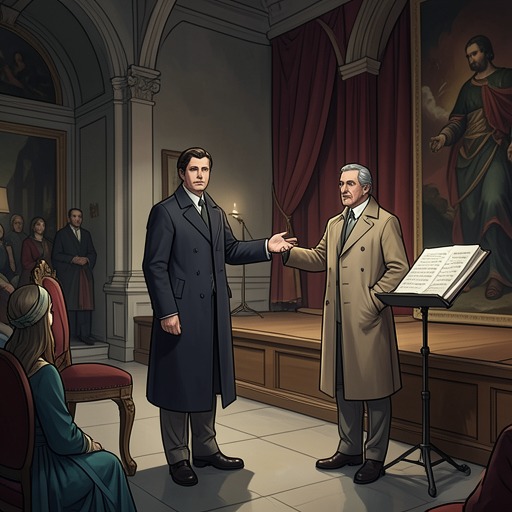
In the unlit theater, Rosemberg asks Mozart to bring him the score of The Marriage of Figaro. He turns through the pages and raises the Emperor’s prohibition on ballet in his operas, pointing to a dance in the third act. Mozart initially questions the relevance of the ban, then argues that it was intended to prevent pointless ballet insertions of the kind associated with French opera, not a dance integrated into the story. Rosemberg rejects Mozart’s right to interpret imperial edicts: the composer’s duty, he insists, is simply to obey them.
Rosemberg then tears the offending pages from the score. He does so in silence, while Mozart watches in disbelief, and continues removing pages as he warns Mozart to comply with imperial orders in future. The damage is not merely administrative. Mozart protests that the deleted music leaves a great void at the story’s climax. He abruptly accuses Salieri of having devised the removal. Rosemberg dismisses the accusation as absurd. Behind them, Salieri and Strack have been watching together from the darkness, an arrangement that gives Salieri a view of the confrontation without placing him openly in its center.
The Rehearsal Reverses the Decision
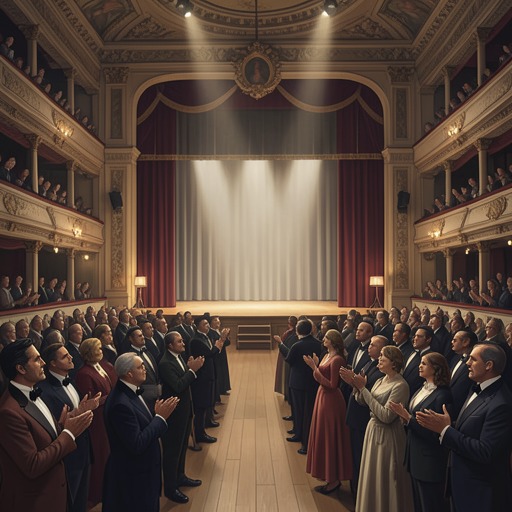
Salieri tells Mozart that he cannot promise to intervene but will try. He then insists, in an aside to the audience, that he did absolutely nothing about the matter. The next day, during the final rehearsal, Joseph II arrives with his courtiers. The Emperor reaches the third-act point where the dancers would have performed the now-deleted passage. The orchestra stops at the censored section, but the dancers proceed without music. What was an argument on paper becomes a conspicuous absence in performance: the bodies continue the dance while the musical structure that should carry it has vanished.
Joseph II watches the silent action with evident perplexity and asks whether it is modern. Mozart answers that it is not, explaining that the director has removed a dance that should be there. Asked why, Rosemberg invokes the Emperor’s own rule: no ballet in opera. The moment places the prohibition before its maker in an awkwardly literal form. The Emperor has not simply heard competing explanations; he has seen how the rule operates when applied without regard to the passage’s place in the drama.
Joseph II says he dislikes wax figures, and Mozart agrees. Salieri, when asked for his view, makes a pointed joke about Italians and their fondness for wax figures, linking that taste to their religion. Strack then voices Rosemberg’s concern that restoring this music would create a precedent and lead to hours of dancing in opera. Joseph II rejects the implication that the court cannot control future cases. He orders that Mozart’s music be put back, then reinforces the command when Rosemberg protests: the Emperor wants to hear the music in full. Mozart leaps onto a chair and throws himself at Joseph II’s feet, kissing the Emperor’s hand with exuberant gratitude.
Salieri’s Position and the Event’s Significance
Salieri’s presence gives the episode a second, more uncertain account. He and Strack watch Rosemberg remove the pages from the darkness; Mozart names Salieri as the source of the idea, though Rosemberg denies it. Later Salieri disclaims involvement, yet describes the events surrounding the rehearsal as mysterious and more than a mere coincidence. He notes that Joseph II arrived precisely when the dancers were due to begin, at the point where the suppressed music would have sounded. The scene therefore leaves a distinction between what Salieri says he did and what his staging as observer invites the audience to suspect; it does not establish that he arranged the Emperor’s arrival or the restoration.
The reversal depends on performance rather than abstract argument. Rosemberg treats the ban as a command that settles the question, while Mozart understands the dance as part of the dramatic action. When the music is removed, the silent choreography makes the gap legible to Joseph II, whose authority had been invoked to justify the cut. His order restores the passage not by abolishing the rule, but by asserting his own judgment about this particular work. The episode thus makes theatrical form part of the court’s power struggle: a missing score passage changes what the audience sees and hears, and the rehearsal gives the Emperor grounds to revise the decision. Mozart’s gratitude is immediate and excessive, but the reprieve is specific—the ballet music is restored because Joseph II wants to hear Mozart’s opera complete.