The Abduction from the Seraglio Premieres
AmadeusThe Abduction from the Seraglio Premieres marks Wolfgang Amadeus Mozart’s arrival before the imperial audience as a composer commissioned to serve a new German-language opera, while exposing the court’s uncertainty about what that service should sound like. The performance ends in applause and a warm public reception, yet Joseph II’s assessment turns on a phrase supplied by Count Orsini-Rosemberg: the music has more notes than the Emperor thinks an evening can bear. In Antonio Salieri’s telling, the same occasion also becomes a private drama of suspicion, as he treats Mozart’s aria for Katherina Cavalieri as evidence of a sexual relationship without establishing that his accusation is true.
Commission and Courtly Expectations
The premiere follows a commission from Joseph II. Johann von Strack conveys the Emperor’s request that Mozart compose a comic opera in German. Strack explains the political and cultural purpose: Joseph II wants to establish a national opera and hear works in pure German. Count Orsini-Rosemberg, the opera director, objects that Italian is the only possible language for opera. Gottfried van Swieten raises a different objection, questioning why music should be comic at all. Before a note of the new opera is heard, then, the commission has exposed competing assumptions about language, genre, and the court’s authority over theatrical taste.
When Joseph II later asks whether Mozart has received the commission, Mozart responds eagerly. He promises the best, most perfect spectacle ever offered to a monarch and says that he has already found a libretto. Count Orsini-Rosemberg is alarmed that Mozart did not tell him. The exchange gives the commission a practical edge: Mozart is ready to proceed, while the director appears surprised that the composer has begun moving ahead. The premiere therefore fulfills an assignment formed amid institutional disagreements, rather than arriving as an isolated display of musical skill.
The Performance and Salieri’s Suspicion
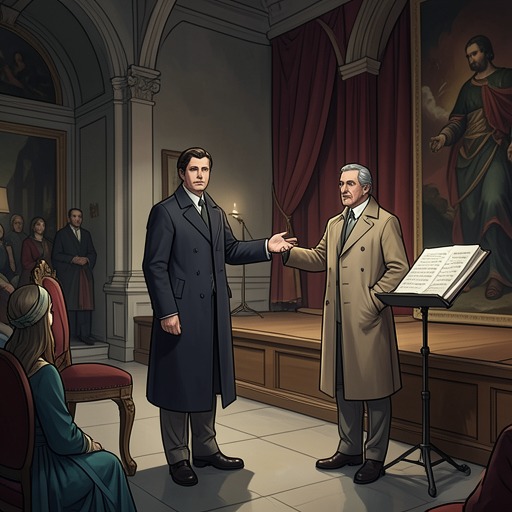
The stage becomes an eighteenth-century theater, with Joseph II and his courtiers seated above the servants and citizens of Vienna. Antonio Salieri sits near his wife and watches Mozart, who enters in a conspicuously bright new coat and powdered wig, then goes to the pianoforte and mimes conducting. Salieri describes the opera as an expression of human love. His account, however, is sharply divided: what the audience hears as performance, he frames as evidence about Mozart’s character and motives.
For his student Katherina Cavalieri, Mozart has written the aria Martern aller arten. Salieri singles out its soprano scales and fioriture, describing a passage that he says lasts ten minutes and dismissing the result as futile and showy. He imagines that the aria gives a foolish young soprano what she wants, then leaps from that judgment to the claim that Mozart has possessed Cavalieri. Salieri presents the suspicion with certainty, but the scene supplies no independent confirmation of an affair. The distinction matters: the accusation reveals Salieri’s possessiveness toward his student and his hostility toward Mozart, not an established fact about either performer’s private life.
The opera’s bright Turkish-style finale brings a strong response from the audience. Mozart jumps to his feet to acknowledge the applause, and Joseph II rises, followed by the others. Katherina Cavalieri enters in a dress covered with feathers and flounces to receive renewed cheers. She bows to the Emperor; Salieri kisses her and introduces her to his wife. After bowing to Mozart, Cavalieri withdraws. The sequence gives her a visible public triumph, while Salieri’s narration has already tried to recast her success as proof of a private bargain.
Applause, Embarrassment, and the Imperial Verdict
In the brief silence after Cavalieri’s reception, Constanze Mozart hurries down from the back of the theater and throws herself at Mozart, absorbed in congratulating him. Her affectionate address momentarily eclipses her awareness of the Emperor’s presence. When Mozart indicates Joseph II, she apologizes and bows, embarrassed. Mozart then presents her as his fiancée, Fraulein Weber. Her spontaneous embrace makes the couple’s intimacy part of the public scene, but her sudden deference also restores the courtly hierarchy that the excitement briefly displaced.
Joseph II tells Mozart that the work is a great effort and asks how he should describe it. Looking to Count Orsini-Rosemberg, he receives the suggested judgment that it contains too many notes, and repeats it. The remark is not initially presented as a carefully formed musical analysis: the director supplies the wording, and the Emperor adopts it. Joseph II elaborates that an audience can hear only a certain number of notes in an evening, then calls the work intelligent, German, and of good quality while maintaining his reservation. Antonio Salieri, asked to agree, answers hesitantly. His discomfort contrasts with the ease of Count Orsini-Rosemberg’s intervention and shows how a courtly judgment can gather authority through agreement, even when its formulation originates with someone other than the monarch.
Mozart does not accept the criticism as a useful measure of the score. He replies that it contains exactly as many notes as necessary, neither more nor fewer. Joseph II answers mildly and leaves abruptly with Count Orsini-Rosemberg and Johann von Strack. Mozart, nervous, asks whether the Emperor is angry. The exchange closes the reception without converting applause into an unequivocal endorsement: Mozart has been heard and publicly praised, but his own defense of the music does not settle the question of how the court will receive it.
Significance in the Larger Court Conflict
The scene stages a contrast between performance and administration. The audience responds to the finale with applause, and Katherina Cavalieri receives renewed cheers; the official verdict, by contrast, reduces the work to a question of how many notes an evening can accommodate. Joseph II’s commission had called for German comic opera as an expression of a national project, yet the reception shows that the project’s patrons and administrators do not share a settled view of what such opera should be. Mozart’s insistence that every note is necessary asserts the composer’s judgment against a courtly standard articulated by others.
Later disputes over The Marriage of Figaro extend, but do not erase, this tension. Gottfried van Swieten condemns Mozart’s choice of a comedy about nobles, servants, and real social behavior; Mozart defends the subject as an attempt to make an opera about real people in a real place. When the dance music is removed, Joseph II encounters the dancers performing without it and orders the music restored despite Count Orsini-Rosemberg’s resistance. These later episodes are distinct from the premiere, but they echo its central problem: opera at court is simultaneously an artistic form and an object of institutional control. The premiere’s applause grants Mozart a moment of public success, while the qualifications attached to that success foreshadow the recurring struggle over who has the right to decide what his music may contain.