Mozart’s Physical Decline
AmadeusMozart’s Physical Decline unfolds from intermittent stomach cramps into persistent pain, sleeplessness, nightmares, and a final, fatal illness. The play gives no diagnosis for most of these symptoms; instead, it makes decline visible in brief exchanges, unsettled perceptions, and the contrast between Mozart’s failing body and the music he continues to compose inwardly.
Early Symptoms
During a meeting with Antonio Salieri, Mozart laughs at Salieri’s imitation of the Emperor, then abruptly doubles over with stomach cramps and groans. Salieri asks what has happened; Mozart explains that the cramps come to him at times, apologizes, and insists that it is nothing really. The interruption punctures the ease of their shared laughter, but Mozart’s own minimization keeps the episode from being treated as an emergency. At this stage, the pain is recurring yet described as manageable.
When Salieri sees him again at Prater Park, he registers a change for the worse. Mozart tells him that he is unwell and still has pains. The word still marks a shift from an occasional complaint to a continuing one. Salieri also describes Mozart’s eyes as shining strangely, like a dog’s eyes reflecting light. That image belongs to Salieri’s observation rather than a medical account: it gives the encounter an ominous quality without identifying a physical cause.
Pain, Sleeplessness, and Fear
At Prater Park, Mozart adds that he sleeps badly and has nightmares. Constanze Mozart warns him as he begins to disclose this, and Salieri follows up by asking about the dreams. The exchange places the symptoms in a social setting: Mozart’s illness is visible to others, yet what he can say about it is checked by his wife’s warning and met by Salieri’s questions. The text does not establish whether the nightmares arise from the illness, from other pressures, or from some combination of them.
Later, when Salieri asks whether Mozart is mad, Mozart first suggests that he may be and then says that he thinks he is. His uncertainty deepens when he recounts an encounter whose reality he cannot determine: the visitor left after telling him that the work must be finished by their next meeting. Mozart insists that the experience felt real, while admitting that he does not know whether it happened in his head or outside it. He connects the episode to Constanze’s departure, saying that he frightened her and that she believes him mad. His distress is thus not confined to private perception; it also affects the marriage and his understanding of why she has gone.
Mozart’s account carries practical and emotional concerns together. He regrets that Constanze will not be able to see the vaudeville, then turns to the contrast between the ease of the music and the difficulty of marriage. The remark does not resolve whether his account of the visitor is a nightmare, an event, or a confused recollection. Instead, the uncertainty itself becomes part of his decline: he cannot confidently separate an experience that felt real from something that may have occurred in his mind.
Final Collapse
By the final scene, Mozart is described as sickly and speaks with the seriousness of a child. As Constanze helps him to a chair, he says that Salieri has killed him and repeats that Salieri told him so. Constanze answers in a soothing manner rather than confirming the accusation. Her response cannot establish what caused Mozart’s condition; it shows her trying to calm a dying husband whose conviction has become part of the crisis around his illness.
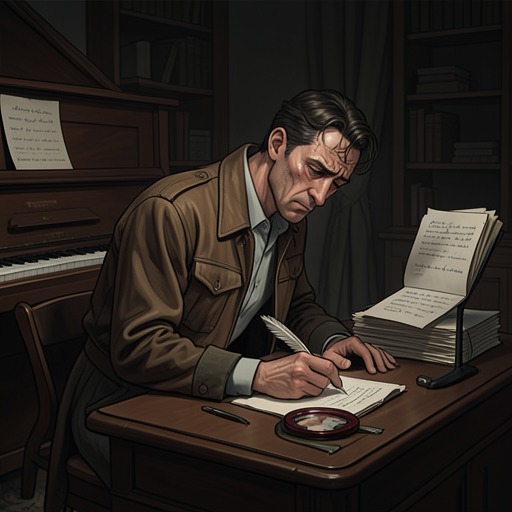
Constanze helps Mozart lie on the table, which becomes his bed, and covers him with her shawl. When the Requiem Mass’s Lacrimosa begins faintly, Mozart sits up and leans on her shoulders to listen. His hand weakly marks the rhythm. The stage direction makes clear that he is composing the Mass in his head and no longer hears his wife speaking to him. As she pleads with him to recover and recalls their marriage, his drumming slows and stops. His physical weakness and the continuation of musical thought occupy the same moment: the body can no longer sustain the gesture, while the composition remains active in his mind.
Death and Recorded Cause
The play distinguishes Mozart’s final accusation from the official account of his death. Salieri reports that the death certificate listed kidney failure, accelerated by exposure to cold. No earlier symptom is identified as the cause, and the script does not supply a fuller medical explanation. The distinction matters: Mozart dies believing that Salieri has killed him, while the stated documentary cause is illness aggravated by cold.
His death is followed by a pauper’s funeral shared with twenty other bodies in an unmarked lime pit. Gottfried van Swieten tells Constanze that money saved on the burial can be given to the children instead of being spent on unnecessary ceremony. The sparse burial gives the account of decline a material consequence beyond the sickroom: Mozart’s failing health ends not in a public commemoration but in an economical funeral, with support redirected to his family.
Dramatic Significance
The progression is marked less by a clinical chronology than by changes in how symptoms are spoken about and perceived. Mozart first dismisses cramps as something that happens sometimes; later he says that pain continues, reports poor sleep and nightmares, and doubts his own grasp of reality. At the end, he is visibly frail, relies on Constanze to move and lie down, and can only mark the music weakly before he dies. These moments make deterioration cumulative without assigning it a precise onset or diagnosis.
The final scene also refuses to reduce Mozart’s decline to either bodily illness or mental disturbance. A death certificate names kidney failure and exposure to cold; Mozart’s own account centers on Salieri’s alleged violence; Constanze responds with care; and the Requiem continues as an inward act of composition as his strength fails. Their coexistence leaves the medical cause distinct from the play’s dramatic and emotional meanings, while making the body’s collapse the condition under which Mozart’s last musical work is imagined to persist.