Mozart’s Requiem Manuscript
AmadeusMozart’s Requiem Manuscript is both an unfinished musical work and the object through which the play’s final confrontation becomes tangible. The gray messenger’s command gives Mozart a deadline he cannot meet; when Salieri appears in the messenger’s guise, Mozart offers him the completed Kyrie as proof that the work is underway. Salieri then tears the score, and the manuscript’s destruction makes their conflict over music, God, and Mozart’s life physically visible.
Commission and Uncertain Origin
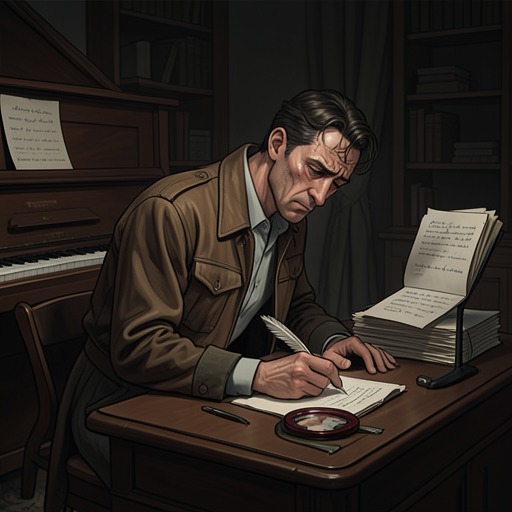
The manuscript begins with a frightening instruction. Mozart tells Salieri that the gray, masked figure from his dreams appeared while he was awake, stood before his desk, and ordered him to write a Requiem Mass. When Mozart asked who had died, the figure did not answer. Instead, it required the work to be finished by their next meeting and left the room. The commission therefore reaches Mozart without an identified patron or explanation, and its deadline is bound to the return of the mysterious visitor.
Mozart cannot decide whether the apparition occurred outside his mind or within it. Yet he insists that it felt real, and his uncertainty does not make the command less powerful: he believes he must begin writing. He also connects the episode to Constanze Mozart’s departure, saying that he frightened her and that she will miss the vaudeville. The manuscript is thus introduced amid both a supernatural threat and an immediate domestic consequence. The work he begins is not presented as a calm commission; it grows out of fear, isolation, and a demand whose purpose remains concealed.
The Work on the Desk
By the time the messenger returns, the Requiem remains unfinished. Mozart pleads for another month, contrasting his present difficulty with a time when he could write a mass in a week. He points to the pages on his desk and presents the Kyrie as completed, describing its first theme and second theme as combining into a double fugue. The manuscript is therefore not an empty promise: it contains a specific, developed musical structure, even as the larger work has not reached completion.
The finished Kyrie becomes Mozart’s evidence that the unfinished Requiem is worthy of patience. He asks the visitor to take the pages and show that he is not unworthy, treating the fragment as a plea on his behalf as well as a portion of the composition. He promises that, given time, he will write a perfect piece, but admits that his past claims to have written hundreds of such works were boasts. In this exchange, the manuscript carries both professional work and painful self-judgment: the completed music demonstrates his ability, while his appeal exposes how little confidence he retains in the value of his achievement.
The Final Appeal
As Salieri sits behind Mozart’s desk and examines the pages, the Requiem’s somber overture begins. Against that music, Mozart recalls an earlier life of journeys, smiling salons, and royal attention, including the King at Schönbrunn and the Princess at Versailles. His memories of candles lighting the way to the keyboard and his father repeatedly bowing over the celebrated child stand against the present scene: the composer is asking a masked figure to grant him more time, and he cannot understand why the happiness of his earlier life has ended.
The manuscript is central to this appeal because Mozart places the visible work before the visitor instead of relying on a general promise. Its Kyrie is meant to show that the Requiem is already taking shape and that the unfinished state need not be final. The contrast between the page’s concrete musical achievement and Mozart’s fear of having made nothing definitively good gives the manuscript a double force: it records what he can still create, while standing in for a life whose former confidence and public favor he believes have vanished.
Destruction and Significance
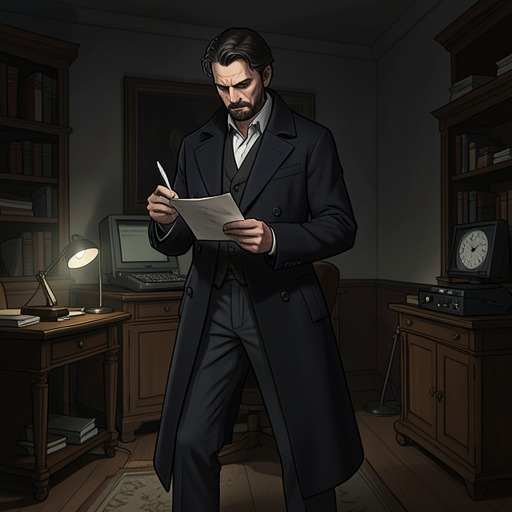
Salieri deliberately tears the papers in half. The overture stops at once, leaving silence; Mozart then asks, timidly, whether the work is good. Salieri answers that it is. That judgment does not save the manuscript. He tears a corner from the score, raises it like a fragment in a Communion rite, and swallows it. The manuscript’s destruction is therefore not simply an interruption of Mozart’s composition: Salieri first acknowledges its quality, then makes a torn piece of it part of his own body.
Salieri explains the gesture through the image of poison, saying that he takes what God gives him dose after dose and that he and Mozart have poisoned one another. He identifies himself as Antonio Salieri and says that ten years of his hatred have mortally poisoned Mozart. Mozart falls to his knees beside the table. The manuscript has passed from Mozart’s anxious offering into Salieri’s deliberate act of violence, linking the Requiem to the concealed identity behind the gray messenger and to the damage Salieri claims his envy has done.
The score’s ending remains materially and musically incomplete in the scene. The evidence shows Mozart’s completed Kyrie, the larger Requiem still unfinished, and pages torn by Salieri; it does not establish that the entire manuscript is destroyed. What the scene does establish is that Mozart’s music is good even as Salieri destroys the pages in front of him. The manuscript consequently holds together the work’s central contradiction: an artistic creation capable of receiving Salieri’s reluctant recognition, and a vulnerable object through which he enacts his hatred.