The Marriage of Figaro Full Score
AmadeusThe Marriage of Figaro Full Score is the object through which a dispute over opera, imperial authority, and artistic judgment becomes concrete. Its third-act dance music is treated as an offense against Joseph II’s prohibition on ballet in opera: Count Orsini-Rosemberg removes the pages, leaving a gap Mozart says falls at the story’s climax. When that gap becomes an awkward silence onstage, the Emperor orders the music restored. The score thus carries both the threatened mutilation of Mozart’s work and the means by which the damage is publicly exposed and reversed.
Commission and Context
The score enters a court already arguing over what opera should be. Johann von Strack announces that Joseph II wants a comic opera commissioned from Mozart in German, as part of the Emperor’s wish to establish a national opera and hear works in the language. Count Orsini-Rosemberg objects to the choice of German, asserting the supremacy of Italian in opera; Gottfried van Swieten questions the purpose of comic music. The commission gives the score a political and institutional setting before its pages are examined: the work is expected to answer an imperial initiative, but it must also pass through officials who hold strong views about language and genre.
When Joseph II asks Mozart whether he has received the commission, Mozart confirms it and says he has already found a libretto. Count Orsini-Rosemberg is surprised that Mozart did not tell him. The later identification of the work as The Marriage of Figaro sharpens the contrast between the commissioned undertaking and the resistance it meets. Van Swieten calls the Beaumarchais play shameful and vulgar, objecting to its nobles, servants, disguises, and subject matter. Mozart answers that he wants a work about real people in a real place, describing the boudoir as its setting and emphasizing the intimate, ordinary objects of the room. The score is therefore caught between competing ideas of what is fit for operatic representation: decorum and inherited standards on one side, the dramatic possibilities of everyday life on the other.
The Score as a Physical Object
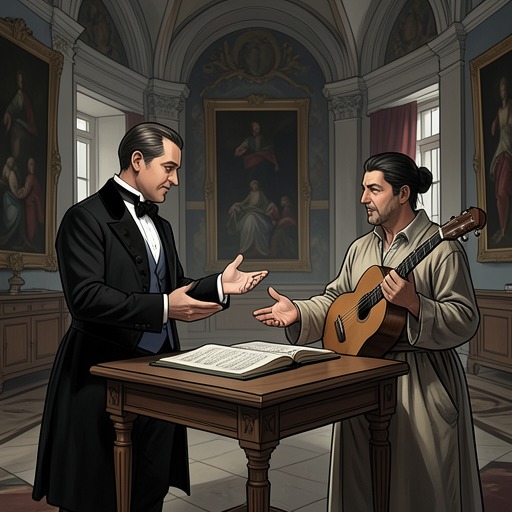
Count Orsini-Rosemberg asks to see Mozart’s Figaro score and has him bring it over. Mozart hands it to him, puzzled by the request. The Count turns through the pages and points to the ballet in the third act, asking whether Mozart knew that the Emperor had expressly forbidden ballet in his operas. The score is not merely discussed at a distance: its pages are placed in the hands of the official who will enforce the rule.
Mozart distinguishes the dance in his opera from the kind of insertion the prohibition was intended to prevent. He argues that Joseph II’s rule was meant to exclude foolish, detachable ballet episodes, not a dance that belongs to the story. Count Orsini-Rosemberg rejects Mozart’s interpretation, telling him that interpreting imperial edicts is not his business and that obedience is. The disagreement turns on the relation between a musical passage and its dramatic function: Mozart presents the dance as part of the work’s action, while the Count treats its presence as a violation regardless of its place in the story.
Censorship and the Missing Pages
Count Orsini-Rosemberg takes the offending pages between his fingers and tears them from the score. He removes more pages after telling Mozart to obey imperial orders in future. The gesture makes censorship an alteration to the object itself, rather than an abstract warning: the music is cut out in front of its composer, and the score is left without material Mozart considers necessary.
Mozart protests that removing the passage will create a great void precisely at the climax of the story. In that instant he accuses Antonio Salieri of having devised the intervention, although Count Orsini-Rosemberg dismisses the accusation. The score’s torn pages consequently register both a practical loss and a conflict over responsibility. The Count enforces the rule in the Emperor’s name; Mozart sees the cut as a deliberate obstruction; and Antonio Salieri, watching with Johann von Strack from the darkness, is implicated by Mozart’s suspicion even as the accusation is denied.
Restoration in Performance
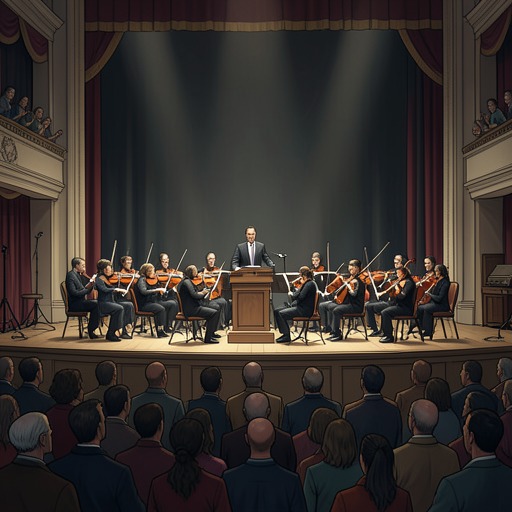
The score’s missing music becomes unmistakable when the opera is performed. Joseph II arrives at the point where the dancers should begin. The orchestra stops at the censored passage, and the dancers perform without music, turning the absent pages into a visible and audible problem before the court. The Emperor watches the silent dance in perplexity and asks whether what he is seeing is modern. Mozart answers that it is not, then explains that the director has removed a dance that should be there.
Count Orsini-Rosemberg defends the cut as compliance with the rule against ballet in opera. Johann von Strack warns that restoring the music might set a precedent and lead to hours of dancing. Joseph II rejects that argument as decisive: he says the court can prevent such an excess and commands that Mozart’s music be put back in its place. When Count Orsini-Rosemberg persists, the Emperor insists that he wants to hear the music complete. The order reverses the earlier act of excision and makes the score’s completeness a matter of explicit imperial decision. Mozart responds with extravagant gratitude, dropping to Joseph II’s feet and kissing his hand.
Performance and Significance
The opera proceeds despite Antonio Salieri’s efforts to prevent it, and he takes his place as a spectator in his box beside his wife, Teresa. He describes the result as a notable defeat for himself, yet says he feels strangely excited. During the performance, the melody associated with his Welcome March is heard in Figaro’s song. Salieri recognizes it as his own march, now arranged to delight the world. The full score therefore belongs not only to the dispute over the restored dance: the performance also makes a musical motif associated with Salieri part of the work that has overcome his opposition.
The score’s dramatic force lies in the sequence of material actions around it. It is commissioned amid disagreement about German opera and comic form, scrutinized by a court official, physically cut, and then vindicated when the silence created by the cut exposes what is missing. Joseph II’s order restores the passage, but the episode does not erase the conflict: it shows how the work’s structure can be understood differently by its composer and its censor, and how a supposedly administrative restriction can disrupt the drama itself. In the staged performance, the score’s missing music speaks through the dancers’ silence; its restoration allows the opera to proceed as Mozart intended.