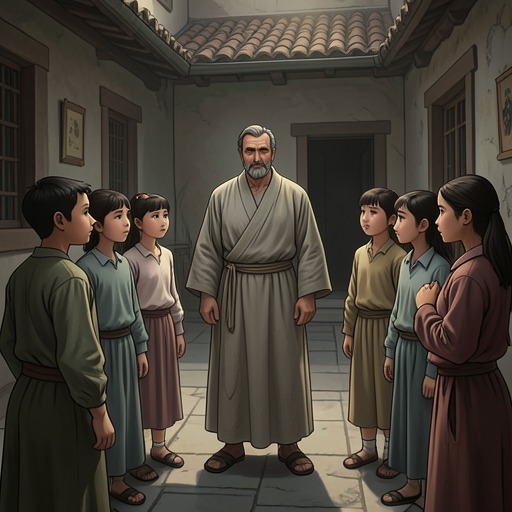
Book of Poetry (Shijing)
AnalectsThe Book of Poetry (Shijing) is both a classic to be studied and a practical education in feeling, judgment, and public life. The Analects links its verses to disciplined learning and interpretive intelligence, while insisting that recitation alone proves little: the learner must be able to respond to situations, understand people, and put knowledge to use.
Learning and interpretation
The classic appears within a broad account of learning as sustained practice. The opening teaching asks whether it is not a pleasure to learn and regularly practise what has been learned; a later discussion makes the same discipline visible in the relation between instruction and inference. When Zigong compares the stages of cutting and polishing to carving and grinding, Confucius approves the comparison and says that Zigong can now be spoken with about poetry: after being shown what has already been said, he understands what follows from it. The exchange makes interpretation an active achievement, not the passive accumulation of lines.
The text also gives the Book of Poetry a unifying moral horizon. Its three hundred pieces, Confucius says, can be gathered under the idea of having no depraved thoughts. This formulation does not reduce the collection to a single subject; it proposes a standard by which its variety can be understood. The poems matter as language that helps shape the learner’s orientation, rather than as ornamental knowledge detached from character.
Uses of the Odes
The most explicit account of the Odes’ work is a compact catalogue of capacities. They can stimulate the mind and provide a means of observation; they can help people associate with one another and give form to grievance. Their reach also extends across relationships and political life: near at hand they serve in attending to one’s father, and at a distance in attending to one’s ruler. They further teach the names of many birds, beasts, plants, and trees. The list moves from inward response to social connection, ethical duties, and knowledge of the natural world, making poetry a resource for several kinds of attention at once.
That range gives expression a public as well as a personal consequence. The Odes are not confined to private appreciation: their use can be measured in the ability to engage with people and to meet duties beyond oneself. Even grievance belongs within this education. Poetry gives feeling a form that can be communicated and understood, while the surrounding emphasis on propriety and disciplined learning places expression within an ethical practice rather than treating it as mere release.
Study, cultivation, and proportion
The injunction to study the Odes is directed to the disciples as a group, but the collection is also brought into a family setting. Confucius asks his son whether he has studied the Zhou Nan and Shao Nan; a person who has not studied them, he says, is like someone standing directly before a wall. The image presents failure to learn these poems as a blockage of perspective: without them, one is left facing an obstruction rather than seeing or moving forward. The passage gives particular weight to named sections of the collection without explaining their contents, so its emphasis falls on the necessity of study itself.
The classic is also one of the Master’s recurrent subjects of discourse, alongside the Book of History and the maintenance of the rules of propriety. This grouping places poetry in company with historical learning and ritual practice. It belongs to a curriculum through which knowledge is connected to inherited forms and conduct; it is not presented as a substitute for either practical responsibility or ethical discipline.
Learning put to the test
The Analects draws a sharp distinction between possessing literary material and being able to act. Even someone capable of reciting all three hundred Odes may fail when given a government assignment or sent abroad on a mission if he cannot handle the work or answer independently. In that case, the size of his learning has not made it useful. Poetry’s educational promise is therefore conditional: the learner must be able to convert familiarity with the text into judgment in circumstances that demand action and speech.
This practical test clarifies the relation between memory and understanding. Recitation is not condemned, but it cannot stand as proof of competence. The earlier praise of Zigong supplies the positive counterpart: he receives a point and perceives what follows from it. Together, the passages define learning as the movement from the words one has acquired to conclusions and responses one can produce for oneself.
A literary education with ethical reach
The collection’s place in the Analects rests on the breadth of its effects. It trains attention to feeling and the world, gives resources for fellowship and grievance, and bears on obligations within the family and toward political authority. Yet the text repeatedly asks what such learning enables: whether it informs conduct, supports sound judgment, and equips a person to answer real demands. Poetry is valued neither as bare information nor as decoration, but as an education whose literary, ethical, and practical dimensions meet.