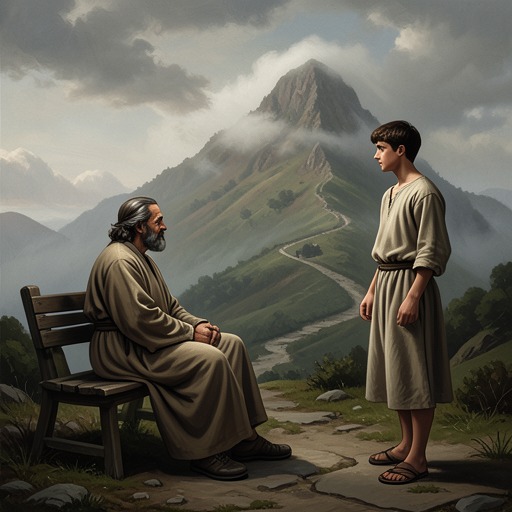
Chang Ju, Jie Ni met Confucius's group
AnalectsThe encounter between Confucius’s traveling party and the recluses Chang Ju and Jie Ni turns a practical request for directions into a dispute over whether anyone should attempt to mend a disordered world. The recluses treat withdrawal as the wiser course; Confucius answers that he cannot abandon human society, and that his work would be unnecessary if right principles already prevailed. The scene gives physical form to a central tension in his political ethic: disillusionment may explain retreat, but it does not absolve those who remain from their obligations to others.
The Encounter in the Field
Chang Ju and Jie Ni are working together in a field when Confucius passes by with his party. He sends Zilu to ask where they can ford the water. The exchange begins with a question about the carriage: Chang Ju asks who is holding its reins. When Zilu identifies the driver as Confucius, Chang Ju recognizes the name and says that Confucius must already know the ford. The answer turns the request back on the travelers, hinting that a man devoted to finding a way through political disorder should know his way through a stream.
Zilu then approaches Jie Ni, who first asks who he is. Zilu gives his personal name, Zhong Yu, and confirms that he is a disciple of Confucius of Lu. Jie Ni’s response shifts the encounter from navigation to principle. The water has become the occasion for a deeper question: where is a person to go when disorder seems to encompass the whole world?
The Recluses’ Challenge
Jie Ni describes disorder as a flood spreading throughout the empire and asks who could possibly change its course. In his view, following Confucius as he avoids one person or regime after another is inferior to joining those who have withdrawn from the world altogether. His challenge treats Confucius’s continued political engagement not as an answer to disorder, but as a futile effort to escape it without truly leaving it.
The argument is made through action as well as words. Jie Ni keeps covering the seed and continues his work without stopping. His steady labor contrasts with the travelers’ movement and political purpose: he does not interrupt his chosen life to pursue the public project Confucius represents. The contrast makes withdrawal visible as a practiced alternative, not merely a theory. Chang Ju’s pointed remark that Confucius already knows the ford likewise makes the natural crossing stand beside the harder, unresolved passage through political failure.
Confucius’s Reply
Zilu returns and reports what the two men have said. Confucius responds with a sigh, then rejects the premise that a person can simply leave society behind. Human beings cannot be treated as though they were birds and beasts; if he were not to associate with people, he asks in effect, with whom could he live? His answer does not deny the disorder Jie Ni describes. Instead, it insists that the fact of living among people creates a responsibility that retreat cannot discharge.
Confucius closes by conceding the condition under which his political labor would no longer be needed: if right principles prevailed throughout the empire, there would be no need for him to try to change it. This ending gives his persistence its double edge. His work is necessary because the world is not rightly ordered, but the ideal he serves would make that work unnecessary. The scene leaves the conflict unresolved in practical terms—the recluses continue their course, and Confucius continues his—but clarifies why he will not choose their escape.
Political and Ethical Significance
The encounter stages competing responses to failed government without suggesting that the conflict can be settled by finding a literal ford. Jie Ni’s flood image presents disorder as vast enough to overwhelm individual effort; Confucius’s answer shifts attention from the scale of the crisis to the human relationships within it. The recluses judge engagement by whether it can change the whole condition of the empire. Confucius judges withdrawal by whether it remains faithful to the obligations people have to one another.
The episode therefore frames political service as a commitment maintained without any assurance of success. Confucius does not claim that his efforts have already transformed the world, and the conversation offers no conversion or compromise. Its force lies in that refusal of easy resolution: one path is to withdraw from a disorder that seems beyond repair; the other is to remain among people precisely because the disorder persists. The reported sigh registers the weight of the disagreement, while the final conditional statement preserves the distinction between the world as it is and the world in which his mission would no longer be necessary.