The Death of Yan Hui and the Controversy over His Funeral
AnalectsYan Hui’s death and the dispute over his funeral bring private grief into conflict with ritual restraint. Confucius mourns his beloved disciple intensely, but when Yan Lu asks him to provide his carriage so that an outer coffin shell can be obtained, he refuses. The disciples later give Yan Hui a grand burial despite the prohibition; Confucius accepts that the choice was theirs, while insisting that his inability to treat Yan Hui as a son was not his own fault.
Death and the request for a coffin shell
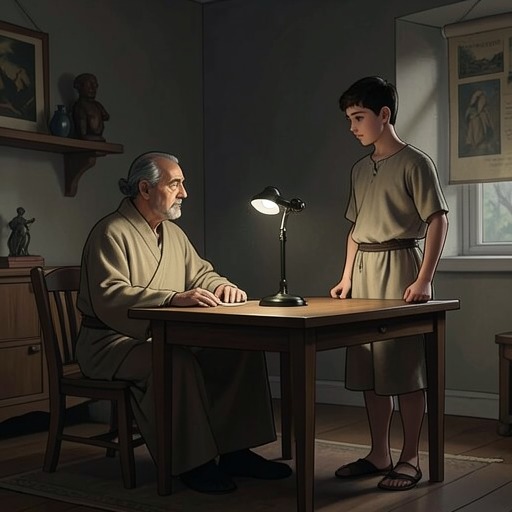
Yan Hui’s death is presented through the practical urgency of burial as well as the grief it causes. His father, Yan Lu, asks Confucius for the carriage, intending to sell it and obtain an outer shell for his son’s coffin. The request turns mourning into a question of material means: the family seeks a more complete burial, and the teacher is asked to give up a possession that could meet that need.
Confucius declines. He explains that his own son, Li, died with a coffin but without an outer shell, and that he did not walk on foot in order to secure one for him. His refusal is framed through the conduct expected of his position: because he had served among the great officers, it was not proper for him to travel on foot. The comparison does not diminish Yan Hui’s importance. Instead, it makes Confucius’s answer a deliberate appeal to consistency: he will not grant for a disciple’s funeral what he did not provide for his own son.
Grief without concealment
The account gives Confucius’s sorrow several distinct forms. On hearing of Yan Hui’s death, he cries out that Heaven is destroying him, repeating the lament. The repeated words make the loss sound not like a measured comment on mortality but like a blow to the life and work of the person left behind.
When Confucius weeps bitterly, the disciples who are present tell him that his grief is excessive. His reply turns their rebuke into a defense of the particular bond: if he is not to mourn bitterly for this man, for whom should he mourn? The question does not erase the disciples’ perception of excess; it answers it by insisting that the depth of grief belongs to Yan Hui’s singular place in Confucius’s affections.
A funeral against the teacher’s instruction
The dispute shifts from Yan Lu’s request to the disciples’ own decision. They wish to give Yan Hui a grand funeral, and Confucius tells them not to do so. They nevertheless bury him in great style. The sequence is direct and consequential: the teacher states a limit, the disciples cross it, and the scale of their act makes their devotion visible as conduct rather than merely sentiment.
Afterward, Confucius says that Hui had treated him as a father, while he himself had not been able to treat Hui as a son. He then assigns responsibility for the mismatch to the disciples, not to himself. The statement acknowledges a filial-like closeness without claiming that the relationship was literally that of parent and child. It also separates affection from authority: Confucius can recognize the intimacy of the bond and still maintain that he neither ordered nor authorized the extravagant burial.
The limits of ritual and authority
The episode is not a simple contest between a cold teacher and devoted mourners. Confucius’s refusal is supported by a comparison with his own son’s burial and by the propriety attached to his standing; his grief, meanwhile, is strong enough to draw comment from those around him. The text leaves both facts intact. Restraint governs what he will do with his carriage and what funeral he permits, but it does not make his attachment to Yan Hui emotionally slight.
The funeral also exposes the limits of instruction within a community of mourners. Confucius says the burial should not be grand, yet the disciples proceed otherwise. His final distinction—Hui treated him like a father, but he could not reciprocate as a father to Hui—gives the disagreement its lasting force. The death reveals both the extraordinary closeness between teacher and disciple and the painful gap between that personal bond and the roles, resources, and decisions that ritual life allows.