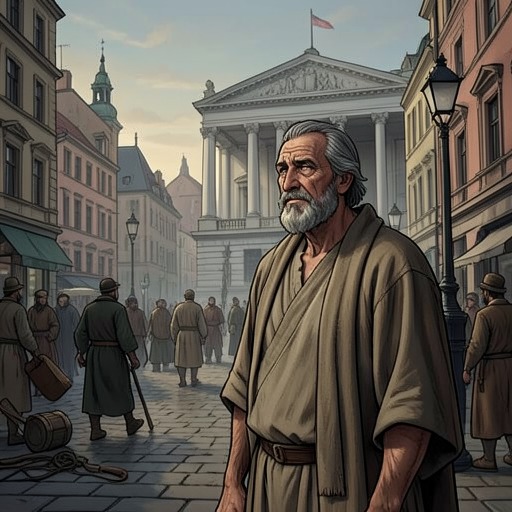
Confucius left Lu country
AnalectsConfucius’s departure from Lu is presented as a response to political failure rather than as an isolated change of residence. The account gives two closely related circumstances: the Duke of Qi declines to put Confucius’s doctrines to use, and, back in Lu, Ji Huan accepts a gift of female musicians and neglects court for three days. Confucius leaves; the compressed sequence makes withdrawal the consequence of a court that does not sustain the conditions for principled service.
Political Conditions for Service
The surrounding teachings define the standard against which the departure can be read. Confucius says that a ruler should employ ministers according to ritual and that ministers should serve with loyalty. His exchange with Zilu makes the same concern institutional: when names are not correct, speech loses its proper force, affairs fail, ritual and music do not flourish, and punishments cease to be appropriate. Political authority therefore depends not only on possessing office, but on aligning titles, conduct, and public duties.
That alignment is also expressed through the principle that a ruler whose own conduct is correct can govern without issuing orders, while an incorrect ruler cannot secure obedience simply by commanding it. The court’s conduct matters as a model and as an operating standard. The episode of departure places Confucius’s withdrawal against this broader account of how political legitimacy and effective government are maintained.
The Two Courtly Failures
The first circumstance concerns the Duke of Qi, who considers how Confucius might be treated. He says he cannot accord him the standing given to the head of the Ji clan and proposes a position between that and the standing of the head of the Meng family. He then says that he is old and cannot use Confucius’s doctrines. Confucius leaves. The account thus connects the departure not to a dispute over a particular policy, but to the ruler’s declared inability to make use of the teaching.
The second circumstance returns the action to Lu. The people of Qi send Lu a gift of female musicians; Ji Huan accepts it, and court is not held for three days. Confucius then leaves. The detail of the three-day absence makes the breach concrete: the issue is not merely that entertainment has arrived, but that the recipient’s acceptance coincides with a sustained failure to attend to public business. The two episodes differ in setting and immediate cause, yet both end in departure: one ruler rejects the possibility of using Confucius’s doctrine, while a powerful figure in Lu allows court duties to lapse.
Departure and Political Judgment
The narrative gives no itinerary, subsequent destination, or account of what Confucius does after leaving in these passages. Its emphasis falls instead on the decisions that precede the departure and on the simple repeated outcome that he goes. That brevity makes the act legible as a judgment on the terms of service available to him, without supplying an unrecorded speech or motive.
The broader political arguments in the book sharpen the contrast. Confucius warns that when authority over ritual, music, and military action passes from the Son of Heaven to princes, then to great officers, and finally to their subordinate ministers, political order is increasingly unstable. He also argues that government should value the people’s livelihood, mourning duties, and sacrifices, and that authority should be beneficent without waste, dignified without pride, and imposing without fierceness. Against those standards, the Duke of Qi’s refusal and the three days without court in Lu mark failures of political receptiveness and responsibility. The departure closes the episode not with reform or reconciliation, but with Confucius leaving a court whose conduct has made effective service unavailable.