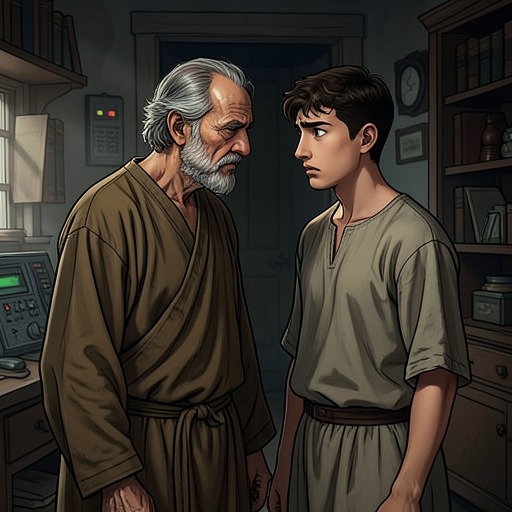
Confucius was afraid at Kuang
AnalectsConfucius's ordeal at Kuang is presented not merely as a moment of danger but as a test of whether the inheritance of culture and right principles can be destroyed by force. Confucius answers fear with a claim about Heaven's purpose; when the episode returns, the focus shifts from that conviction to Yan Hui's loyalty, made vivid by his having fallen behind and then rejoined his teacher.
Danger and the claim of cultural inheritance
The account first states simply that Confucius was put in fear at Kuang. It gives no description of the threat's immediate circumstances or of how the danger began. Instead, the episode turns quickly to Confucius's response: he recalls the death of King Wen and asks whether, after that death, the cause of truth had not been lodged in him. The emphasis falls on the transmission of a cultural and moral inheritance, not on the mechanics of the peril.
Confucius reasons that if Heaven intended this inheritance to perish, he would not have received his relationship to it as a later mortal. Conversely, if Heaven has not allowed it to perish, the people of Kuang cannot determine its fate. His words recast the threatened encounter as a test whose outcome is larger than personal safety: the danger cannot, in his account, overrule the authority that has entrusted him with the work of preserving the tradition.
The return of the episode
The narrative revisits the danger in a later chapter, now with attention to the separation between Confucius and Yan Hui. Yan Hui had fallen behind during the episode at Kuang. When he caught up, Confucius told him that he had thought him dead. The brief exchange supplies a human consequence absent from the first account: the peril had separated the two, and the reunion makes that separation speakable.
Yan Hui replies that while Confucius was alive, how could he presume to die? The answer is framed as a statement of attachment to his teacher, not as a further account of what happened at Kuang. The text does not explain how long Yan Hui was missing or what he faced while apart. Its economy instead places the remembered fear, the master's thought that his disciple had died, and the disciple's reply together in a compact scene of reunion.
Conviction, loyalty, and the form of the telling
The two tellings cast the same episode in different lights. In the first, Confucius's reasoning makes danger subordinate to the continued existence of the cause he serves. In the later recollection, the center of attention is relational: Yan Hui's return and his insistence that his life is bound up with his teacher's. The event therefore joins a public-sounding assertion about cultural continuity to an intimate exchange between teacher and disciple, without supplying a fuller narrative of the crisis.
The placement of the episode's return also makes recurrence significant. The first account records what Confucius says when threatened; the later one recalls the same danger through a specific absence and reunion. Neither version describes the threat in detail or reports a political aftermath. What the text does preserve is a contrast between danger's power to create fear and its inability, in Confucius's argument, to erase the inherited cause of truth—or, in Yan Hui's answer, to loosen his bond with his teacher.