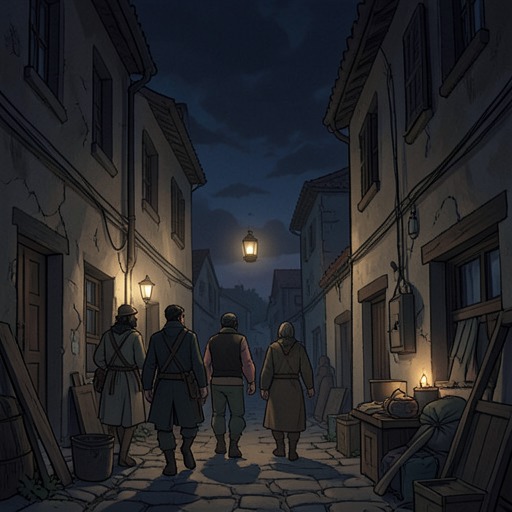
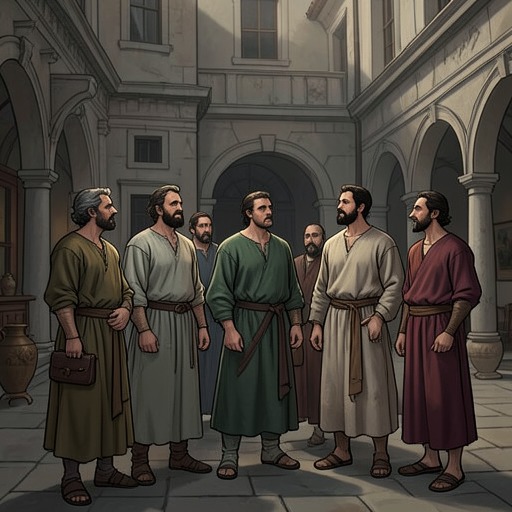
Confucius was blocked by Chen and Cai
AnalectsThe hardship at Chen is presented as a stark test of character: with provisions exhausted and his followers too ill to rise, Confucius distinguishes the superior man’s endurance from the mean man’s surrender to excess. The episode places material deprivation beside a larger question of political and moral steadiness, a question echoed elsewhere in the book’s teachings on government, duty, and conduct.
Background and Immediate Crisis
Before the hardship at Chen, the Duke Ling of Wei asked Confucius about military tactics. Confucius answered that he had learned about sacrificial vessels but not the conduct of military affairs, and departed the next day. The account then turns to the crisis at Chen: their provisions were exhausted, and the followers’ illness left them unable to get up. The text gives no further account of the journey or the duration of the deprivation; its focus narrows instead to the exchange that follows.
Zilu’s Challenge and Confucius’s Reply
Zilu approaches Confucius with evident dissatisfaction and asks whether a superior man must also endure such hardship. Confucius does not deny the deprivation or promise relief. He answers that the superior man may indeed have to endure want, whereas the mean man, when deprived, gives way to unbridled license. The contrast is not between suffering and comfort, but between two responses to conditions neither can immediately control: hardship may constrain conduct, but it does not determine it.
Conduct and Political Standards
The scene’s emphasis on self-command resonates with the book’s wider account of moral and public responsibility. In discussing government, Confucius places the people’s confidence in their ruler alongside food and military equipment, and says that if one necessity must be relinquished, military equipment should go first; if another must be given up, food comes before the people’s trust, since people cannot stand without trust. The episode at Chen does not present that political exchange as its own cause or solution, but its image of exhausted provisions gives the question of material need a concrete human edge.
Elsewhere, the book links a ruler’s correct personal conduct to effective government, and describes political progress as upward for the superior man and downward for the mean man. Those distinctions sharpen the reply to Zilu: the hardship tests the same principle at close range that the political teachings formulate more broadly. When conditions press, character is revealed in whether a person preserves measure and responsibility or lets want become license.
Narrative Significance
The episode closes on a compact opposition rather than a recovery or resolution: the followers remain described as unable to rise, and the account records no change in their circumstances. Its force lies in the answer given amid that unresolved want. By setting Zilu’s frustrated question against Confucius’s distinction between endurance and license, the narrative makes deprivation a measure of ethical steadiness, not evidence that moral standards have ceased to apply.