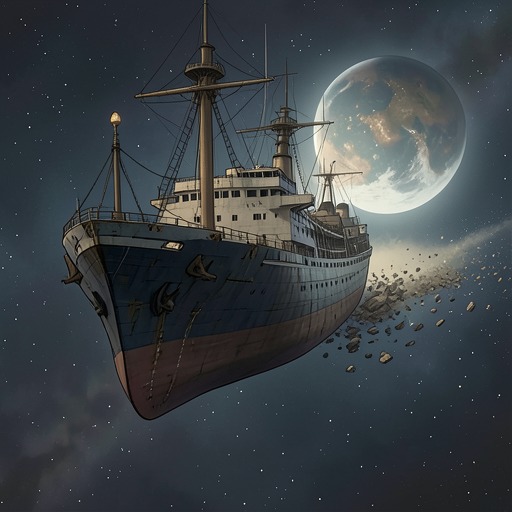
Aniara Deviates and Loses the Ability to Return
AniaraAniara Deviates and Loses the Ability to Return is the turning point at which a navigational deviation becomes an irreversible condition. A swerve to clear the Hondo asteroid takes the ship off course; subsequent hazards and damage prevent it from turning back. The account makes the loss cumulative rather than instantaneous: the ship first misses its course, then abandons attempts to reverse, and finally emerges from danger with return no longer possible. The distinction between repairable apparatus and irretrievable fate gives the episode its stark force.
Causes and Background
The first cause is a manoeuvre to clear the Hondo asteroid, which the narrator pointedly says is thereby proclaimed discovered. The wry announcement accompanies a grave consequence: the swerve itself takes the ship off course. The account does not describe a chosen departure from the intended route. Instead, a response to an obstacle begins a chain of events that steadily narrows the available choices.
The ship comes too wide of Mars and slips from its orbit. It then encounters great swarms of leonids and heads farther off toward Yko-nine. These successive changes matter because they are not presented as a single miscalculation that can simply be undone. Each new circumstance carries the vessel farther from its previous trajectory, and the effort to navigate around danger increases the distance between deviation and recovery.
The Failed Return
In the Field of Sari-sixteen, those aboard give up attempts to turn around. That decision marks an important threshold in the episode: the possibility of return is already under pressure, and the crew no longer treats turning back as an active plan. The account then describes a ring of rocks along the vessel's curved path, making the route forward hazardous as well as the way back uncertain.
The passage through the ring is associated with dizzying angles and the breakdown of the Saba Unit. Space-stones and great swarms of space-pebbles hit the unit hard. The damage is specific, material, and consequential: this is not merely a report that the ship has wandered off course, but an episode in which the vessel's apparatus is battered while it negotiates the obstacles around it.
When the ring has moved off and space has cleared, turning back is no longer possible. The sequence makes the reversal painfully clear: the clearing of the immediate danger does not restore freedom of movement. The crew has survived the passage, but the opening it leaves behind is not a road home. Aniara's nose-cone points toward Lyra, fixing the ship's direction in an image that contrasts with the abandoned effort to reverse course.
Damage, Survival, and Irreversibility
The account distinguishes damage that can be addressed from a fate that cannot. Some other apparatus is damaged, while less damaged parts can be mended. Against these limited possibilities, the narrator calls the ship's ill-fate irretrievable. Repair remains conceivable at the level of individual components; restoring the lost course does not. The difference prevents the episode from collapsing into a general statement that everything has failed. Some work can still be done, but it cannot undo the decisive change in the voyage.
That distinction also shapes the episode's emotional register. The crew faces a condition that cannot be repaired by the kinds of practical measures still available to them. The rock ring has passed, and certain damaged parts may be mended, yet neither fact alters the finality of the lost return. The episode's reversal lies precisely there: the immediate passage through danger ends, but the larger danger of permanent separation remains.
Mima and the Meaning of the Turn
At the close, the narrator hopes that Mima will hold until the end. The hope is deliberately limited. It concerns the endurance of Mima, not the recovery of the route or the reversal of the ship's fate. Set beside the declaration that the ill-fate is irretrievable, it preserves a remaining point of reliance without pretending that the central loss can be repaired.
The account is voiced through a collective experience, but its measured sequence gives the turning point the shape of a recognition: evasion has become displacement, failed attempts have become abandonment, and a cleared passage has not made return possible. The Hondo swerve begins the chain; the leonids, the Field of Sari-sixteen, the damaged Saba Unit, and the ring of rocks progressively close it. By the time the ship points toward Lyra, the crucial change is not simply where Aniara is headed, but what has ceased to be possible. The voyage has crossed from deviation into permanent exile.