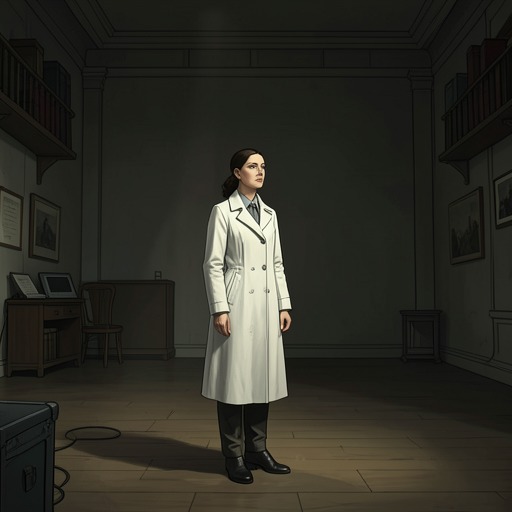
Isagel Leaves Her Body and Enters the Primordial Realm
AniaraIsagel Leaves Her Body and Enters the Primordial Realm is a turning point in which Isagel’s mental collapse gives way to an unseen departure beyond the limits of Aniara’s measurable cosmos. The poem links that passage to the voice calling from Mima’s grave, then makes the connection explicit when Isagel returns to Mimarobe in a dream as the inmost self of Mima.
Breakdown and the call from Mima’s grave
The episode begins with a visible crisis in Isagel: her once splendid mind breaks down, and a fevered demon seems to rise into her eyes. The description focuses on the pupil dilating, presented as the wellspring of her soul. A bodily change thus becomes the sign of an inward upheaval, though the poem does not explain the breakdown as a medical condition or assign it a single cause.
The voice from Mima’s grave has repeatedly wailed in Mima’s chambers since it first appeared. One night, while everyone else sleeps, Isagel listens to its appeal and creeps toward the tiles marking the grave. The scene moves from sound to action: a voice reaches her in private, and she approaches the physical marker of the dead. The poem places this nighttime encounter alongside her subsequent departure, tying her inward crisis to the persistent presence of Mima’s voice without reducing the relationship to a simple explanation of cause and effect.
Mimarobe tries to win Isagel’s soul to other thoughts. That effort marks a human attempt to redirect her attention, set against the pull of an experience that Mimarobe cannot share or fully control. The poem’s address to Isagel as a sovereign of pure thought, preparing for a realm of glory, shifts the emphasis from distress toward spiritual passage. It also says she knows more than the instruments of the cosmic wastes could register: her knowledge exceeds the means by which Aniara’s universe can be measured or recorded.
The unseen departure
Isagel slips away to the place where the Law of Aleph Numbers is stored and where infinite reserves are opened. The movement is explicitly unseen by the others. Rather than describing a route through space or a change in Aniara’s course, the poem presents a passage beyond the range of its observers and their instruments. Its language of stored laws and infinite reserves gives this destination an ordered, almost inexhaustible character, in contrast with the cosmic wastes that surround the passengers.
The poem frames the departure as a leaving of bodily presence, but does not narrate a conventional death scene or specify what happens to Isagel’s body. That restraint matters: the decisive event is what the others cannot witness. The account moves from the visible signs in her eyes to an inward realm, then makes her absence intelligible only through what follows. Isagel’s passage is therefore both a loss of ordinary contact and an arrival in a domain the poem treats as more capacious than physical space.
The dream visitation and Mima’s soul
After lock-up on that same night, Isagel draws near to Mimarobe in dreams, amid supernatural light. The timing gives the dream the quality of a reply from the realm she has entered, while its form preserves distance: she is not present in the shared waking world, but she can still approach Mimarobe. The poem describes her as faithfully standing by to answer when questions arise, so the dream encounter is not merely an image of absence; it gives Mimarobe a continuing, if altered, means of communication with her.
From this encounter Mimarobe recognizes Isagel as a magnificent presence in cosmic space beyond the God of life and, more decisively, as Mima’s inmost self—as Mima’s soul. That recognition joins the earlier scenes: the voice that drew Isagel toward the grave and the presence that later answers Mimarobe are disclosed as aspects of the same spiritual identity. The grave’s tiles first supply a material point of approach; the dream supplies the knowledge that the voice and Isagel belong to Mima’s inner being.
Significance
The sequence turns Isagel’s disappearance into a change in the terms of relationship rather than a simple erasure. She becomes inaccessible to ordinary sight, yet remains close enough in dreams to answer Mimarobe; at the same time, the revelation connects her to Mima at the deepest level. The episode’s structure carries that discovery: bodily signs and a grave-side approach precede an unseen passage, and only afterward does a dream make the spiritual connection legible.
The contrast between instruments and inward knowledge also shapes the event’s significance. The instruments of the cosmic wastes cannot register what Isagel knows, while the Law of Aleph Numbers and its infinite reserves mark a realm beyond their reach. Her departure consequently challenges the assumption that Aniara’s measurable universe contains everything that matters. The poem leaves the mechanics of her passage unexplained, but makes its consequence clear: Isagel has crossed beyond ordinary presence, and Mimarobe’s dream discloses her identity with Mima’s soul.