The Final Deaths of Aniara’s Passengers
AniaraThe Final Deaths of Aniara’s Passengers are the terminal human event of Aniara’s voyage: the passengers’ selves break down and disappear, while the ship continues onward as an immense tomb. The ending does not present death as a single dramatic incident or a sequence of individual farewells. Instead, it moves from the final night in Mima’s hall to a much later vision of the dead carried through cosmic emptiness, giving the passengers’ extinction both a bodily image and a metaphysical one.
The Final Night in Mima’s Hall
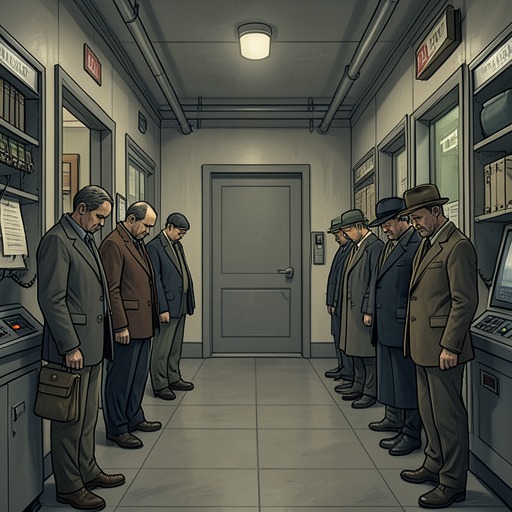
The passage begins by identifying the occasion as the passengers’ final night in Mima’s hall. That setting makes the end more than an abstract report of deaths: the lastness belongs to a particular shared place within the ship, and to a collective gathered there. Yet the poem supplies no personal conversations or separate accounts of who dies first. Its focus is the collapse of selfhood across the group, rendered as a succession in which one self after another breaks down and disappears.
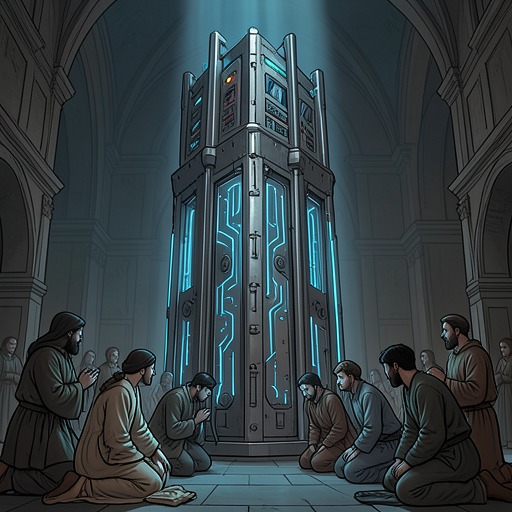
The sequence is gradual rather than instantaneous. The self has not wholly ceased to be when another element comes into view: the will of the soul rises more clearly. This qualification gives the ending an interval of transition. Individual selves are vanishing, but the poem’s language does not equate that disappearance with the immediate erasure of everything spiritual. What emerges is not a rescued personality or a return to ordinary life; it is a will associated with the soul, made clearer as the self recedes.
Self, Time, and Space
The passage associates that final emergence with the soul’s disentangling of time from space. The phrasing changes the scale of the event: the passengers’ ending is no longer described only as the loss of individual selves, but as a loosening of the ordinary dimensions through which existence is experienced. The poem does not explain this as a physical process or specify what the soul’s will accomplishes. Its force lies in the contrast it establishes: as personal identity fades, a larger and less individual condition becomes perceptible.
The image of the Doric race being lulled fast asleep follows this separation of time from space. Sleep softens the language of extinction without undoing its finality. The race is not shown waking or returning to the life it knew; the passage presents its sleep as part of the terminal movement. In this way, the poem holds together two registers that might otherwise seem opposed: the disappearance of the selves is stark, while the language of sleep and the soul’s will gives that disappearance a quiet, almost cosmic stillness.
Aniara as a Moving Tomb
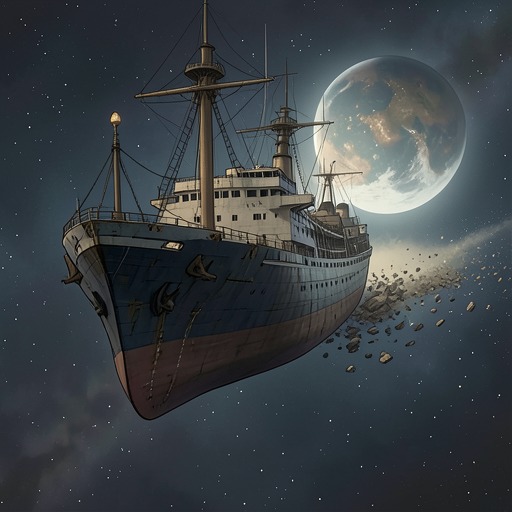
The poem then enlarges its timescale sharply. Aniara drives toward Lyra’s figure for fifteen thousand years, with undiminished speed. The ship’s continued motion is set against the passengers’ disappearance: the vessel persists, but not as a living community proceeding toward a renewed future. It is figured as a museum filled with things and bones, including desiccated plants from Dorisgrove. Human remains and remnants of former life have become the contents of a collection carried through space.
The passengers are also described as lying in an immense sarcophagus as the ship passes through empty seas. This image makes the ship’s movement a kind of burial without a resting place. Cosmic night remains separated from day, and a glass-clear silence surrounds the grave. The precise, almost transparent stillness of that image contrasts with the immense duration of the voyage: for fifteen thousand years the spacecraft continues at speed, yet the world around the dead is marked by silence rather than arrival or change. The passage gives no rescue, destination reached, or interruption to that journey.
Mima’s Grave and the Final Image
In the last vision, the dead are sprawled in rings around Mima’s grave. Their arrangement is collective, but it is not described as a reunion of recognizable personalities; they have fallen and changed to guiltless ashes. The image draws together bodily remains, the loss of individual identity, and the grave associated with Mima. The passengers’ final condition is thus represented through what is left of them and through their relation to the place of Mima’s burial, rather than through a last act or statement by any one person.
The ending’s final movement is inward and shared: the current of Nirvana ranges through them all. That image does not reverse their deaths or restore the selves that have disappeared. Instead, it offers the poem’s most encompassing account of what follows their extinction, extending the change from individual selves to a condition that passes through the group as a whole. The passage closes not with the ship stopping, but with the dead carried onward around Mima’s grave, through cosmic night and silence. Their finality and the vessel’s motion remain bound together: the passengers are gone, while Aniara continues as their sarcophagus.