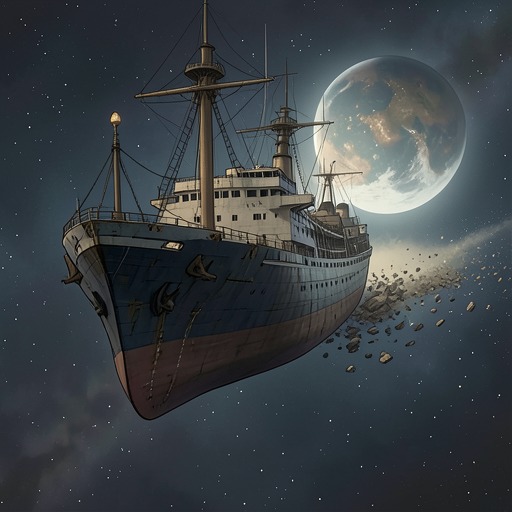
Aniara’s Irreversible Drift
AniaraAniara’s irreversible drift is the condition in which a navigational deviation becomes an exile without a practicable return. A swerve to clear the Hondo asteroid takes the ship off course; the passage through a region of space-stones and pebbles then damages the Saba Unit, and the opportunity to turn back disappears. Aniara continues with its nose-cone pointed toward Lyra, unable to change course. Its isolation is registered not only in its trajectory but in the severing of its ties to the Sun and the eventual failure of its call-sign.
The Deviation and Its Cause
The drift begins with an evasive manoeuvre rather than a chosen destination. Aniara swerves to clear the Hondo asteroid, which is proclaimed discovered in the account, and comes too wide of Mars, slipping from its orbit. The immediate act is one of avoidance; its consequence is a new course that carries the ship farther from the route it had been following. The episode makes the danger of the voyage concrete: a manoeuvre meant to clear one obstacle redirects the entire ship.
The altered trajectory brings Aniara into a passage at such dizzying angles that the Saba Unit breaks down. The unit is hit hard by space-stones and great swarms of space-pebbles. The account links the damage to the ship’s inability to reverse course: when the ring has moved off and space has cleared, turning back is no longer possible. The threat is therefore not simply the impact itself, but the conjunction of a damaged system and a lost opportunity. Once the immediate obstruction has passed, the route home is already beyond reach.
A Course That Cannot Be Changed
The ship’s new orientation gives the irreversible condition a precise, visible form: Aniara lies with its nose-cone pointed at Lyra. The account immediately qualifies that image with the operational fact that no change in course can be thought of. Lyra marks the direction in which the ship is headed, not a destination it can freely select or a route it can revise. The distinction between movement and agency is central to the predicament: Aniara continues through space, but its people can no longer determine where that movement will lead.
The damage is uneven. Some apparatus is damaged, while other, less-damaged parts can be mended. That remaining capacity for repair does not undo the decisive failure: the ship’s ill-fate is described as irretrievable. The contrast prevents a simple equation between damage and total mechanical collapse. Work may continue on what can still be repaired, yet repair does not restore the lost course or make return possible. Mima, meanwhile, is hoped to hold until the end. This hope concerns the endurance of the ship’s remaining support, not a reversal of its trajectory; the possibility of lasting longer is distinct from the possibility of getting home.
Separation and the Failed Call-Sign
The physical deviation becomes a wider severance when Aniara is cut off from the bonds and pledges of the Sun. The ship is described as given over to a void that stiffens it with shock. Against that separation, those aboard spread the call-sign Aniara through what the account presents as glass-clear boundlessness. The signal is an attempt to make the ship present across the emptiness around it, but nothing is picked up. Its clarity does not produce contact: the surrounding space remains legible to the image, yet offers no response.
The attempt does not end with the first silence. The call-sign is sent in anguish, and then it fades until it fails. That sequence gives the ship’s isolation a second, communicative dimension. Aniara has lost the ability to turn back, and its effort to announce itself beyond the ship yields no answer; finally, even the announcement cannot be sustained. The name that is spread wide in the void becomes a signal that disappears within it. The progression from transmission to silence makes the drift more than a navigational state: it is also a condition in which connection with the outside world cannot be established.
Narrative Significance
The episode establishes the difference between an accident that can be survived and a consequence that cannot be reversed. The asteroid is cleared, the ring moves away, some apparatus remains repairable, and Mima is expected to endure; none of these survivals restores the lost route. The irreversible turn is defined by what remains impossible after the immediate danger passes. This contrast lends the ship’s continued functioning a grave ambiguity: Aniara can persist, but persistence is no longer a promise of return.
The account also makes the change legible through a sequence of narrowing possibilities. First comes the swerve; then the Saba Unit’s breakdown amid space-stones and pebbles; then the explicit loss of any chance to turn back; then the fixed bearing toward Lyra and the severed connection to the Sun. Finally, the call-sign sent into space fades without having elicited a reply. Together these details establish Aniara’s irreversible drift as both a mechanical and existential condition: the ship remains in motion, while its former bonds, navigational choices, and means of reaching others fall away.