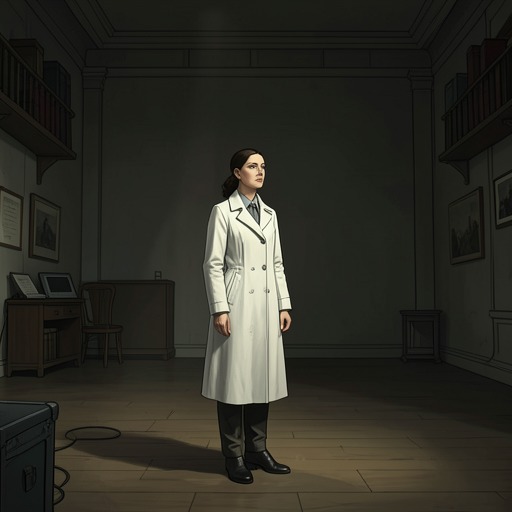
Isagel’s Mental Collapse and Disappearance
AniaraIsagel’s Mental Collapse and Disappearance is the point at which Isagel’s intellectual and moral endurance gives way under the accumulated violence of the voyage. After the Mimarobe’s efforts to steady her fail, she withdraws from the visible world into a primordial Mind, where the laws of existence may be remade. Her departure is both a personal loss and a revelation: in a later dream, the Mimarobe sees Isagel as the innermost self of Mima, joining two figures whose searches for connection have been directed toward the material world and its Things.
Endurance and Its Limit
For a time, the Mimarobe tries to contain grief through the language of resistance and calculation. He invokes asbestos and silicon, the even distribution of stress studied by statics, and the hard knowledge that sins must be atoned for. These images offer a temporary discipline: pain might be borne if it could be given structure, measured, or understood as part of a moral order. But they cannot protect Isagel from what the voyage has made her encounter.
Her mind had been steeled even to the prospect of a Chefone-like plan for mass extermination, with Aniara directed toward an unknown sun. Yet the Mimarobe describes a shard entering her soul: a fragment of everything the travellers had met in space, including their collision with the Leonid. The metaphor makes the breakdown cumulative rather than sudden in cause. The surrounding universe has lodged inside her, and her former strength cannot keep its violence at a distance. The account also says that she spared Aniara from that last resort; the possibility of the ship’s destruction remains part of the pressure under which her collapse occurs, not an action she carries out.
Collapse and Withdrawal
The narrative marks the change in Isagel through visible signs as well as inward injury. Her splendid mind breaks down; a fevered demon rises into her eyes, and her pupil dilates toward what the poem calls the wellspring of her soul. She has become self-accusatory, feeling like Death. These descriptions make her distress more than an abstract surrender: the body itself registers a mind altered by what it has endured.
The Mimarobe tries to win her soul to other thoughts, but she slips away unseen. Her departure is figured as a passage toward the realm of glory and the place where the Laws of Aleph Numbers are stored. There, infinite reserves can be opened when Chance approves, and Chance is named the world’s new overlord. The destination therefore stands beyond the settled laws the Mimarobe had relied on for comfort. It is not presented as a clearly mapped place within ordinary space, but as a primordial domain in which the conditions of a world can begin again.
Isagel’s weeping ends, though the poem immediately allows that there may be things worse. That qualification refuses to make her disappearance a simple consolation. She is preparing for another realm, but those left aboard have lost her company; the Mimarobe’s account gives no ordinary explanation or physical description that would make her return to the ship certain. Her state is suspended between death and renewal: she has reached death’s door, yet her new phantasmal existence awaits rebirth into form.
The Mimarobe’s Recognition
The Mimarobe’s understanding of Isagel’s departure develops through a dream in which she visits him once more. He experiences the visit as an illumination, and Isagel is revealed to him as Mima’s inmost self, Mima’s soul. This recognition links her disappearance to the earlier loss of Mima without making the two experiences identical: what the Mimarobe learns in the dream is a relation between them, a shared inwardness beneath their different forms of existence.
That relation rests on their common way of searching. Isagel’s search is directed toward spiritual light; Mima searches for signs of life that might relieve the passengers’ distress. Both join powers of thought—rooted in material processes, electrical in one case and biochemical in the other—to the effort to recover connection with material reality. The dream thus changes the meaning of Isagel’s withdrawal. She has not simply turned away from the world that injured her; the Mimarobe comes to understand her as bound to the same search that animated Mima.
Matter, Chance, and Renewal
The episode places Isagel’s fate within the poem’s account of matter as more than inert substance. In the world’s substance, the Mimarobe recognizes an active kindness that binds living beings to it; matter is suffused with spirit and is a home of worth. Against that belief, the ship’s isolation and the universe’s brutality threaten to make the material world seem indifferent. Isagel’s wound is evidence of that threat, while the Mimarobe’s dream offers a way to understand her continued relation to the world without denying her absence.
The final movement toward the primordial Mind also makes renewal conditional rather than assured. Isagel awaits rebirth into form, and the opening of infinite reserves depends on Chance. The laws that once seemed capable of ordering experience are not final; a new age may be inaugurated when the Things of the world go elsewhere, and Isagel and Mima will go with them. Her disappearance therefore holds grief and possibility together. It does not repair the damage of the voyage or restore Isagel to those aboard, but it places her beyond the universe’s measurable wastes, in a domain where new laws—and another form of life—remain possible.