Mima’s Breakdown and Death
AniaraMima’s Breakdown and Death is the destruction of Aniara’s vision-giving system and the loss of the presence through which its passengers could see a world beyond their drifting ship. The episode moves from a damaged, distressed Mima to a final burst of light and sound, then to the human casualties of the crowd’s panic. Its aftermath reaches beyond the moment of her death: Mimarobe later finds a mirror-world dying at her base, as if the capacity to show a world had not survived its maker.
Crisis and the Days of Distress
The crisis begins in the wake of Dorisburg’s destruction. Mima has been ill for days, suffering heavy static from the phototurb while her third webe struggles against what the narration figures as a cloud of distant, compact shame. On the third day, she begs for deliverance from her vision. The sequence makes her distress cumulative: the damaged perception is not a brief malfunction but a condition that persists across days and culminates in an explicit request for release.
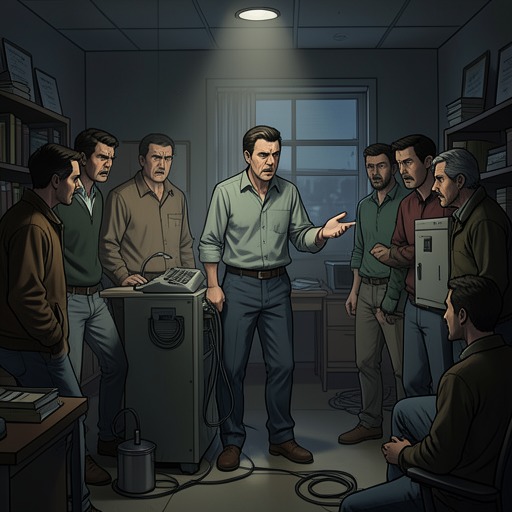
On the fourth day, Mima still offers Mimarobe practical advice about the scanner-transpodes used in her cantor-works. The contrast matters. Even amid illness, she remains able to address the technical work associated with her system; she is not presented only as an object in crisis. The account also mentions higher ultramodern tensor-theory, ordinarily used on working days, setting familiar work routines against an emergency that those routines cannot resolve.
Conscience, Perception, and the Plea for Peace
Mima asks Mimarobe to tell the High Command that, for some time, she has been as innocent in conscience as the stones. She has heard the stones cry when stone and ore were vaporized to mist, and she has been troubled by their suffering. This confession connects her distress to the violence of the world she perceives: the vision that makes her a guide to things also exposes her to the destruction inflicted upon them.
The narration then describes her as darkened in her cell-works by the cruelty human beings exhibit in their time of sin, and says that she has reached a long-expected phase. The third webe’s tacis see a thousand things no eyes see, a capacity that gives Mima’s perception unusual reach but also makes knowledge an ordeal. In the name of Things, she now wants peace and says she will be done with her displays. Her request turns the system’s defining function against itself: seeing is no longer an unqualified gift when what becomes visible includes suffering that she cannot relieve.
The Final Burst and Its Human Cost
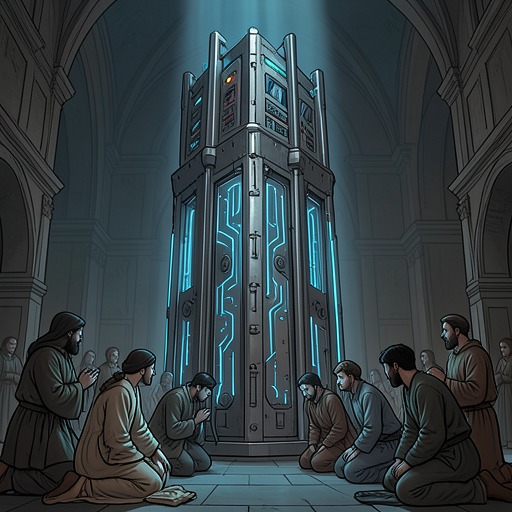
The emigrants are horrified and wish to flee the mimadrome, yet they move onward, eager to watch what will happen. The moment holds fear and attraction together: the crowd recognizes danger but continues toward the spectacle. A bolt-blue light flashes from Mima’s screens, and a rumbling rolls through her halls like thunder remembered from Doriswold. The sudden violence pitches terror into the mass of onlookers.
As the crowd surges in panic, many emigrants are stomped to death. Mima perishes deep in space aboard Aniara, and the final word she broadcasts is a message from someone calling himself the Detonee. The message’s sender is identified, but the passage does not explain the message’s contents or its relation to the collapse. That unresolved final transmission accompanies, rather than clarifies, the abrupt end of Mima’s presence. Her death is therefore both the loss of a system and a disaster among the people gathered to witness it.
Aftermath and Significance
Three years after seeing Mima burst apart in Aniara’s hall, Mimarobe has gained a grounding in seeing through things as through glass and probes the transtomizers for a law. The later search does not reverse the earlier loss. Instead, it establishes the interval between the spectacular destruction and the narrator’s continued attempt to understand what can be known after Mima is gone.
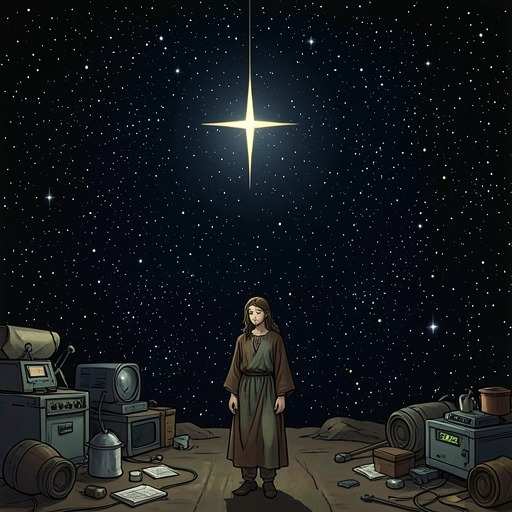
Mimarobe finds a mirror-world dying at Mima’s base and slumps beside her remains, looking into her breast and seeing a hearth grown cold. The image makes the aftermath intimate and material: what had been a source of vision is now a site of ruin, and the warmth associated with a hearth has vanished. The episode’s final contrast is between Mima’s former capacity to disclose a world and the failing mirror-world left behind. Her breakdown exposes the cost of perception; her death leaves Aniara’s passengers not only without their guide to unseen things, but amid the wreckage of the very means by which that world had been shown.