Mimarobe's Attempts to Restore Mima
AniaraMimarobe's Attempts to Restore Mima are a repeated effort to revive the ship’s broken source of comfort and wonder, and a measure of how completely that effort fails. Mimarobe first turns to Mima’s sacred machinery as if its functions might still be recovered; later, with Mima’s soul shattered and her circuitry dead, the search for a cure has become prayer. The movement from attempted repair to supplication makes the limit of Mimarobe’s power plain: the person who longs to restore Mima cannot heal her.
Purpose and Intended Restoration
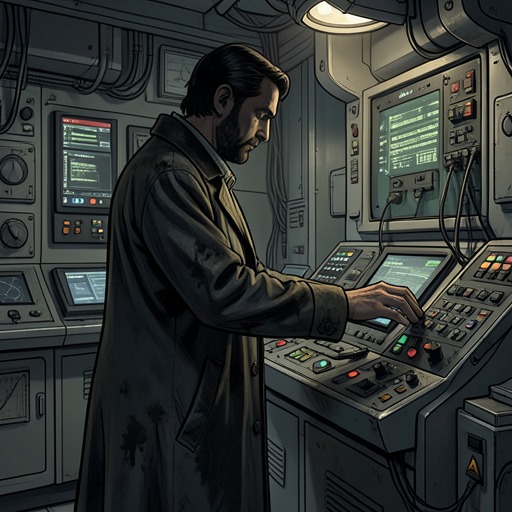
In the Mima hall, with evil sending dark rays from behind, Mimarobe frantically seeks to activate Mima’s comfort-works and art. The urgency is both practical and devotional. Mimarobe wants the systems working, but the effort is directed toward more than machinery: these works had offered consolation, and Mima’s heart is described as the hub of marvels. To restore the apparatus would mean trying to recover the presence and sustaining power associated with Mima, not merely restarting an ordinary device.
Mimarobe reaches for the tensorides to operate that hub. The scene gives the attempt a concrete procedure—find the controls, engage the instruments, make the central system work—while casting the hoped-for result in sacred terms. That contrast is essential to the action. The equipment can be approached and operated, but what Mimarobe hopes to bring back is a living, comforting presence. The technical intervention therefore carries a human and spiritual burden that its mechanism cannot meet.
Signs of Failure
The first signs that the effort is failing come from Mima’s communications. The voice within the phonoglobe is still, and the few calls the sensostat can detect come from a Boeotian shade, described as imbecile. These are not signs of a recovering intelligence: the principal voice is absent, while the scarce signals offer no adequate substitute. The apparatus may still register something, but its capacity to return Mima as a responsive presence has collapsed.
That silence gives the attempted activation its painful measure. Mimarobe’s frantic effort meets not a clear malfunction that can be corrected, but an absence at the heart of the system. The contrast between the elaborate instruments and the still phonoglobe prevents technical activity from becoming reassurance. Mimarobe can seek a signal and try to operate the hub; neither action produces a meaningful answer from Mima.
The Cure and the Limits of Agency
Later, Mimarobe states that finding a cure matters more than the trampling of the self witnessed aboard the spacecraft. The desired cure is specified as an effort to rouse Mima’s broken breath and refashion her celestial tissue. The language retains the hope of repair, but its terms make the scale of the damage difficult to ignore: breath and tissue suggest a being to be restored, while the celestial description sets Mima beyond ordinary treatment. Mimarobe’s objective remains restoration, even as the object of that hope becomes increasingly irrecoverable.
The surrounding hostility makes this undertaking more precarious. Mimarobe says that blankness has been turned upon them, that they are driven into the spacecraft’s worst recesses, and that death threats are made if they do not comply at once. The passage does not complete the threatened demand, but it does show that Mimarobe’s concern for a cure unfolds amid coercion rather than in a protected place of study. The attempt to help Mima is thus set against pressure that further limits the narrator’s freedom to act.
The decisive recognition comes through the comparison of Mima’s soul to Humpty Dumpty, fallen and shattered against time’s waves. Nobody can heal Humpty Dumpty, Mimarobe says, and Mimarobe is still less the person who can heal Mima. This is not a change in the object of the effort but a collapse in the belief that effort can succeed. The earlier language of activating, operating, rousing, and refashioning gives way to the admission that the damage cannot be undone by Mimarobe.
Prayer at Mima’s Grave
The last attempt takes place at Mima’s grave. Mimarobe lies sprawled there in prayer, without certainty about which divinity is being addressed, and begs for a miracle from the dead circuitry. The gesture brings together the two forms of hope that have accompanied the restoration effort: technical intervention and sacred appeal. The machinery is dead, yet Mimarobe still addresses it as the possible source of a response.
No outward sign appears. Mimarobe nevertheless hears the circuitry utter something in silence; the passage breaks off before the utterance is disclosed. The ending grants neither a confirmed recovery nor an explanation of what was heard. Its force lies in that unresolved instant: even after acknowledging that Mima cannot be healed, Mimarobe remains at the grave, praying toward the silent mechanism. The effort to restore Mima therefore ends not in a repair, but in a final act of hope whose answer the text withholds.