
Animal Farm
A Fairy Story That Tells the Truth
Animal Farm is a political allegory and dystopian novella by George Orwell, published in London on 17 August 1945 by Secker and Warburg. Its original title, Animal Farm: A Fairy Story, emphasizes the fable-like form, but the subject is unmistakably real. Orwell wrote the book as a reflection of the Russian Revolution of 1917 and its degeneration under Stalin. A democratic socialist who was fiercely anti-totalitarian, he wanted to show how revolutionary ideals could be hijacked by a new ruling group, turning liberation into tyranny. The book is short, direct and often grimly funny, and it has become one of the most widely read political fables in the world.
Plot Outline
The story begins on Manor Farm in England. Old Major, an ageing prize boar, gathers the animals and preaches a doctrine of rebellion: man is the only creature that consumes without producing, and once man is removed, the animals can run the farm for themselves. When Old Major dies, the pigs develop its ideas into a system called Animalism. Led by two rival pigs, Snowball and Napoleon, the animals chase away the neglectful farmer, Mr Jones. They rename the farm Animal Farm, establish a set of commandments called the Seven Commandments, and adopt the founding principle that all animals are equal. For a time, the experiment seems to work. The animals work hard, harvest the fields and look forward to a better life. But the pigs, being the cleverest, gradually create privileges for themselves and take control of policy. A power struggle follows: Napoleon, with his trained dog pack, drives Snowball off the farm and rewrites history so that Snowball becomes the scapegoat for every failure. Napoleon becomes an absolute dictator. The Seven Commandments are quietly altered: permission to sleep in a bed, to trade with humans and to wear human clothes appears under revised wording. The loyal draft horse Boxer, who believes that it will be "work harder" and "Napoleon is always right," is sold to the knacker's yard when he collapses. Finally, the pigs begin to walk on their hind legs and entertain human farmers. The farm's name reverts to Manor Farm, and the animals outside the window cannot tell pigs from men.
Themes
At its heart, Animal Farm is about the corruption of power. Orwell does not condemn the animals' desire for freedom; he condemns what their leaders make of it. The most famous line—"All animals are equal, but some are more equal than others"—captures how revolutionary language can be hollowed out by hypocrisy. The novella also explores the rewriting of history, the manipulation of memory, the use of fear and intimidation, and the willingness of ordinary people to accept lies when truth becomes inconvenient. Each animal stands for a kind of human response: Boxer for blind loyalty, Benjamin the donkey for cynical detachment, the sheep for unthinking repetition of slogans. Together they form a warning about how easily a society can slide from uprising into dictatorship.
Background and Legacy
Orwell's experience in the Spanish Civil War in 1936–1937 was fundamental. He saw anti-fascist forces divided by Stalinist purges and understood plainly how authoritarianism could disguise itself as revolution. During the Second World War, however, the Soviet Union was Britain's ally, and publishers regarded a satire on Stalin as politically impossible. The book was rejected by several London publishers and did not appear until after the war, when Cold War tensions changed the mood. Since then it has never been out of print. It was included in Modern Library's 100 Best Novels and on NPR's list of the 100 Best Science Fiction and Fantasy Books, and it has received both Hugo and Prometheus recognitions. For generations of readers, Animal Farm has remained a clear and chilling story about power, language and the betrayal of ideals.
About the Author
From Eric Blair to George Orwell
George Orwell was the pen name of Eric Arthur Blair, one of the most influential English writers of the twentieth century. He was born on 25 June 1903 in Motihari, Bengal, in British India, where his father, Richard Walmesley Blair, worked as an Opium Agent in the Indian Civil Service. The family belonged to the class of middle-ranking colonial administrators, and Orwell was sent home to England for his education. He won a scholarship to Eton College, where he received a classical English education. Instead of going on to university, he joined the Indian Imperial Police and served in Burma in the early 1920s. The job made him an instrument of imperial authority, and the experience left him with a permanent hatred of imperialism. It also gave him material for his later novel Burmese Days and for the celebrated essay 'Shooting an Elephant,' in which he described being caught between the demands of the British Empire and the silent judgement of the colonized crowd.
Poverty, Journalism and War
After resigning from the police, Orwell moved to Europe and deliberately lived among the poor. He worked as a dishwasher in Paris and as a tramp in London, experiences he turned into his first book, Down and Out in Paris and London. Through the 1930s he wrote novels and documentary journalism, supporting himself as a reviewer and essayist. In 1936 he was commissioned to investigate industrial poverty in the north of England; the result was The Road to Wigan Pier, which openly discussed class and socialism. Later that year he travelled to Spain to fight in the Spanish Civil War. He joined a militia of the Republican side and served on the Aragon front, where he was seriously wounded. The war also exposed him to a deeply troubling political reality: Soviet-aligned communists were imprisoning and killing other leftists who refused to obey them. That experience destroyed his remaining faith in Soviet communism and shaped nearly all of his later writing, especially Homage to Catalonia and, later, Animal Farm.
Major Works and Lasting Reputation
During the Second World War, Orwell worked for the BBC and for left-wing publications, while struggling against poor health. His tuberculosis had been diagnosed in the late 1930s and repeatedly returned. Animal Farm, published in 1945, was his first major success. It made him famous as a political satirist and remains a standard school text. His last novel, Nineteen Eighty-Four, appeared in 1949 and created an unforgettable picture of a totalitarian future ruled by Big Brother, Newspeak and perpetual surveillance. Orwell died of tuberculosis in London on 21 January 1950, aged forty-six, and was buried at All Saints' Church in Sutton Courtenay, Oxfordshire.
Although he is often remembered as a dystopian prophet, Orwell was equally distinguished as an essayist and journalist, with an unrivalled gift for writing plain, lucid prose in the service of moral seriousness. He called himself a democratic socialist and devoted his career to opposing totalitarianism in every form. The word 'Orwellian' is now part of the English language, used to describe deceptive language, mass surveillance and the rewriting of history. More than seventy years after his death, his name continues to stand for intellectual courage and the defence of truth.
StoryFlow
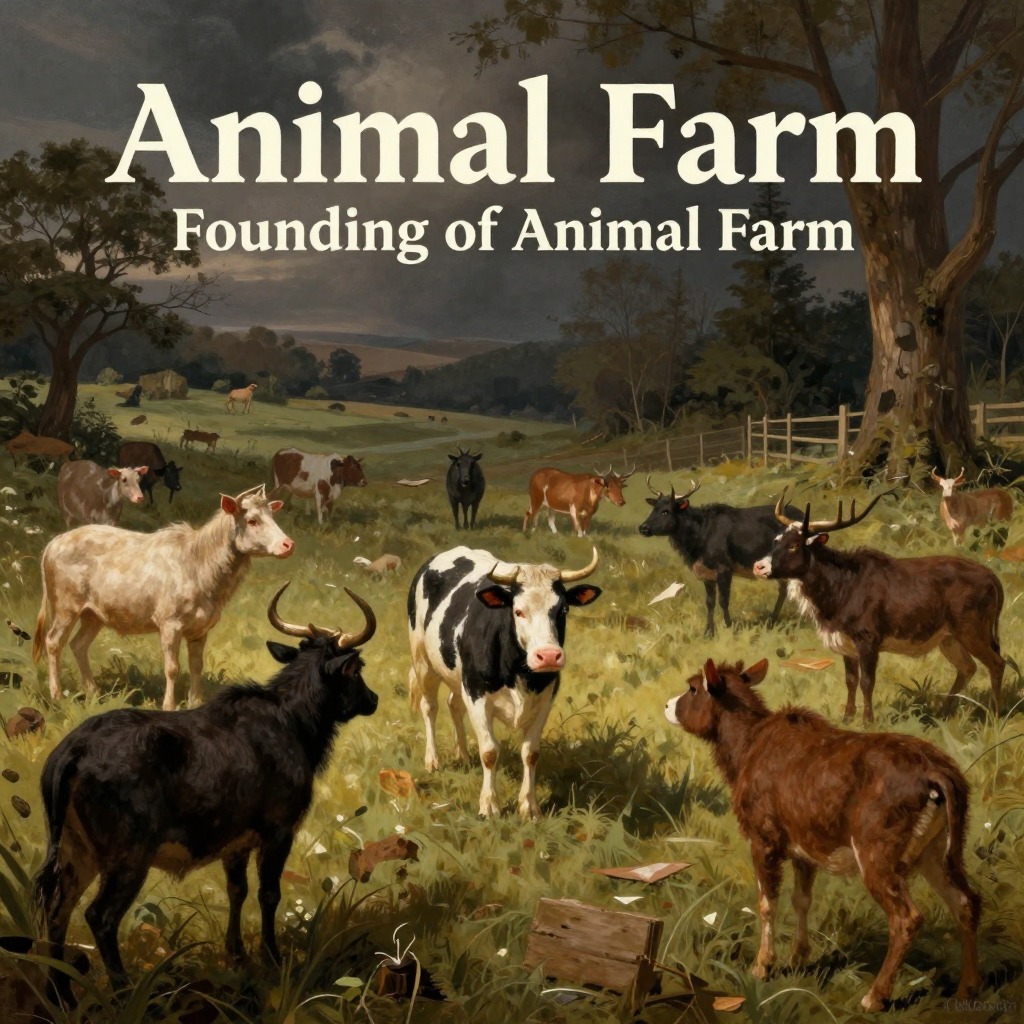
The Rebellion and Founding of Animal Farm
Traces the initial uprising against Mr. Jones, the establishment of Animalism, and the early achievements of the animals.
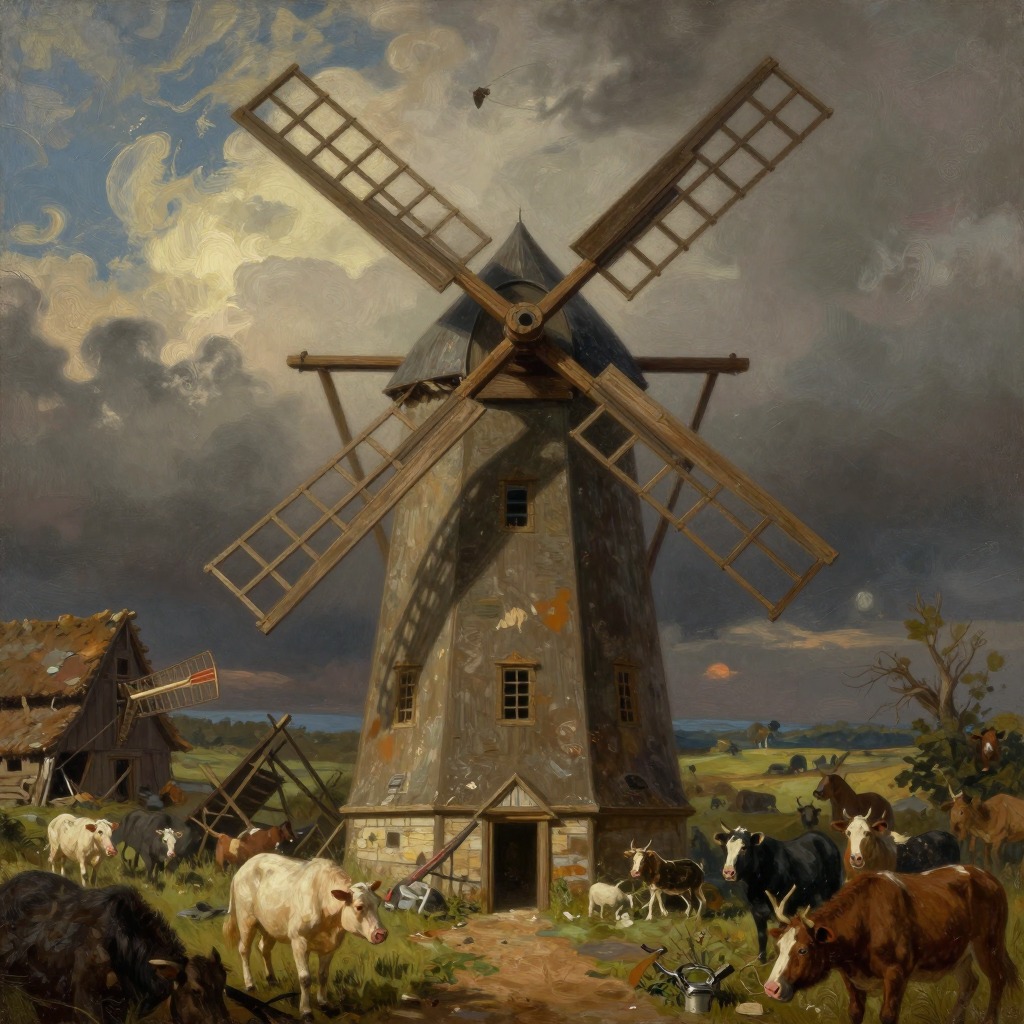
The Windmill Project: A Symbol of Hope and Exploitation
Follows the windmill from conception through destruction and rebuilding, revealing how it becomes a tool of manipulation.
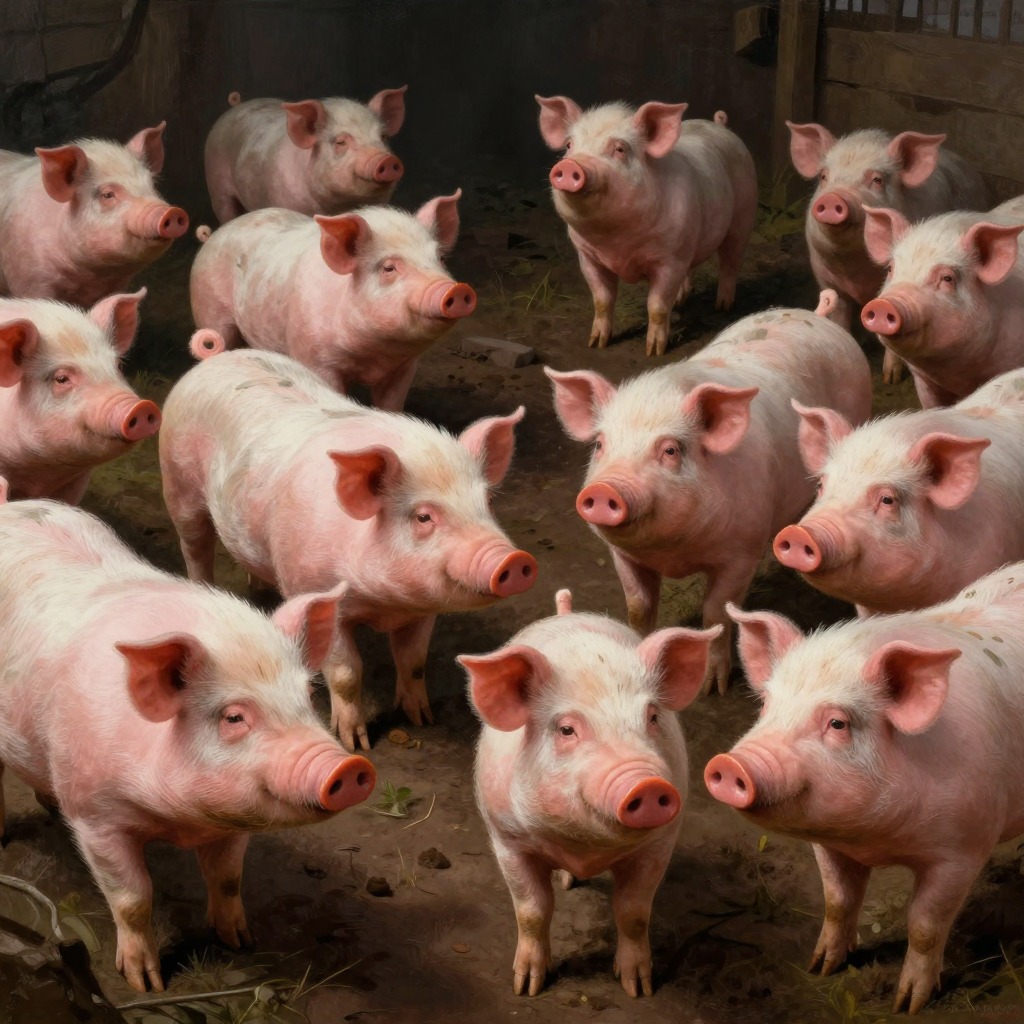
The Pigs' Gradual Seizure of Privileges
Chronicles the incremental steps by which the pigs claim special rights, culminating in absolute tyranny.
