Jim
AnimalsJim is Laura’s fiancé, a pianist, and the partner with whom she tries to imagine a shared future. His steadiness and self-possession attract her, but the couple’s different needs, his decision to stop drinking, and the instability of their engagement steadily complicate that future. Their relationship ends not with a clean resolution but with a final meeting in which alcohol briefly accompanies the possibility of reconciliation, only for Laura to answer that she loves him sometimes.
Identity and Introduction
Jim first enters Laura’s life as a man who makes an immediate impression. When they meet, he introduces himself with a handshake that Laura remembers in unusually close detail. She is attracted to him and senses a gentleness in him, while his appearance and manner suggest to her a person who is composed and self-contained. Her response is not simply admiration from a distance: she imagines a profound intimacy with him almost at once, and later recalls that holding his hand repeatedly brought back a sense of beauty associated with Yeats.
That impression of inward certainty becomes one of the foundations of Laura’s attachment. She regards Jim as someone who knows who he is, in contrast to her own feeling of being unsettled. She values the reassurance of his separateness and solidity, even as the relationship later shows how difficult it can be for two people to remain close while needing different things. The attraction is therefore tied from the outset to both comfort and imbalance: Jim seems to offer a stable point of reference, while Laura is conscious of her own uncertainty.
A Shared Future and Different Needs
By the time Laura calls Jim her fiancé, the word itself makes both of them uncomfortable. Their engagement nevertheless represents a real change in the relationship: marriage, which Laura had previously treated as an abstract possibility, has begun to take a material and demanding shape. She experiences it as something large and costly that has suddenly arrived in the room, rather than as a simple confirmation of feelings she already understands. Her unease does not cancel her love for Jim, but it makes clear that commitment is becoming a practical question as well as a romantic one.
Jim is away in New York City performing a piano recital on a barge in Brooklyn when Laura and Tyler are out in Manchester. The night before, he had warned Laura to be careful. He understands that nights out can gather momentum for her and Tyler, who encourage one another. Laura is drinking outside a bar on Oxford Road while Tyler, inside, transfers a dealer’s number from her failing phone onto her arm. Laura recalls the warning against the aftermath of nights like this, including a recent visit with Tyler to a man in Stretford who had invited them for a friendly drink but had very little gin. The episode establishes that Jim knows the pattern Laura and Tyler can fall into, while being physically absent when it unfolds.
A decisive difference emerges when Jim tells Laura he has decided to give up drinking. He explains that alcohol no longer fits with his work or with what he wants for their future. Laura initially misunderstands the gravity of the announcement, briefly fearing that he may be withdrawing from marriage; she is startled when she discovers that the decision concerns drinking instead. His choice marks a divergence in how the couple approaches the life ahead of them. For Jim, sobriety is a considered adjustment to work and future plans. For Laura, it changes the conditions of a relationship in which drinking has been part of her own recurring life, and it raises the question of whether they can stay on equal terms.
Partnership, Age, and the Future
Jim gives voice to the strain between them by wondering how they will remain on a level in the limited time they have together. He presents the concern as an effort to be realistic about both their needs, not as a sudden rejection of Laura. Even so, she cannot answer him. The exchange turns the future from a shared assumption into a source of paralysis: Laura feels caught between a past that is difficult to accept and a future that feels threatening.
The couple’s plans also sit within a wider pressure around marriage and parenthood. In a conversation with Tyler about the so-called Baby Club, Laura asks whether Tyler is worried about getting too old to have a baby. Tyler emphatically says she is twenty-nine; Laura points out that she will be thirty in two weeks. Tyler insists that she has at least fifteen years before she needs to panic and resists treating parenthood as an exclusive invitation into a club. Her reply frames the choice as something she might do on her own terms, while admitting that longing would remain part of her life. Elsewhere, Jacqueline describes wanting another baby before thirty-five and worries about a biological window. These conversations place Jim and Laura’s engagement among competing expectations about timing, children, and adulthood, without establishing that the couple has reached an agreement on parenthood.
Jim and Laura’s intimacy is conveyed not only through explicit discussions but through small acts of attention. At his Stockholm concert, Laura resists the urge to buy a drink before he performs. When Jim comes onstage, he looks for her; she gives a small wave, and he holds her gaze for a few seconds. Laura watches him play and recognizes both his skill and the parts of him she does not fully understand. Seeing him at work renews her admiration, but it also sharpens her desire to observe him without his awareness, as though love might disclose itself most clearly when he is alone. After the concert she waits by the dressing-room door with two orange juices. The scene holds together care, distance, and attraction: she knows him intimately, yet still experiences him as partly unknowable.
Separation and Final Meeting
After the relationship breaks down, Jim remains present in Laura’s thoughts through repeated nightmares and the sense that returning to Tyler would mean moving along a familiar track. Laura sits at her family’s dining table, longs for a drink to quiet her thoughts, and then answers Jim’s call outside. He tells her that her parents are distressed and that money and arrangements are on hold; he recognizes that she has every right to ignore him but points out that more than a week has passed. Laura cannot find an answer. The call makes the practical consequences of the separation audible alongside its emotional distance.
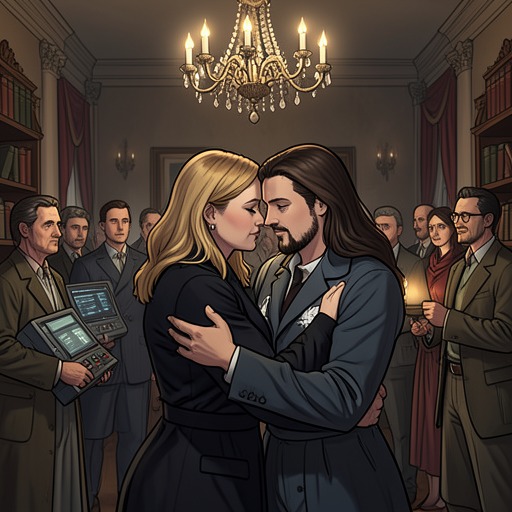
They meet later in a small pub. Jim is seated in a back corner with two glasses of white wine, and neither rises to greet the other; they do not kiss or shake hands. His return to drinking is important because he had earlier made sobriety a decision tied to his work and their future. Laura acknowledges that it is good to see him drink, even as the meeting leaves her unsure what she can say to a person with whom she had been making plans. When she asks how the wine is going down, Jim calls it disgusting but takes another drink. Laura senses a possibility of renewal, though the feeling is tentative and entangled with anger and hurt.
At first, the conversation circles around his parents and the fuss caused by the separation. Laura asks whether he will apologize to them for her. The question briefly exposes her pity for herself and the tenderness she still feels, interrupting any simple satisfaction she might have taken in his pain. She then makes the subject explicit by asking how he feels about their relationship. She describes the dream of their life together as what had enchanted her, a thought Jim does not understand. He asks directly whether she loves him. Laura puts down her glass and answers that she does, sometimes. The qualification refuses both a clean restoration and a denial of their history.
Narrative Role and Significance
Jim’s role in Laura’s story depends on the distance between what he represents to her and what their relationship can sustain. At first, his composure offers an appealing counterweight to her sense of being a mess; the engagement seems to give their love a definite shape. Yet Jim’s concern about staying on a level, and Laura’s inability to respond, reveal that commitment cannot by itself settle their differences. Marriage appears not as a guaranteed destination but as a heavy, newly concrete possibility that both attraction and anxiety surround.
His sobriety decision and later drinking also create a telling contrast. The first is attached to work and a hoped-for future; the second occurs during a meeting after the separation, where familiar feeling momentarily returns without repairing what has happened. Jim’s question about love seeks a decisive answer, but Laura’s sometimes preserves the mixed truth of the encounter. The novel presents him as neither merely the stable partner Laura once imagined nor simply an obstacle to her independence. He remains someone she has loved and planned with, while the final meeting shows that affection and the prospect of resuming a relationship are not the same thing.