Mei Misaki–Kirika Misaki relationship
AnotherThe Mei Misaki–Kirika Misaki relationship is formally an adoptive mother–daughter relationship, but its emotional structure is more complicated: Mei was raised by Kirika as her only daughter after being transferred from the Fujioka family to the Misaki family, while Kirika treated her as a substitute for a stillborn child. The relationship therefore joins genuine care to a wound that Mei cannot entirely separate from her own identity. Kirika makes Mei’s special artificial eye and raises her with devotion, yet Mei comes to feel that she is one of Kirika’s dolls rather than the irreducible child her mother was meant to have.
Adoption and Concealed Origins
Mei was born as one of the twins in the Fujioka family. A year after Mitsuyo Fujioka’s pregnancy, Yukiyo Amane became pregnant, but the birth ended in a stillbirth and left her unable to have more children. One of the Fujioka twins was consequently sent to the Misaki family as a foster daughter. Mei changed from Mei Fujioka to Mei Misaki at about two years old, although she has no memory explaining why she, rather than Misaki Fujioka, was chosen. She speculates that the decision may have been made for the awkwardness of a child named Misaki Misaki, but this remains her own attempt to supply a reason for an act decided before she could understand it.
Kirika raised Mei from before she could remember as her only daughter, without telling her that she had been adopted. Mei therefore grew up believing that Mitsuyo was her aunt and Misaki Fujioka was her cousin, despite their identical birthdays and close resemblance. The family resemblance was explained to her through the fact that their mothers were twins, allowing the concealed adoption to remain embedded in an apparently ordinary family story. Mei learned the truth in the fifth year of elementary school, when Grandma Amane accidentally revealed it and then explained what had happened. Kirika reacted violently to the disclosure, suggesting that she would have kept Mei’s origins hidden for life if she had been able to do so.
Care, Substitution, and the Doll Motif
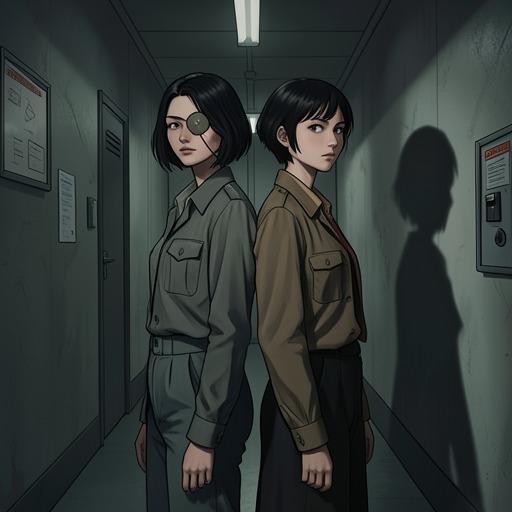
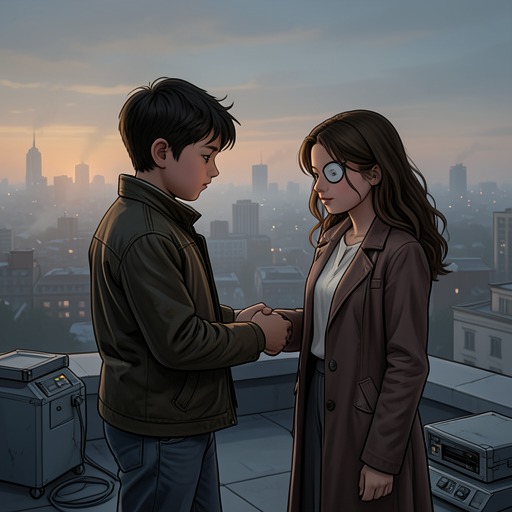
Mei does not describe Kirika’s care as simple cruelty or indifference. She believes that Kirika and her husband cherished her intensely, perhaps more than most parents cherish a child, precisely because Mei served as a substitute for the child Kirika had lost. Mei remains grateful for that care. When she was four, a malignant tumor formed in her left eyeball and the eye had to be surgically removed. After ordinary artificial eyes failed to satisfy Kirika aesthetically, Kirika made a special artificial eye for her daughter: Mei’s distinctive doll’s eye.
The eye is consequently both an intimate object of protection and a material sign of the relationship’s instability. Kirika uses her artistic skill to give Mei an eye that is uniquely hers, but the eye also links Mei to the dolls that fill Kirika’s workshop. When Mei later sees a doll in Kirika’s coffin, she explains that the doll was modeled partly on her, yet Kirika made it while thinking of the child she had been unable to bring into the world. Mei says that she is only half of the doll, perhaps even less, because its deepest imaginative source is Kirika’s lost child rather than Mei herself. The doll motif turns maternal creation into an ambiguous act: Kirika gives Mei form and care, but Mei fears that she has been made to occupy someone else’s absence.
Mei’s Reinterpretation of Kirika
Once Mei understands that she was adopted as a replacement, her account of Kirika changes without erasing the years of care between them. Before the revelation, Kirika was simply her mother. Afterward, Mei can regard her only as the mother who raised her, not as her actual mother. This distinction is not presented as a denial of affection; it is the consequence of discovering that the family role she had inhabited was founded on a hidden substitution.
Mei also interprets Kirika’s continued doll-making through the same history of loss. She believes that Kirika’s withdrawal into her workshop and her persistent creation of dolls express the heartbreak she still carries for the stillborn child. In this reading, Kirika’s artistic labor is neither merely a profession nor a harmless eccentricity. It is a repeated attempt to create, preserve, or approach the child who never lived, while Mei remains physically present as the replacement through whom that absence has been given a human life.
Distance, Recognition, and Illness
The relationship is marked by an unusual mixture of domestic familiarity and emotional distance. When Mei is asked whether Kirika makes her lunches, she answers that Kirika does so only when she feels like it, without complaint or self-pity. The smallness of the exchange is significant: Mei does not dramatize neglect, but neither does she present maternal care as consistently warm or dependable. Her calmness reflects the broader way she speaks about Kirika, stating painful facts with very little outward agitation.
After learning the truth, Mei wanted to see Mitsuyo Fujioka and her father. That wish indicates that the concealed adoption did not remain a purely historical fact; it redirected Mei’s emotional orientation toward her birth family and made Kirika’s position newly difficult to name. The bond with Kirika survives as the relationship that formed Mei’s life, but it is no longer identical with biological motherhood in Mei’s understanding.
Narrative Significance
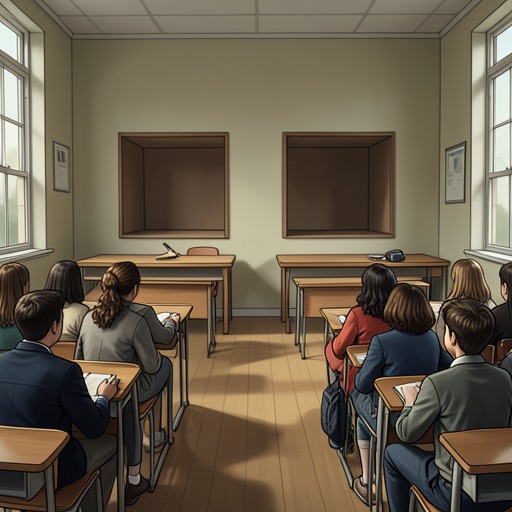
The relationship gives personal form to the story’s recurring concern with people who are present yet treated as absent, or present only in place of someone else. Mei is socially designated as “not there” at school, while within her family she has been made present through another absence: she is the living child installed where Kirika’s stillborn child should have been. These two structures of substitution mirror one another without being identical. The school’s exclusion denies Mei her presence; Kirika’s motherhood grants her a place, but that place is burdened by the identity of a replacement.
This tension also clarifies why Mei’s self-description as one of Kirika’s dolls is so powerful. A doll can be carefully made, treasured, and given a special eye, yet it remains an object shaped by another person’s desire and memory. Mei’s account resists reducing her to that object. She acknowledges Kirika’s sacrifice, the special eye, and the love she received, while insisting that a replacement is still a replacement and that being alive does not make her the lost child Kirika imagined. The relationship thus becomes a central inquiry into whether care can be fully separated from the grief that produced it, and whether a person can claim an identity not determined by the absence she was brought in to fill.