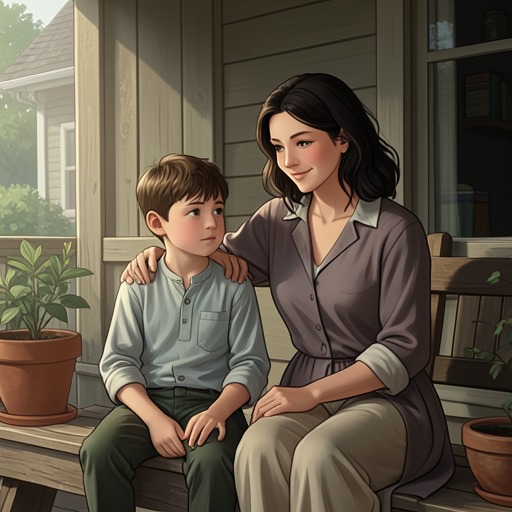
Ritsuko Sakakibara–Reiko Mikami relationship
AnotherThe Ritsuko Sakakibara–Reiko Mikami relationship is the hidden familial structure linking Koichi Sakakibara’s home life with the supernatural history of Third-Year Class 3. Ritsuko Sakakibara and Reiko Mikami are sisters, but the relationship is obscured by the fifteen-year gap separating Ritsuko Sakakibara’s death from the present, by Reiko Mikami’s death two years earlier, and by the memory distortions associated with the Yomiyama phenomenon. Its decisive significance lies in the way a private family tragedy becomes inseparable from the class’s public effort to identify the casualty and contain the disasters.
Family Bond and Concealed History
Ritsuko Sakakibara and Reiko Mikami belong to the same family, and their connection makes Reiko Mikami both Koichi Sakakibara’s aunt and one of the adults closest to the history of Third-Year Class 3. Reiko Mikami knows the class’s circumstances, yet she cannot give Koichi Sakakibara a complete account of what happened fifteen years earlier. When he asks whether the death of his mother, Ritsuko Sakakibara, after giving birth to him was one of that year’s disasters, Reiko Mikami does not confirm or deny it. Instead, she apologizes repeatedly, revealing emotional involvement without supplying a stable explanation.
The family’s knowledge is also fractured across generations. Koichi Sakakibara thinks that his grandmother probably does not know the truth, or that any memory she once possessed would have become hazy. His grandfather’s grief nevertheless joins the two sisters together in a single lament: he mourns Ritsuko Sakakibara and Reiko Mikami both. The words initially seem to refer to two losses in the same emotional register, but their meaning is delayed until Koichi Sakakibara reconstructs the chronology behind them.
Death, Memory, and Delayed Recognition
Reiko Mikami eventually says that she honestly does not know what happened to Ritsuko Sakakibara, although she feels that the disasters stopped partway through that year. Her uncertainty is not simple ignorance. Throughout the story, records and memories can be tampered with while the casualty remains hidden, making otherwise impossible details appear ordinary and preventing people from recognizing the true identity of the extra person. Reiko Mikami’s incomplete recollection therefore belongs to the same unstable world that has altered the class’s collective understanding.
The relationship becomes intelligible through a belated act of interpretation. Koichi Sakakibara remembers his grandfather’s statement that both Ritsuko Sakakibara and Reiko Mikami were to be pitied, then understands that the older man’s senility has mingled two different griefs. He had outlived his oldest daughter, Ritsuko Sakakibara, fifteen years earlier, and his second daughter, Reiko Mikami, two years earlier. The past and the more recent death have collapsed into one utterance, so that family mourning reproduces the same temporal confusion that governs the class’s supernatural history.
Reiko Mikami’s Double Position
Reiko Mikami’s relationship to Ritsuko Sakakibara also determines how she behaves toward Koichi Sakakibara. At school, she is Ms. Mikami, a teacher connected to the class; at home, she is Reiko, his aunt. The Fourth of the North Yomi fundamentals requires Koichi Sakakibara to address her as Ms. Mikami at school and to treat her as a separate person from his aunt. Reiko Mikami follows the same discipline: she does not call him Koichi at school and instead treats him as Sakakibara, the transfer student.
This separation is especially painful because the two share a household after school. Their reserve is therefore not evidence of emotional distance but the performance of a rule designed to protect the class. When the class decides to treat both Mei Misaki and Koichi Sakakibara as if they were not there, Mr. Kubodera already knows the truth and describes Ms. Mikami as being in a difficult position. Her difficulty is precisely that she must ignore her nephew at school as though he were absent, even while remaining his aunt at home.
The Family Within the Class Disaster
The sisters’ deaths place the family inside the recurring structure of the Yomiyama phenomenon. Reiko Mikami’s apparent participation in ordinary school life is later reinterpreted against the fact of her death, while Ritsuko Sakakibara’s death remains entangled with the year in which the disasters may have ceased. The family does not stand outside the class’s rules: it is one of the places where those rules become most intimate and destructive.
The class’s countermeasures depend on social exclusion. Those without a direct link to Third-Year Class 3, such as Mr. Chibiki, can interact safely with Mei Misaki and Koichi Sakakibara, while the students attempt to create a second person who is not there. When that attempt has no effect, the class gradually stops ignoring Mei Misaki and Koichi Sakakibara, and their behavior changes after Mr. Kubodera’s death. Against this shifting collective practice, Reiko Mikami’s familial connection makes ordinary recognition dangerous or impossible. The sisters’ relationship thus exposes the cost of converting human relationships into tactical categories.
Narrative Significance
The Ritsuko Sakakibara–Reiko Mikami relationship is revealed not through a straightforward family explanation but through recurrence: an apology, a grandfather’s broken lament, a delayed reconstruction of dates, and the discovery that school identities have been artificially separated from domestic ones. Its narrative force comes from the gradual conversion of apparently disconnected details into one family history.
The relationship also gives the story’s treatment of memory a concrete emotional form. The Yomiyama phenomenon distorts records and collective recollection, but the damage is not merely administrative. It reaches into mourning, making one death resemble another and turning the names of two sisters into a compressed expression of grief. By the time Koichi Sakakibara understands what his grandfather meant, recognition does not restore the past; it reveals how thoroughly the family has been living inside its unresolved consequences.