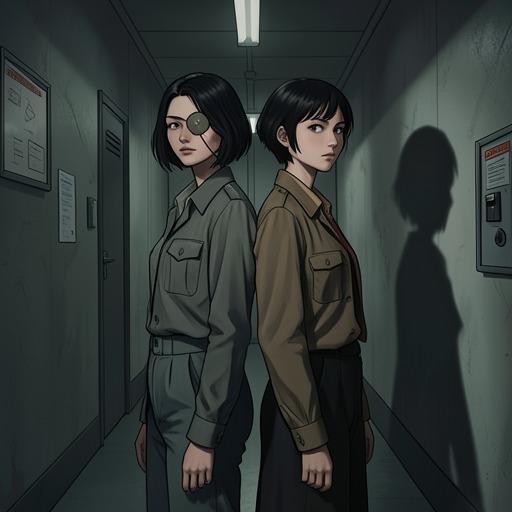
Mei Misaki–Misaki Fujioka relationship
AnotherThe Mei Misaki–Misaki Fujioka relationship begins as an apparently ordinary cousinship but is ultimately revealed as a hidden sisterhood. Mei Misaki and Misaki Fujioka were born as fraternal twin daughters of Mitsuyo Fujioka, yet one twin was sent to the Misaki household and became Mei Misaki. Their bond therefore joins biological closeness with separation, secrecy, unequal upbringing, and the grief of a death that arrived just as Misaki Fujioka seemed to be recovering.
Family Origin and Hidden Identity
Mei Misaki explains that Misaki Fujioka and she were cousins of the same age, but that they had not begun their lives in that relationship. Their mothers, Mitsuyo Fujioka and Yukiyo Misaki, were fraternal twin sisters who looked remarkably alike and had been raised in the same environment. Mitsuyo married first, to Mr. Fujioka, while Yukiyo later married Kotaro Misaki. Mitsuyo was the first of the sisters to have children, and she gave birth to two girls: Misaki Fujioka and another fraternal twin who also closely resembled her.
The two households faced different pressures. The Fujioka family had financial concerns about raising twins, while Yukiyo Misaki had fallen into profound despair and needed support. A private arrangement answered both needs: one of Mitsuyo’s twin daughters was sent to the Misaki household as a foster daughter. That child was Mei Misaki, who changed her name from Mei Fujioka to Mei Misaki at about two years old. She retained no memory explaining why she, rather than Misaki Fujioka, had been chosen.
This arrangement transformed a biological sisterhood into the public appearance of cousinship. Misaki Fujioka grew up with her biological parents, while Mei Misaki was raised by her aunt and uncle and understood herself through an identity that had been assigned across households. The relationship consequently carries a persistent split between what the family knows, what the girls later discover, and what Mei herself can remember.
Recognition and Secret Meetings
After moving into middle school and becoming involved in more activities, Mei Misaki and Misaki Fujioka sometimes met secretly. Misaki Fujioka eventually learned that the two girls were originally sisters as well as cousins. Their shared knowledge created what Mei described as an unbreakable connection, grounded in the fact that they had occupied the same mother’s body as twins. Yet the bond was not presented as uncomplicated comfort. Mei felt the unsettling force of encountering an apparent other self, while Misaki had grown up with her real mother and father and Mei had been transferred to another family and had lost an eye as a young child.
The contrast between their lives complicated their resemblance. They were alike in origin and appearance, but not in experience. Misaki Fujioka possessed the continuity of a childhood within her birth family; Mei Misaki carried fosterage, secrecy, and bodily difference. Mei therefore viewed the connection with a measure of cynicism even while acknowledging its unusual strength. Their meetings did not erase the separation between them; they made that separation more conscious.
The family’s anxiety also remained active in the present. Mitsuyo Fujioka became nervous as Mei Misaki drew closer to her biological mother, Yukiyo’s place in her life, and the fact that the two women were twin sisters. Mitsuyo’s insistence that Mei carry a cell phone functioned as a way of keeping the two connected, although Mei understood it as an expression of fear as much as affection. The relationship thus extends beyond the girls themselves into the unresolved emotions of their mothers.
Illness, Transplant, and Care
The relationship became especially intimate when Misaki Fujioka developed a serious kidney illness in the spring before the main events. The disease was severe enough to require dialysis for the rest of her life unless she received a kidney transplant. Misaki Fujioka received one kidney from Mitsuyo Fujioka and entered a major hospital in Tokyo for the operation. The surgery succeeded, and after her condition stabilized she was transferred to the municipal hospital for continued monitoring and recovery.
Mei Misaki wanted to donate her own kidney. Because the two girls were fraternal twins of the same age and size, Mei believed she might be the more suitable donor, but the doctors explained that transplanting an adult’s kidney into a child was difficult because of the difference in size. The medical decision therefore exposed both the practical limits of their biological connection and the depth of Mei’s willingness to act for Misaki Fujioka. Their twinship was emotionally powerful, but it could not simply override medical circumstances.
Mei secretly visited Misaki Fujioka at the municipal hospital without telling Yukiyo Misaki. During those visits they spoke about many things, including the dolls kept at Mei’s home. Misaki Fujioka admired them, so Mei showed her a photograph and promised to give her whichever doll she liked best when she was discharged. The doll later taken to the memorial chapel was not an incidental object: it was the material form of a promise between the sisters, preserved after the promised celebration became impossible.
Death and Aftermath
Misaki Fujioka’s recovery appeared to be progressing normally, and the expectation was that she would soon return home. Instead, she died suddenly at the municipal hospital at the end of April. Mei Misaki had not expected such an abrupt reversal; the doctors had been satisfied with Misaki’s progress, and nothing in the recovery had prepared her for the loss. The death therefore shattered not only a family relationship but also a narrative of successful treatment and imminent return.
When Mei later says that people are ultimately alone despite appearing closely linked, she includes Misaki Fujioka in that claim. The statement is not a denial of their bond. It is an acknowledgment that even the strongest biological, emotional, and familial connection could not prevent Misaki’s death or allow Mei to accompany her through it. Misaki Fujioka’s death becomes the most painful proof of the distance that remains between one person and another.
The loss also intersects with the strange social conditions surrounding Mei Misaki. Mei had become “not there” within the class, and the class’s treatment of her later shifted so that people began treating her as someone who was present. Misaki Fujioka’s death, however, makes Mei’s status more than a classroom label: it binds her to a recent casualty whose identity and family history are entangled with her own. When classmates suspect that Mei herself might be the extra person for the year, the suspicion gains force from the uncanny fact that the girl who appears to stand apart from the class is already connected to someone who has died.
Death, Memory, and Narrative Significance
Mei Misaki’s perception of a distinctive color associated with death gives the relationship an additional dimension. After repeatedly seeing the same phenomenon and being told by doctors that she was imagining it, Mei came to understand that the color meant death was present. She had sensed it on the face of a dead man trapped in a crushed car, just as she had sensed it at a funeral. Misaki Fujioka’s illness and death therefore stand beside Mei’s supernatural or unexplained perception of mortality: the sister whose life was saved by a transplant nevertheless became the person whose sudden death confirmed the fragility of every apparent recovery.
The relationship is significant because it turns the mystery of Mei Misaki’s identity into a history of displacement rather than a simple question of whether she belongs in the classroom. She is at once a daughter raised by one family, the biological child of another, a cousin in public terms, and Misaki Fujioka’s fraternal twin in origin. Her connection to Misaki Fujioka also gives emotional weight to the doll, the hospital memories, the secret visits, and the shock of a death that medical success had seemed to postpone. Their relationship embodies a central tension in the narrative: people may be joined by blood, memory, promises, and shared history, yet death can still expose the irreducible solitude within every connection.