The Disasters
AnotherThe Disasters are the recurrent deaths and calamities attached to third-year Class 3 and centered on Yomiyama. Their decisive significance lies in the way they turn an apparently ordinary school year into a closed system of inherited catastrophe: once the “extra person” enters the class, deaths spread through students and blood relatives, records and memories are altered, and the class responds by inventing increasingly severe countermeasures. The phenomenon therefore operates both as a series of physical fatalities and as a pressure that reorganizes knowledge, responsibility, space, and communal life.
Definition and Historical Pattern
The Disasters are associated with an “on year,” when the phenomenon is active, as opposed to an “off year,” when the expected deaths do not occur. In 1975, an off year encouraged Mr. Chibiki to take over third-year Class 3 for 1976 in the hope that the danger had ended. It had not. 1976 was an on year, and five students from the class and nine immediate family members died, making fourteen deaths in one year. The forms of death varied sharply: accident followed illness, suicide, and murder. This variety prevents the calamity from being reduced to one recognizable mechanism; its unity lies in the pattern connecting otherwise different disasters.
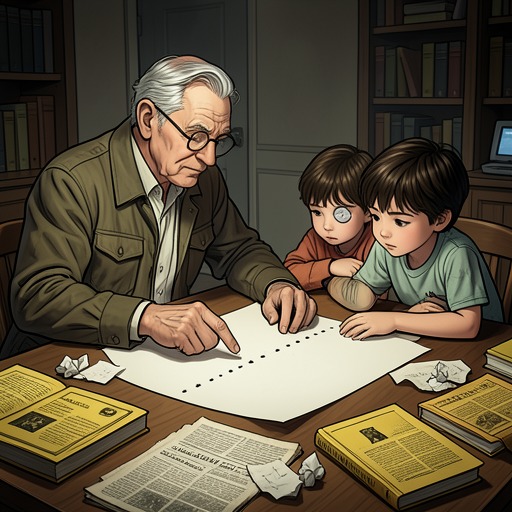
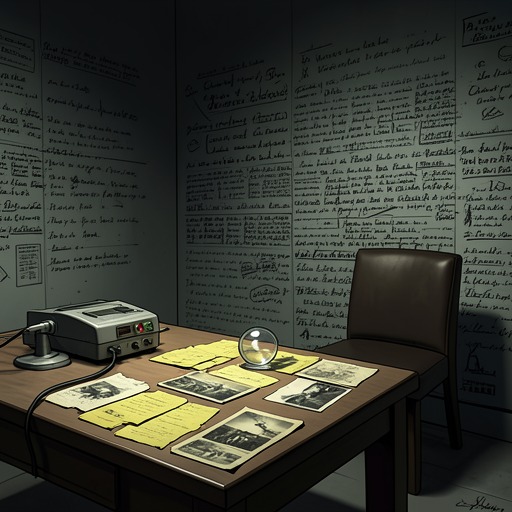
The 1976 deaths also established the phenomenon’s relationship with the “extra person.” After graduation, the person who could not possibly have been present vanished from the class, yet Mr. Chibiki could no longer remember who that person had been. He later collected information and identified a likely candidate, but the discovery remained documentary rather than experiential because the memories of those involved had disappeared. In the following year, he concluded that the extra person had apparently been a girl who had died in third-year Class 3 in 1976. He began recording the candidate’s name immediately after graduation so that, when his own memories were erased, the written note would still tell him what had happened. This led him to a larger conclusion: the extra person is a casualty selected at random from people who had already died in disasters produced by the phenomenon.
Scope and Mechanism
The Disasters do not affect everyone indiscriminately. Mr. Chibiki’s records suggest that their range extends to class members and blood relatives within two degrees: parents, grandparents, and siblings. Relatives without a blood connection, such as stepparents and stepsiblings, are considered outside the range because no such relative had died in the recorded cases. The rule gives the phenomenon a formal boundary even while its causes remain unexplained.
Geography forms a second boundary. The phenomenon centers on the school and the town of Yomiyama, and its effect weakens with distance. No family member living in a distant location had been affected, and very few people living in Yomiyama had died outside the town. The pattern resembles a weakening signal: connection to the class matters, but physical separation can reduce exposure. Together, the blood-relation and geographic rules make the disasters appear governed by a precise, if opaque, structure rather than by random misfortune alone.
The mechanism is intensified by the extra person’s concealment. While the casualty remains hidden in the class, records and memories are tampered with throughout the surrounding world. Details that should be impossible become acceptable, and no one recognizes the casualty’s true identity. Mr. Chibiki confirms this process without hesitation, establishing that the disasters are not merely deaths occurring against a stable background of reality. They also attack the means by which the class might interpret those deaths. The phenomenon protects itself through altered evidence and damaged recollection.
Countermeasures and Escalation
The first recorded attempts to resist the disasters arose from desperation. After the “tragedy of ’87,” the class developed the “Not There” Strategy: one student would be treated as though absent, reducing the class’s recognized membership by one and, in theory, restoring the balance disturbed by the extra person. In 1988, the first year of the strategy, the extra person was believed to have infiltrated the class in April, yet no one died. That success established the tradition that the strategy should be used in an on year.
The results were never dependable. In the following years, excluding the current year, there were five on years; the strategy succeeded twice and failed twice, while the year-before-last attempt failed partway through the year. Failure meant that the student assigned to be “not there” abandoned the role, exposing the fragility of a solution based on collective denial. The strategy does not eliminate the phenomenon so much as impose an artificial absence upon the class, and its success depends on continued obedience to an unstable fiction.
In the current year, the class increased the number of students treated as “not there” to two. By the end of June, Ms. Mizuno and Takabayashi, both linked to the class, had already died. July therefore became an immediate test of whether doubling the exclusion would prevent further deaths. The apparent continuation of ordinary school life with Mei Misaki concealed a heightened atmosphere of tension: the absence strategy had altered the social surface, but it had not restored confidence that the disasters were over.
From Threat to Violence
The Disasters encompass events that resemble natural illness or accident as well as acts of direct violence. Mr. Kubodera’s classroom crisis begins with speech breaking apart into unintelligible sounds, after which he withdraws his right hand from a bag and reveals a sharp-bladed knife. The scene converts the abstract expectation of a class calamity into an immediate threat inside the classroom, where an ordinary school object gives way to a weapon.
The same destabilization appears in the conflict involving Naoya Teshigawara and Tomohiko Kazami. Teshigawara reports that he had secretly tested Kazami’s memories of their childhood, including a riverbank secret base and a failed bicycle trip toward the ocean. Kazami no longer recognized either memory, and Teshigawara interpreted this as evidence that something was wrong with him before attacking him. The suspected murder thus grows out of the phenomenon’s characteristic assault on memory: uncertainty about identity becomes a reason for violence.
At the Sakitani Memorial Hall, the danger takes an explicitly criminal form. Koichi Sakakibara discovers blood, enters a dark dining hall despite having the option to follow the others, and encounters a fire consuming the room. The later inquest establishes that none of the six victims died from the fire itself. Kensaku Numata, the caretaker, had been stabbed in the neck with numerous metal cooking skewers and then burned; four students—Maejima, Yonemura, Sugiura, and Nakao—died from blood loss after being stabbed and cut repeatedly; Akazawa died after her spine snapped in a fall from a second-floor balcony. The fire was therefore not the primary disaster but an attempt to conceal a sequence of murders.
The investigation concluded that Mieko Numata, Kensaku Numata’s wife and co-manager of the hall, had caused the six deaths and had scattered kerosene in the kitchen after killing her husband. Mr. Chibiki restrained her, but before she could be surrendered to the police, she died after biting through her tongue in an apparent suicide attempt. The evidence establishes responsibility for the massacre, yet the root cause of Mieko’s actions remains unclear. This unresolved motive preserves the central ambiguity of The Disasters: individual criminal agency can explain how particular people die, but not why the wider pattern gathers such violence around the class.
Ritual, Place, and Meaning
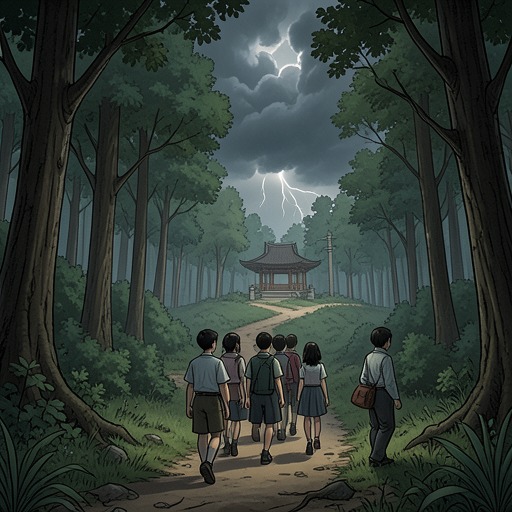
The phenomenon repeatedly draws the class toward ritualized attempts at repair. During the camping trip, the students visit Yomiyama Shrine, reportedly at the head teacher’s suggestion. The shrine’s name connects it to Yomiyama Mountain and, through the word “Yomi,” to the land of the dead. Oral traditions describe the shrine as a dividing point, or “linchpin,” between this world and the next. Such associations encourage the belief that a ritual act might interrupt the disasters.
The class camping trip lasts two nights and three days beginning on August 8, at Sakitani Memorial Hall, a school-owned lodge at the foot of Yomiyama Mountain. The shrine is in an extremely run-down state, appearing abandoned and neglected. While visiting, the students clean it together and become convinced that the work might break the curse. Mr. Koga reinforces that hope by assuring them that everything will be all right. The effort fails. The curse is presented as too deeply established to be undone by a simple communal cleaning, and the failed ritual marks the collapse of a hopeful, collective explanation.
The danger nevertheless continues to be managed through collective planning. Before the class is due to ascend Yomiyama, Mr. Chibiki announces that he will accompany everyone and help ensure that the outing proceeds safely, while warning them to be careful on the return. Deteriorating weather threatens to cancel the ascent, and Ms. Mikami responds uneasily that the decision will depend on conditions the next day. The mountain outing thus becomes both a practical excursion and a confrontation with the geography at the center of the phenomenon.
When a student suffers an attack associated with his medical condition, Mr. Chibiki tells the frightened class that the student will be fine after going to the hospital and insists that the incident is neither extraordinary nor a freak accident. His calm is meant to prevent fear from taking control, but the narration identifies the reassurance as a lie. The moment shows how The Disasters corrupt even protective authority: reassurance becomes concealment, and the attempt to preserve order depends on withholding the truth about danger.
Narrative and Thematic Significance
The Disasters produce a world in which death is recurrent but never fully legible. Their variety—illness, suicide, murder, accidents, and apparently ordinary medical crises—keeps the class from recognizing a single visible enemy. Their recurrence, meanwhile, makes every new event retrospectively meaningful. A knife in a classroom, a forgotten childhood memory, blood in a dining hall, or smoke behind a door can each become part of the same pattern.
The concept also exposes the cost of survival strategies built on exclusion and denial. The class tries to defeat the extra person by declaring someone absent, while the phenomenon itself alters records and memories to make an impossible presence seem normal. Both sides manipulate recognition. The human countermeasure therefore repeats the structure of the threat: it seeks safety by controlling who counts as present, who can be remembered, and whose death can be acknowledged.
At the same time, the Sakitani Memorial Hall massacre demonstrates that not every disaster requires a supernatural explanation. The deaths there are conclusively attributed to Mieko Numata’s actions, and the fire is shown to have been set after the killings. Yet this naturalistic resolution does not dissolve the broader phenomenon. Instead, it reveals how the category of The Disasters absorbs heterogeneous forms of suffering, joining supernatural recurrence to human violence, institutional secrecy, failed ritual, and the ordinary vulnerability of the body. The result is a pattern that remains terrifying precisely because its structure is recognizable while its individual causes are not.