Yomiyama phenomenon
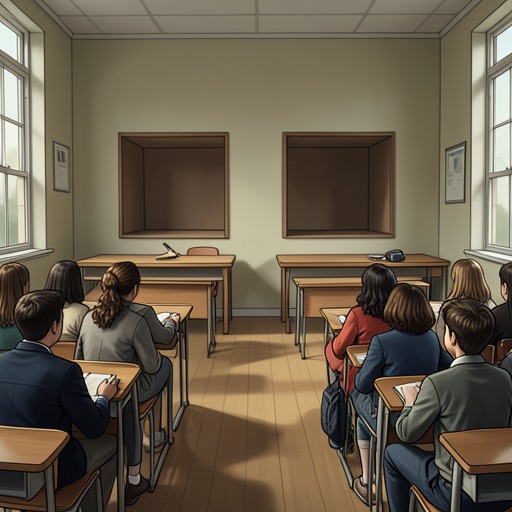
AnotherThe Yomiyama phenomenon is the recurring supernatural disaster associated with third-year Class 3. It begins when an extra person, also called the casualty, is incorporated into the class: someone who should be dead is nevertheless treated as a living member of the group. The phenomenon then forces records, memories, and perceptions to accommodate that impossible presence, while deaths spread through the school community. Its decisive significance is that it converts an apparently social problem into an alteration of reality itself, leaving the class to resist not an enemy with a visible will but a process that behaves like a natural disaster.
Origin and Nature
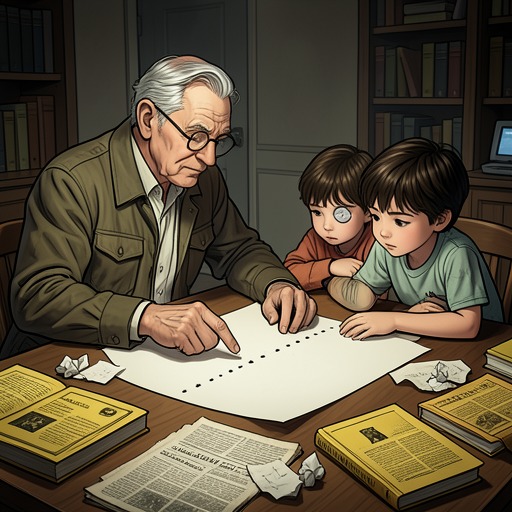
The phenomenon is traced to the death of Misaki, a popular student in third-year Class 3 twenty-six years before the main events. According to Tatsuji Chibiki, no one involved acted with malicious intent. As a young educator, he and the students clung to ideals about how the situation should be handled, but their response became the trigger through which the doors to death opened at the school. Tatsuji Chibiki regards himself as responsible not only for that beginning but also for failing to stop the disasters that followed in subsequent years.
Tatsuji Chibiki rejects the familiar language of a curse. The deaths are not caused by Misaki's angry spirit, by a grudge, or by the casualty deliberately attacking anyone. No human malice or desire to cause harm stands behind the process. He instead describes it as a phenomenon: comparable in operation to a typhoon or an earthquake, though supernatural in origin. This formulation preserves the terror of the event while removing the comfort of an intentional antagonist. There is no will to persuade, punish, or appease; the disaster simply occurs.
Distortion of Reality
The extra person's presence is protected by widespread tampering. When the phenomenon is active, details in class lists, school records, official documents, diaries, notes, photographs, videotapes, and computer data can be corrupted so that contradictions disappear. Information that should prove the casualty's absence instead becomes consistent with the impossible fact of the person's presence. The alteration is not confined to written evidence or institutional archives: the memories of family members, friends, and teachers are also changed or erased.
Tatsuji Chibiki gives Mami Asakura as a concrete example. Although she had died at fourteen in October 1993, people connected with her had forgotten that she was dead, and he himself had not suspected that she should not have been present. The phenomenon therefore defeats investigation at its source. Searching for a missing name or an incorrect document cannot reliably expose the extra person, because the evidence has already been reorganized. The class is not merely deceived by false testimony; its documentary and personal history has been made to support the deception.
The same mechanism explains why ordinary relationships become dangerous and unstable. Tatsuji Chibiki is considered safe because he has no direct link to third-year Class 3, allowing him to interact normally with students without being affected in the same way. His position outside the class makes the Secondary Library a comparatively secure place for information to survive and be discussed. By contrast, members of the class are caught inside the phenomenon's field of altered recognition.
Countermeasures and Their Limits
The school repeatedly experiments with ways to break or contain the phenomenon. One early measure changed the class designations from numerical names such as Class 1, Class 2, and Class 3 to alphabetical names. Third-year Class 3 became third-year Class C, on the theory that changing the name of the site's identity might disrupt the disaster. It failed, and many people died that year as well.
The later effective tactic was to treat one selected student as if they were not there, compensating for the extra person by creating a deliberate absence within the class. This strategy does not erase the casualty; it attempts to restore a balance by withholding ordinary recognition from someone who is actually present. In June, the class tried to increase the number of people treated as absent to two, but that produced no benefit. After Mr. Kubodera's death, the class gradually stopped ignoring Mei Misaki and Koichi Sakakibara, since continuing the expanded exclusion served no apparent purpose.
The rules are uncertain and conditional. At school, the selected person must be treated as absent, but ordinary interaction outside school may be permitted; school activities outside the campus remain subject to the prohibition. Even these distinctions are not absolute, and no one can determine with certainty which breach causes a countermeasure to fail. Tatsuji Chibiki compares the tactic to using an umbrella in the rain: it is preferable to having no protection, yet the angle of the umbrella and the way a person walks can still leave them soaked. The analogy emphasizes practical reduction of risk rather than complete control.
Social Recognition and Violence
The phenomenon produces an exceptional social order in which recognition itself becomes a protective or dangerous act. In the attempt to treat both Mei Misaki and Koichi Sakakibara as not there, classmates are required to suspend ordinary conversation, acknowledgment, and participation. Tatsuji Chibiki and most of the class already knew that Reiko Mikami was Koichi Sakakibara's aunt, yet the rules required them to behave as though they were separate people at school. Reiko Mikami addressed him as the transfer student there, while he called her Ms. Mikami rather than Reiko. The strategy thus intrudes into family life by demanding that a genuine relationship be divided according to place.
The attempt to identify the casualty can also turn suspicion into violence. Naoya Teshigawara secretly tested Tomohiko Kazami by asking about shared childhood memories, including a riverbank secret base and an abandoned plan to bicycle to the ocean. When Tomohiko Kazami failed to remember those experiences, Naoya Teshigawara interpreted the memory gaps as evidence that the real Tomohiko Kazami had died long before and that the current student was the extra person. His conclusion was mistaken, but the phenomenon had made such reasoning seem plausible by teaching the class that memory itself could be falsified. A supernatural uncertainty was therefore translated into an immediate human threat.
The wider disasters likewise blur the line between supernatural causation and ordinary crime. Mr. Kubodera's death begins with the sudden appearance of a sharp-bladed object from a bag in the classroom. At the Sakitani Memorial Hall, the victims do not die in the fire that initially appears to explain the massacre: Kensaku Numata is stabbed in the neck with numerous metal cooking skewers, four students die from blood loss caused by repeated stabbing and cutting, and Izumi Akazawa dies after her spine breaks in a fall from a second-floor balcony. Mieko Numata is found to have caused the six deaths and then spread kerosene to start the fire, before dying by suicide while being restrained by Tatsuji Chibiki. These details do not reduce the phenomenon to a simple murderer; they show instead how its disasters can be realized through accidents, self-destruction, and human violence within a destabilized social field.
Narrative Significance
The Yomiyama phenomenon makes absence and presence equally unreliable. The casualty is physically present but historically absent, while the person selected for the countermeasure remains physically present yet is denied social existence. The class's survival depends on maintaining this contradiction without knowing exactly how the rules operate, who has authority to enforce them, or which deviation will reopen the disaster.
Its most unsettling effect is epistemological as much as lethal. Documents, photographs, memories, and direct observation all lose their status as stable proof. Even Naoya Teshigawara's apparently intimate knowledge of Tomohiko Kazami's past cannot distinguish a genuine memory failure from an impossible identity. The phenomenon therefore compels characters and readers to accept a world in which common sense still recognizes contradictions, but reality has already repaired them. The resulting horror comes from the collapse of reliable evidence: the class cannot simply discover the truth, because the truth has been made difficult to remember, record, and socially acknowledge.