The Extra Person · The Casualty
AnotherThe Extra Person / The Casualty is the hidden dead member of third-year Class 3 whose presence activates and sustains the Yomiyama phenomenon. Although the casualty is physically absent from the life that should have followed death, the class, its records, and the memories of everyone connected to it are altered so that the impossible person appears fully legitimate. The concept therefore makes death not an end but an administrative and social contradiction, one that can be corrected only when the casualty is killed or otherwise returned to Death.
Definition and Origin
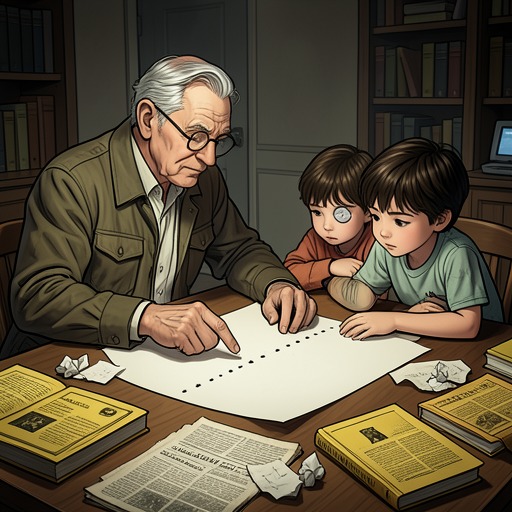
The casualty is not simply an unexpected student or an ordinary impostor. Tatsuji Chibiki explains that the extra person appears at random from among those who have already lost their lives in disasters caused by the phenomenon. In the case he documented, the casualty was Mami Asakura, a girl who had died in third-year Class 3 in 1993. Three years later, she entered the 1996 class from the beginning of April and remained there through the graduation ceremony in March, despite having died at fourteen.
Mami Asakura’s name illustrates the contradiction precisely. Her name appeared on the 1993 class list beside a red X and the notation “October 9—illness,” but it was absent from the 1996 list because the casualty did not officially belong to that year’s class. During the phenomenon, however, Chibiki remembered that her name had seemed to occupy the appropriate place on the 1996 list. The casualty thus exists between incompatible categories: dead according to the earlier record, present according to the current class, and accepted by everyone who should have recognized the impossibility.
How the Phenomenon Conceals the Casualty
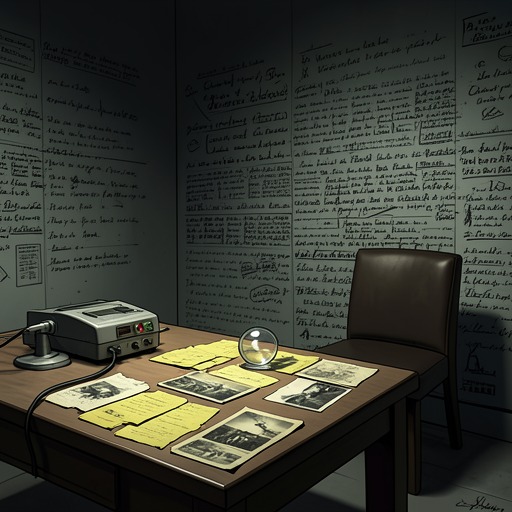
The extra person’s presence produces a comprehensive falsification rather than a single missing entry. Records, official documents, diaries, notes, photographs, videotapes, and computer data are all tampered with or corrupted so that contradictions disappear. Details that should fail to match instead become mutually consistent. Chibiki states that even as an observer he never suspected Mami Asakura’s presence, because the phenomenon altered the surrounding evidence as thoroughly as it altered the class itself.
Memory is changed along with documentation. Mami Asakura’s family, friends, teachers, and classmates forgot that she had died in 1993; they accepted the false reality that she was fourteen and beginning her third year in 1996. When the school year ended and the casualty vanished after graduation, the records returned to their prior form, and the memories of those close to her were repaired so that they no longer remembered her appearance as the casualty. The supernatural process therefore restores a coherent world by erasing the experience that had made the world contradictory.
The effect also explains why investigation is normally futile. Searching one document cannot expose the casualty when every other document, image, recording, and recollection has been adjusted to support the same false reality. Chibiki confirms that the tampering is not limited to school records and that no ordinary appeal to evidence can overcome it while the phenomenon remains in force. The casualty is protected less by concealment than by a total agreement among reality’s available witnesses.
Relation to the Not-There Strategy
The casualty is closely connected to the class’s countermeasure of designating someone as “not there,” but the two positions are not identical. A student made not there is deliberately excluded from ordinary interaction in an attempt to compensate for the extra presence. In 1998, the class tried to increase the number of students treated as not there from one to two by ignoring both Mei Misaki and Koichi Sakakibara. When this attempt produced no effect, there was no reason to continue it, and the class gradually resumed treating Mei Misaki as someone who was there.
This reversal exposes the difference between social exclusion and supernatural insertion. The class can deny recognition to a living student, but it cannot simply cancel the casualty through a collective decision. Mei Misaki’s status changed visibly after Mr. Kubodera’s death: classmates who had previously ignored her began addressing her and acting as though she existed, even without formally discussing the change. The return of recognition marked the failure of the two-person countermeasure, while the casualty remained the concealed source of the disaster.
The strategy also depends on who is considered safe to interact with the class. Tatsuji Chibiki could speak normally with Mei Misaki and Koichi Sakakibara because he had no direct ties to third-year Class 3; people without such a link were believed to be unaffected by the act of acknowledging them. By contrast, Mr. Kubodera and the class were directly implicated in the countermeasure. Their behavior shows how the phenomenon turns ordinary classroom relations into an exceptional order in which recognition itself is treated as dangerous.
Discovery and Misidentification
Because the casualty’s identity is erased from ordinary knowledge, characters must infer it indirectly, and those inferences can become dangerous. Naoya Teshigawara suspects Mei Misaki because her calm detachment and connection to the phenomenon make her seem like the obvious candidate. He raises the possibility that she is the extra person, but Mei answers that she does not think she is. The suspicion demonstrates how the category encourages the class to convert unusual behavior into evidence of impossible identity.
A more destructive misidentification occurs when Naoya Teshigawara investigates Tomohiko Kazami. Teshigawara asks Kazami about shared childhood memories, including a secret base by the river and an abandoned plan to bicycle to the ocean. Kazami cannot remember either experience, and Teshigawara interprets those gaps as proof that something is wrong with him. The investigation shows how the casualty’s logic destabilizes trust: ordinary failures of memory can be read as signs that a living person has been replaced by the dead.
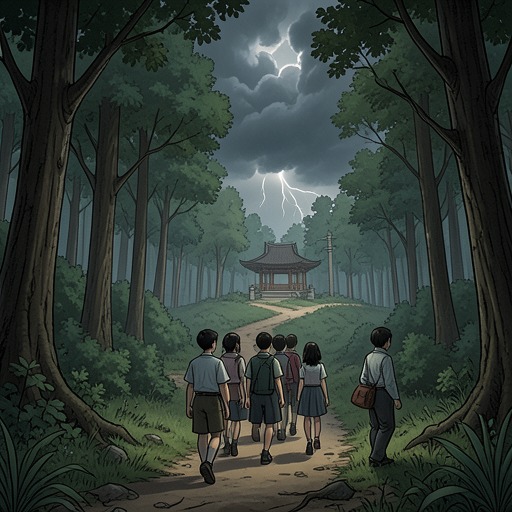
The true identity is eventually disclosed through a recorded confession. The unnamed student who made the recording says that he killed the boy hiding in the class as the extra person. He explains that the school trip had included nineteen students, not twenty, and that the murdered boy seemed to have been retroactively removed from everyone else’s knowledge. The confession converts a vague supernatural theory into a concrete act of violence, while also revealing that the killer alone still remembers the victim because of his profound involvement in the death.
Return to Death and Narrative Significance
The casualty’s death ends the disasters because it restores the numbers and order of the world. The confession describes the killing as accidental salvation: once the extra person died, the disasters stopped, and the next day teachers, students, and the victim’s parents no longer remembered that he had belonged to third-year Class 3 since April. Their memories had been repaired, and the records were likewise corrected. Returning the casualty to Death removes the excess life that had made the class structurally unstable.
This correction is not gentle or morally clean. The act that saves the class is itself a killing, and the person who performs it remains burdened by knowledge that everyone else loses. The casualty’s removal therefore produces safety through the destruction of both a life and a shared memory of that life. The phenomenon presents order as something that can be restored only by making the dead dead again, while leaving the surviving witness isolated inside the truth.
The concept also clarifies why the class’s rituals and rules carry such severe consequences. The students and teachers are not merely trying to identify an intruder; they are attempting to govern an impossible overlap between life and death. Their decisions to ignore particular people, to suppress information, or to preserve a prescribed class arrangement operate as emergency measures within a reality that has suspended ordinary rules. The Extra Person / The Casualty is consequently both a person and a structural role: the concealed casualty generates the disasters, and the surrounding community is forced to reorganize itself around the effort to deny, identify, or eliminate that presence.