Antigone’s arrest
AntigoneAntigone’s arrest is the moment her second attempt to bury Polynices becomes public and irreversible. Three Guards bring her before Creon after finding her digging earth with her hands to cover her brother’s body again. She admits that the charge is true; what follows is not a plea for escape but a clash over whether she or Creon has the right to define what must be done. The arrest releases the play’s central conflict: political order demands obedience, while Antigone holds that she must do what she can for her brother, even at the cost of her life.
Causes and Background
Creon has forbidden anyone to approach Polynices’ body. The Guards explain that they caught Antigone near it, digging with her hands and trying once more to cover the corpse. The act is a renewed burial attempt, not an accidental presence: she has returned to do what the decree explicitly prohibits. When Creon asks what she was doing beside her brother’s body and reminds her that he had forbidden anyone to go near it, the personal and political stakes meet in a direct question of obedience.
Antigone does not deny what happened. Her brief confirmation closes off any uncertainty about whether the Guards have mistaken her actions or whether she will evade responsibility. The arrest therefore does not depend on a hidden motive being uncovered: the act itself, her return to the body, and her willingness to acknowledge it are openly before Creon. The authorities have caught her in the prohibited deed, but the capture only begins the dispute over what that deed means.
Capture and Confrontation
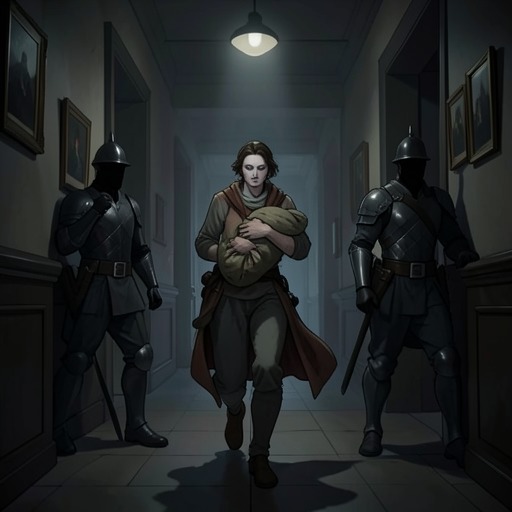
The three Guards push Antigone ahead of them and bring her onto the stage. The Chorus marks the entrance as a decisive turn: now the action begins, the released spring has snapped back, and Antigone has been caught. Its description of her as being able, for the first time in her life, to be herself frames arrest paradoxically. Confinement does not make her inwardly compliant; it places her in the circumstance where her refusal can be stated without disguise.
Asked what she was doing by Polynices’ body, Antigone answers simply that the accusation is true. The Guard’s account supplies the physical detail that gives the admission its force: she had been digging earth with her hands to cover the body again. She later insists that this, at least, is something she can do, and that she has to do what she can. The modest scale of the action does not weaken its significance. She cannot undo the decree or command the state, but she can make another attempt to bury her brother.
Opposed Duties
Before her arrest, Antigone had described the conflict as a division of roles: Creon must have the sisters put to death, and they must bury their brother. In that account, burial and punishment are not competing possibilities to be reconciled; each side has an obligation, and the roles have already been cast. Her capture brings this fatal logic out of abstraction and into the immediate exchange with the ruler who enforces the prohibition.
Creon argues that someone must say yes and steer the ship. He imagines a state taking on water from every side, with crime, poverty, and misery aboard; a crew refuses to work and pillages the hold, while officers build a raft for themselves. In the storm, he says, the ruler has no time for exact distinctions about whether to consent or refuse: he must seize the wheel, give orders, and shoot at the first person who advances. The person struck may have been a smiling man who offered him a light the day before; in the emergency, Creon says, that man loses his name, and so does the ruler. Only the ship and the storm remain.
Antigone rejects that claim as a reason to obey. She says she has not said yes, and denies that Creon’s politics, obligations, and stories determine her choice. He has a crown and guards and can have her put to death, she tells him, but she can still say no to what she dislikes. Her answer distinguishes the power to inflict death from the power to obtain her agreement: Creon can enforce his decision, but cannot make her accept it as her own.
Consequences and Significance
The arrest changes the burial attempt from an act carried out at the body into an acknowledged confrontation before the authority that prohibited it. Antigone’s hands, the earth, and the exposed body establish what she has done; her admission leaves no space for an excuse to replace the act. From this point, the question is no longer whether she broke the decree, but whether survival through compromise would be acceptable to her. She says that she wants everything, here and now, whole and complete, or else nothing. The arrest thus brings her uncompromising standard into collision with Creon’s insistence that political survival requires someone to say yes.
The Chorus’s image of the released spring gives the capture a particular tragic shape. Antigone is caught, yet the Chorus presents the event as the condition under which she can finally be herself. Her freedom is not freedom from the Guards or from the threat of death; it is the ability to hold to her refusal in public. Creon’s power and her self-determination therefore become visible at once, and neither can cancel the other. The arrest starts the fatal passage from a forbidden burial to an open decision about obedience, dignity, and death.