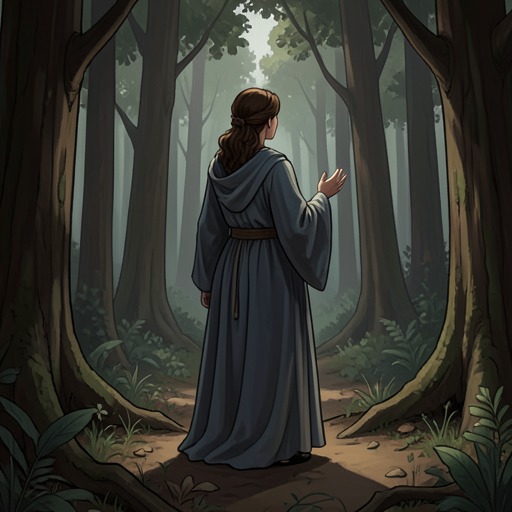
Artemis—Callisto
ArtemisArtemis and Callisto’s relationship is a story of chosen companionship that becomes love and ends in separation, mistaken judgment, and grief. Artemis invites Callisto into her retinue despite being unable to explain what distinguishes her; Callisto chooses to share Artemis’s vow of chastity and remain her companion. Their intimacy grows into a relationship they understand as compatible with that vow, but Callisto’s pregnancy overturns Artemis’s trust. Artemis banishes her, later kills her without recognizing her in bear form, and only then learns the truth. Her plea to Zeus raises Callisto into the heavens, preserving her life among the stars while leaving the lovers divided from the world they knew.
First Recognition and Chosen Companionship
Artemis sees something in Callisto that she cannot yet put into words. The other maidens have displayed recognizable strengths—intelligence, resolve, kindness, or skill in tracking—but Callisto’s potential remains indistinct even to the goddess. That uncertainty does not keep Artemis from wanting her beside her. Their first understanding is conveyed not through an explanation but through a shared smile, followed by Artemis’s invitation to leave her father’s palace and serve as one of her eternal nymphs.
Callisto gives her name when Artemis asks. The introduction places her personal identity at the beginning of a relationship that will be shaped by the role she accepts: she joins Artemis’s company not merely as another attendant, but as the maiden whom Artemis has singled out without being able to account for the choice. Once Artemis’s retinue accompanies her wherever she goes, Callisto’s place in that company also belongs to the public identity of the huntress and goddess of the wild.
Companionship, Chastity, and Love
Callisto’s commitment to Artemis is expressed as a choice. When Artemis asks whether she has ever regretted taking the oath of chastity with her, Callisto says she has not; she chose purity so that she could remain Artemis’s companion forever. The vow therefore functions in their relationship as both a boundary and a bond: Callisto understands it as a way to share Artemis’s life, not as a reason to leave her.
Their intimacy develops through care and emotional disclosure. When Artemis speaks of having seen men without desiring them, and of not wanting the passion of the flesh, Callisto responds with pity and embraces her. The gesture surprises Callisto herself. Artemis accepts the comfort, draws close, and rests her head on Callisto’s shoulder. The scene makes Artemis’s loneliness explicit and shows Callisto answering it through physical affection before either has fully articulated what their closeness means.
The relationship later moves from comfort into a more deliberate expression of desire. Callisto confesses that she wants to please Artemis; Artemis does not order her away or rebuke her, and the two share a kiss. The encounter marks a change in how they inhabit their relationship, but their established hierarchy remains significant: Callisto is Artemis’s nymph and attendant, while Artemis is the goddess she serves. The text presents Callisto’s initiative and Artemis’s acceptance, while also placing that intimacy within a bond structured by service and by Callisto’s enduring devotion.
Artemis eventually names the need beneath her longing. When Callisto asks why they are apart from the others who are enjoying the hunt, Artemis says she wants Callisto to show her that she is not alone and that she can be loved while keeping her solemn vow. Callisto understands the request; Artemis takes her hand, and they go together to a cave. The moment gives their love a stated purpose: Artemis seeks companionship without surrendering the identity and vow she has chosen.
Their attachment is shown as continuing beyond this declaration. Later, Artemis asks whether Callisto still loves her as she did the previous day. Callisto answers that she loves her more, and expects to love her still more the next day. This exchange makes their relationship feel ongoing rather than confined to a single turning point. Artemis approaches Callisto, and they become absorbed in one another, leaving Callisto’s basket of apples and figs and their weapons on the ground. The forgotten objects set the immediacy of their private attachment against the ordinary duties and equipment of the hunt.
Pregnancy and the Rupture of Trust
The relationship’s central rupture begins when Callisto experiences an unexpected bodily change during intimacy and tells Artemis that she can feel something. Artemis tells her not to worry and redirects her attention toward pleasure. The exchange is consequential because the disturbance is acknowledged but not investigated; the reassurance postpones understanding rather than resolving what Callisto has noticed.
Later, a cry from the camp brings Artemis out of her bath. Her companions bring Callisto before her, while Opis and Loxo hold the nymph down as she tries to cover herself with cloth. Artemis first sees no apparent injury, then notices Callisto’s swollen belly and realizes that she is pregnant. The discovery transforms the scene: what had appeared to be an unexplained cry becomes evidence that Callisto is carrying a child, and Artemis’s response changes from fear for her beloved to anger at what she believes is a broken oath.
Artemis accuses Callisto of betraying her and of having lied, insisting that she herself could not have caused the pregnancy. Callisto disputes this account. She says that several months earlier, while gathering olives in the woods, Artemis came to her in a glade; Callisto describes sudden pain followed by pleasure and says she understood only afterward that her purity had been broken. She insists that the encounter was not her intention. The relationship thus reaches a devastating divide between Callisto’s account of what happened and Artemis’s conviction that the pregnancy proves betrayal. The available account establishes the accusation and Callisto’s statement, but does not resolve the discrepancy between them at this point.
Despite tears, Artemis refuses to reconsider. She says Callisto has broken her vow and orders her to leave the retinue and never return. The banishment reverses the invitation that began their relationship: the goddess who once wanted Callisto beside her now excludes her from the company and life they shared. Artemis then asks for her bow and arrows, placing the break between them in the context of her authority and capacity to punish.
Recognition, Death, and Apotheosis
The separation carries into a later encounter in which Artemis faces a bear without knowing that it is Callisto. The animal does not flee and continues to look at her. Frustrated, and affected by Hera’s persistent words in the winds, Artemis shoots. The arrow pierces the bear’s heart; only afterward does Artemis realize that she has killed Callisto.
Recognition changes Artemis’s response at once. She drops her bow, rushes to the dying animal, falls to her knees, and calls Callisto by name. With a shaking hand on the bear’s snout, she grieves as the other maidens gather and then stand back in silence. Callisto is unable to comfort her, and her strength fades as Artemis embraces her. The scene completes the relationship’s reversal: Artemis’s earlier failure to believe Callisto is followed by recognition only when the beloved she banished is dying.
In her sorrow, Artemis calls on Zeus to redeem his deed. Zeus considers that only heroes who have performed great deeds and accomplished the seemingly impossible are ordinarily placed among the stars, but agrees to her suggestion as an act of atonement. Light rises from Callisto’s slain bear form, lifting her into the heavens. Her new celestial existence grants her eternal life, though Artemis understands that the change also means they will no longer truly belong to the world they once knew.
A new constellation appears, with the North Star as its brightest point. The star becomes a guide for sailors, wanderers, builders, and hunters, extending Callisto’s presence beyond Artemis’s private grief into a lasting point of orientation for others. Its public usefulness does not erase the separation: Artemis watches the heavens and finds some comfort in Callisto’s new form, but remains below, contemplating the beloved who has been returned to life only beyond their shared world.
Significance of the Relationship
The relationship is organized around a tension between fidelity to a vow and the desire for intimate love. Artemis explicitly asks whether love can coexist with her solemn commitment, and Callisto understands her own chastity as a means of remaining with the goddess. Their bond initially makes the vow seem compatible with companionship, but the pregnancy exposes how fragile that understanding is within the story. Artemis treats the pregnancy as proof of disloyalty, while Callisto describes an encounter she says she did not intend and which Artemis rejects as impossible.
The sequence also turns on belated knowledge. At the beginning, Artemis acts on an intuition she cannot explain and chooses Callisto; at the crisis, she refuses Callisto’s explanation; after the fatal shot, she finally understands that the bear was her beloved. The recognition arrives too late to restore their life together, so the final transformation into a constellation offers preservation rather than reconciliation. Callisto endures among the stars, and the North Star guides others, while Artemis’s grief marks the cost of a relationship broken by mistrust and mistaken certainty.