Hera—Eileithyia
ArtemisHera’s imprisonment of Eileithyia turns a dispute over Zeus’s relationship with Leto into a direct assault on childbirth: Hera confines the goddess whose duty is to aid women in labor, leaving Leto without her help. Eileithyia protests that she must assist the suffering, and that Leto’s children are Zeus’s, but Hera chooses punishment over both duty and kinship. The confinement lasts thirty days, while Leto labors without the aid Hera has withheld.
Relationship and conflict
Eileithyia is Hera’s daughter and the goddess of childbirth and midwifery. The conflict between them is not presented as a disagreement about Eileithyia’s role: Eileithyia insists that helping women in labor is her duty. Rather, Hera uses her authority as mother and queen to prevent that work in a particular case. Her target is Leto, whose relationship with Zeus has provoked Hera’s jealousy; by restricting Eileithyia, Hera makes Leto’s pregnancy and delivery the means through which she retaliates.
Eileithyia’s appeal also connects the immediate crisis to her father. She tells Hera that even imprisonment cannot change the fact that the twins are Zeus’s children, and argues that Zeus will love them and want them in his royal household. Hera rejects that prospect, declaring that she will not allow the children on Olympus. Her effort to keep Eileithyia from helping Leto is thus tied not only to anger at Leto but also to resistance against the children’s place in Zeus’s family.
The imprisonment
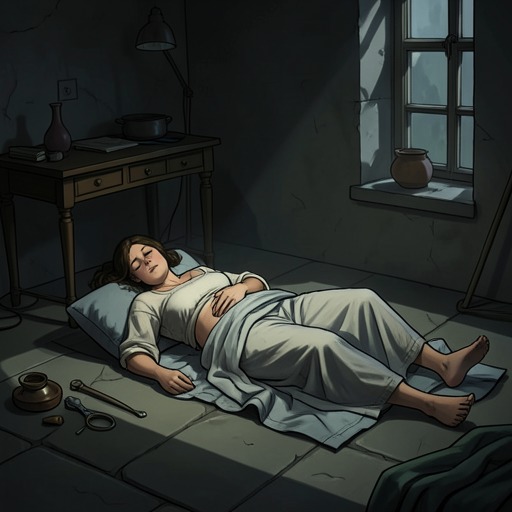
As Leto is in labor on Delos, Eileithyia pleads with Hera to let her assist. Hera instead grabs her daughter by the waist and drags her through the palace, down into the mountain tunnels. Eileithyia protests that Hera is hurting her and causing the suffering of mothers currently in labor, but her resistance fails against the queen’s power.
Hera makes the stakes explicit: she is willing to let humanity suffer rather than permit Eileithyia to relieve Leto. She says Leto may have escaped her wrath, but she intends for the labor to continue long enough to endanger Leto’s life. When Eileithyia persists, Hera throws her into the palace dungeon and locks her there for thirty days. The confinement is therefore an intentional obstruction of aid, not an incidental absence: Hera knows what Eileithyia could do and prevents her from doing it.
Consequences for Leto’s labor
With Eileithyia detained, Leto faces childbirth without the assistance of the goddess whose domain is midwifery. The account presents the imprisonment as the immediate reason Leto endures prolonged labor: she suffers for nine days and nights before Rhea and Dione help her into a cave on Delos. The cave offers a place of refuge, but it does not undo Hera’s decision to withhold Eileithyia’s aid.
The episode emphasizes that Hera’s punishment reaches beyond its intended target. Eileithyia calls attention to all mothers in labor who are suffering while she is prevented from fulfilling her duty, and Hera answers that their suffering does not matter to her. Yet the narrative centers the most immediate consequence on Leto: she must endure the ordeal alone until other divine women arrive to help. The later birth of Zeus’s children makes Eileithyia’s warning about their parentage consequential, but does not erase the suffering Hera has deliberately imposed.
Narrative and thematic significance
The relation exposes a bitter contradiction in Hera’s power. She is able to govern the palace and overpower her daughter, but that authority is used to suppress the very care Eileithyia identifies as her responsibility. Eileithyia’s appeal rests on two grounds—her duty to women in labor and the truth of the twins’ descent from Zeus. Hera answers both with force: she imprisons the daughter who would help Leto and tries to deny the children a place in the royal household.
The episode also makes childbirth a point where family politics becomes bodily consequence. Zeus’s relationship with Leto provokes Hera, but Leto and the childbearing women bear the immediate cost of Hera’s retaliation. Against that coercion, Eileithyia’s protest affirms a responsibility to assist women even when the person in labor is the object of a queen’s vengeance. Her confinement gives the birth narrative its central obstacle and clarifies the conflict between Hera’s private grievance and Eileithyia’s stated duty.