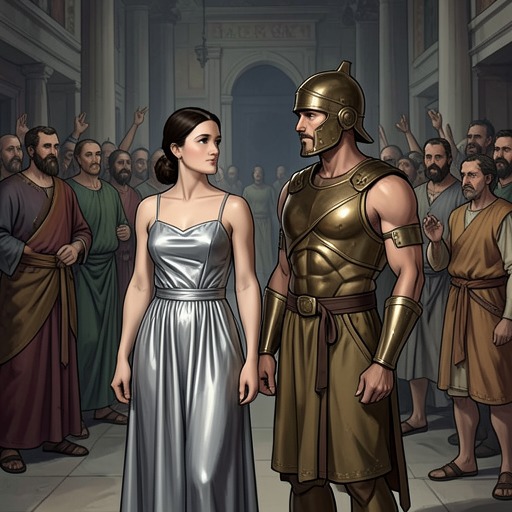
Hera—Callisto
ArtemisHera’s relation to Callisto is one of indirect but decisive persecution: when Callisto’s pregnancy came to light, Hera transformed her into a bear, then manipulated Artemis into hunting the fleeing animal. In the story’s wider pattern, this violence recalls Hera’s earlier attacks on Leto, whose relationship with Zeus had provoked the queen’s jealousy. Hera’s power reaches Callisto not through a direct confrontation but through her ability to turn another goddess’s anger and a hunt into instruments of punishment.
The Pattern of Hera’s Jealousy
Hera’s treatment of Callisto follows a history established before Callisto enters the conflict. When Zeus became involved with Leto, he understood that Hera’s jealousy made Leto vulnerable. Hera discovered the pair despite Zeus’s attempt to conceal them by turning them into quails, and cursed Leto to carry children but be unable to give birth wherever the sun shone. The episode establishes a recurring logic: a relationship involving Zeus becomes the occasion for Hera to punish the woman caught in its consequences.
The book makes that pattern explicit in Hera’s later response to Leto’s labor. Hera imprisons her daughter Eileithyia and refuses to release her, even as the goddess of childbirth protests that her mother is causing suffering to women in labor. Hera declares that humanity may suffer if that is what it takes to make Leto’s pain fatal. Her grievance is framed as retaliation for Leto’s union with Zeus, which Hera regards as a betrayal of her household. This earlier persecution gives the conflict with Callisto a broader context: Hera repeatedly directs her power against women whose lives are entangled with Zeus or with the injuries Hera attributes to him.
Callisto’s Exposure and Expulsion
Callisto’s pregnancy becomes visible to Artemis when her companions bring her forward. Artemis sees Callisto’s swollen belly and realizes she is with child. The discovery shatters Artemis’s trust in a member of her retinue, whose vow has been broken; Callisto tries to explain that she had lain with Artemis, but Artemis rejects her account. The scene’s immediate conflict is between the two women, while Hera remains an observing presence behind the consequences.
Artemis orders Callisto to leave the retinue and never return, then asks for her bow and arrows. When the nymphs do not move, Artemis whistles for her hounds, and Callisto flees. The expulsion leaves her alone in the forest, pregnant and trying to escape. It is at this moment that Hera acts: having watched the argument, she identifies Zeus as the one responsible for Callisto’s pregnancy and, driven by jealousy and resentment toward Artemis, uses an enchantment to turn Callisto into a large brown bear.
Transformation and the Hunt
Hera’s transformation makes Callisto’s situation more perilous without resolving the cause of her persecution. The new bear’s strength helps her keep moving, but her flight continues to be treated as the movement of an animal pursued by Artemis’s band. When Artemis sees a large bear by a lake, the huntress is drawn to shoot despite not having set out to kill game that day. Hera intensifies that impulse through magical persuasion, urging Artemis to aim at Callisto as she runs through the foliage.
The pursuit becomes a trap when another band appears from the opposite side of the lake, leaving Callisto with nowhere to go. She fights off the hounds and escapes their immediate restraint, but Artemis draws an arrow and seeks an opening to shoot. Hera again works through the air with words urging Artemis to fire. Artemis’s hand trembles, an unfamiliar reaction whose cause she does not understand; the narrative places that hesitation beside Hera’s intervention, making the hunt the culmination of a chain of hostility rather than a simple encounter between huntress and wild animal.
Consequences and Significance
Hera’s relation to Callisto is shaped by a double displacement of responsibility. Zeus is identified as the cause of Callisto’s pregnancy, yet Hera’s response falls on Callisto, whom she transforms, and on Artemis, whom she steers toward a lethal pursuit. Callisto is first expelled by the goddess she serves and then deprived of her human form by Hera. The resulting hunt conceals a person inside the figure of game, turning Artemis’s ordinary role as huntress into the means by which Hera’s private grievance may be carried out.
The author’s note describes Artemis and Callisto as the mythic pair who come closest to a lesbian relationship and presents the book as a retelling of Artemis’s life through her first heartbreak. That framing places Hera’s intervention within a story about intimacy, trust, and loss, while the plot’s repeated pattern of punishment for women’s entanglements with Zeus complicates the distribution of blame. Hera’s actions do not undo Zeus’s responsibility; instead, they extend its consequences across Callisto and Artemis, transforming jealousy into an inherited crisis of bodies, vows, and violence.