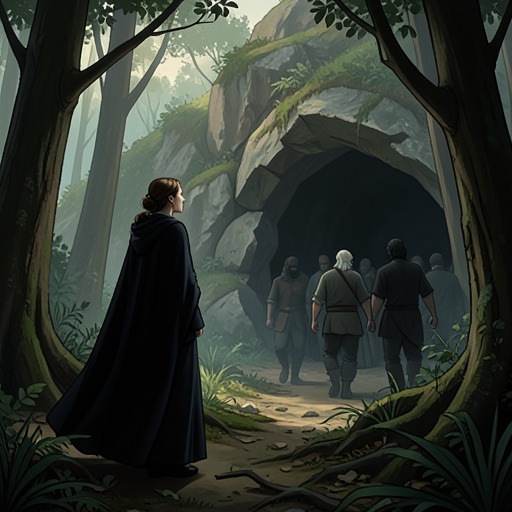
Callisto gives birth to Arcas
ArtemisCallisto gives birth to Arcas after being transformed into a bear and driven into the wilderness. The episode is both an act of survival and a turning point in her story: Eileithyia, the childbirth goddess whose aid Hera had once withheld from Leto, now helps Callisto through labor and ensures that her son will grow up among humans rather than beasts. Yet the birth does not end Callisto’s isolation. She remains a bear, and Arcas is taken away to be raised by King Lycaon.
From threatened mother to laboring bear
Callisto’s pregnancy first becomes undeniable when Artemis sees her swollen belly and understands that the hunter has broken her vow of chastity. The discovery turns the intimacy between the two women into an accusation and precipitates Callisto’s expulsion and transformation. By the time labor approaches, Callisto is living as a bear, with no human speech and no protection from Artemis’s wrath. Her body has been changed, but pregnancy and childbirth continue to impose their demands.
The birth follows an earlier history of childbirth obstructed by divine power. When Leto labored on Delos, Hera kept her daughter Eileithyia from providing aid and imprisoned her for thirty days; Leto endured nine days and nights of pain before other deities helped her into a cave. Artemis, for her part, had claimed a special responsibility to answer women who called to her in childbirth, recalling that Leto had borne her without pain. Against this background, Callisto’s labor makes care for a mother in danger a recurring test of divine authority: the goddess who once represented childbirth’s protection is herself stranded beyond Artemis’s protection, while Eileithyia chooses to help.
Eileithyia’s aid and Arcas’s birth
After catching a fish for food, Callisto runs deeper into the forest and finds a cave where she can rest. She spends an hour dragging leaves and fallen branches to cover its entrance. When she hears rustling in the foliage, she shuts her eyes, expecting Artemis to arrive and shoot her. Instead, the visitor is Eileithyia, formerly the goddess of childbirth. She touches Callisto’s bear snout and offers what she can: she cannot defend her from Artemis, but she can help care for the child.
Callisto cannot answer Eileithyia with words. Her attempt to say the goddess’s name produces only a low rumble and roar, which conveys her thanks without restoring her human voice. By morning, her determination has risen even as her body weakens; labor may begin at any moment, and the cave becomes the place where she gives birth. The scene makes the cave a refuge for the immediate work of childbirth, not a way out of the forest or the dangers that brought her there.
Eileithyia names the boy Arcas, explaining that he will be the father of all Arcadians, lead mortals to triumph, and be honored through the cities built in his name. Her prophecy gives the child a future and a lineage reaching beyond the cave, while Callisto remains unable to speak or resume her former life. Zeus later sends Hermes to take the infant to King Lycaon, so that he can grow up among people instead of beasts. Callisto agrees to this arrangement and continues living as a bear.
Care, separation, and the limits of rescue
The episode’s rescue is deliberately incomplete. Eileithyia comes to Callisto at the moment she expects Artemis’s arrow, and her offer distinguishes two kinds of help: she cannot stop the goddess’s anger, but she can assist with the child. She stays with the immediate needs of birth and care, while the decision to place Arcas among mortals provides him with a future beyond his mother’s animal existence. The arrangement saves the child from growing up in the wilderness, but it separates mother and son soon after his birth.
That separation also echoes the earlier story of Leto without simply repeating it. Hera had used Eileithyia’s confinement to prolong Leto’s labor; here Eileithyia acts as a helper to Callisto, even though she explicitly cannot shield her from Artemis. Divine care is present, but it does not undo divine violence. Callisto survives childbirth and consents to Arcas’s placement with King Lycaon, yet she continues to roam the forest alone, still in bear form.
Legacy and tragic irony
Arcas’s announced future gives Callisto’s motherhood a legacy that reaches into Arcadian human society: he is destined to lead mortals, and cities will honor him. But this promise is delivered at the very point when the mother cannot accompany her child into that society. The story places a celebrated lineage beside the intimate costs of its beginning: a laboring body weakened by transformation, a cave provisioned with leaves and branches, a mother who can only rumble her gratitude, and an infant carried away by Hermes.
The birth therefore changes Arcas’s circumstances more completely than Callisto’s. He is transferred from the danger of the forest to human care, while she accepts the separation and resumes an aimless life as a bear. Her son’s prophesied future preserves a connection to her, but it does not restore her voice, her human form, or her place among Artemis’s companions. The episode offers a moment of shelter and a path forward for the child, while leaving Callisto’s banishment unresolved.