Edgar Stark’s sculpture of Stella’s head
AsylumEdgar Stark’s sculpture of Stella’s head is the surviving centrepiece of the art Edgar left behind when he fled the Horsey Street warehouse loft. Worked down until it was tiny and anguished, then fired and cast in black bronze, the head passes into Peter Cleave’s keeping: a likeness whose artistic delicacy is inseparable from Edgar’s obsessive attention and Peter’s possessive attachment to Stella Raphael’s image.
Creation and Form
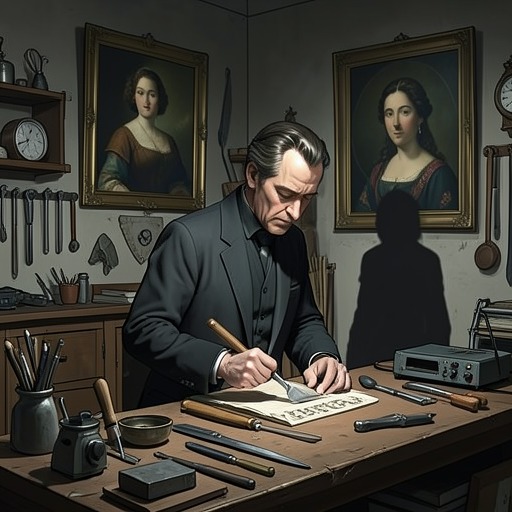
In the last days before leaving Horsey Street, Edgar worked obsessively on the head, reducing it until it was slender and tiny. It was left in the studio with the drawings he had made while Stella Raphael was there. Peter Cleave later described the finished object as thin, beautiful, tiny, and anguished, no bigger than his hand. Its small scale records the process of working it down, while its likeness remains unmistakable to Peter: it is her.
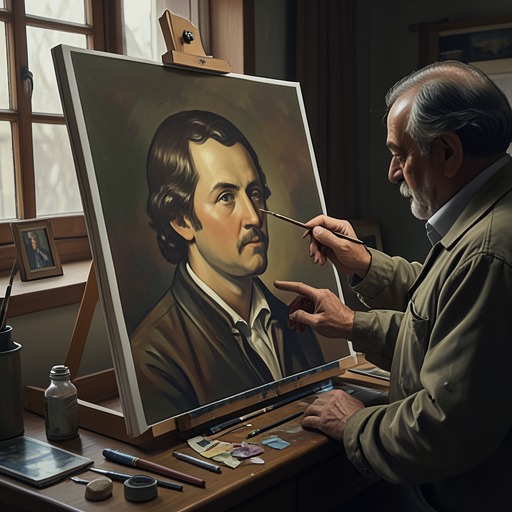
The sculpture belongs to a group of works that also includes drawings of Stella Raphael made in the studio and a sketch made in the Vegetable garden. Peter found the drawings tentative in outline and feature, giving them a softness he associated with the Italian term morbidezza. The head is distinct within this group: a three-dimensional likeness, obsessively shaped and ultimately preserved as a cast.
Abandonment and Custody
After Stella Raphael left the Horsey Street warehouse loft, Edgar returned there and stayed alone for three days, working without rest on the head. On the fourth day, someone apparently warned him that the police were coming. Edgar fled with a few clothes and books in a duffel bag, leaving the head and the drawings behind. The police arrived only minutes after his departure; Stella appeared only minutes after them. The contents of the studio were impounded.
Peter was later invited to inspect the impounded works for anything that might shed light on where Edgar had gone. The police subsequently accommodated him by giving him all the drawings of Stella Raphael, including the Vegetable garden sketch, as well as the head. He had the sculpture fired and cast in black bronze, then kept it in a drawer in his desk. He took it out repeatedly during the day to admire it, turning a work abandoned during Edgar’s flight into an object of private and continuing attention.
Likeness and Possession
The sculpture’s significance rests on the difference between making an image and possessing the person it depicts. Edgar’s work on the head came during the final days of Stella’s presence at the loft, and Peter interprets the sculpture in light of Edgar’s idealization of her and his struggle with passions that could not be contained by the image he had made. Edgar had claimed to be trying to overthrow habit and convention in seeing, and to work against certainty; Peter wonders whether the last sculpture was also an unconscious attempt to reach that problem. The work thus holds together an artistic question about seeing and the unstable idealization of a beloved person.
Peter’s own response repeats that tension in another form. He keeps the cast close at hand and returns to it throughout the day, treating the likeness as a lasting substitute for Stella Raphael. His concluding claim, “So you see, I do have my Stella after all,” makes the sculpture’s emotional function explicit: Edgar’s abandoned image has become Peter’s possession. The head preserves Stella as an artwork, but its presence in Peter’s desk also exposes how readily a likeness can be made to stand in for a person.