Stella’s black silk evening dress
AsylumStella’s black silk evening dress is the central object in the hospital dance’s shift from apparent defiance to concealed longing. Worn again a year after Stella first wore it to dance with Edgar Stark, it appears to the hospital community to declare her dignity; Peter Cleave eventually understands that Stella has put it on for Edgar, preserving in its fabric the memory of their union.
Appearance and Return
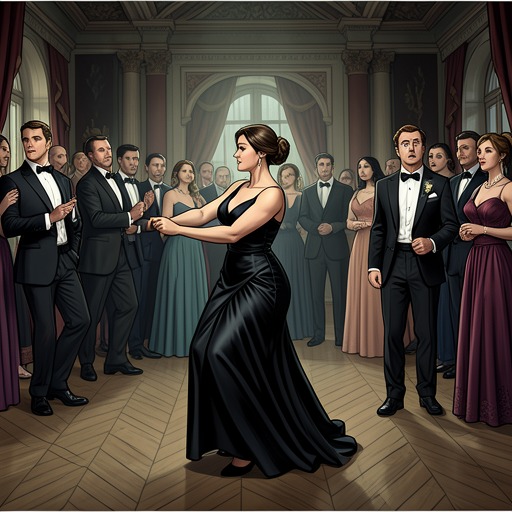
The dress is made of coarse ribbed silk, cut low at the front, and Stella wears it beneath a loose black shawl as she joins the other women on the way to the Central Hall. The smart clothes she brought from Wales have become too tight, but she has chosen this particular garment with care. Its return is striking: it is the same dress she wore to the dance a year earlier, when Edgar took her in his arms. The passage of a year and the change in Stella’s circumstances make its recurrence more than a matter of clothing.
At the earlier dance, the dress belonged to a scene of intimacy with Edgar. At the hospital dance, it appears in a room where Stella is a patient and the staff and patients know her history. The chaplain and Peter see her enter; Peter recognizes the garment and is astonished. Stella’s appearance draws the other women’s admiration, while covert glances from staff reveal how closely they watch her. Her choice makes the past visible in a setting that might otherwise present her only through her present institutional role.
A Public Gesture and a Private Meaning
The dress is first read by Peter as a sign that Stella’s spirit has survived shame: he sees her wearing it before the hospital community and takes the gesture as pride and defiance. He watches over her with affection and solicitude, and she is not disturbed by the attention. Yet that reassuring interpretation is Peter’s, not a meaning Stella explains. The dress’s power in the scene lies partly in the gap between what he thinks he sees and what she may intend.
Later, while writing in his office, Peter recalls the dress and the night Edgar took Stella in his arms. He realizes that she wore it not to make a statement to the hospital but for Edgar: in her private meaning, it is her wedding dress, associated with the night she became joined to him. The recognition overturns Peter’s first reading. The garment can look like a declaration of dignity to onlookers while carrying, for Stella, an intimate attachment they cannot see.
Consequences and Significance
Once he understands the dress as a sign of Stella’s continuing love for Edgar, Peter fears that he has mistaken her state of mind. He recognizes that his own private concerns have clouded his judgment, a failure he identifies as Countertransference. He telephones the female ward and asks an attendant to check Stella’s room. The attendant finds her in bed, asleep and breathing deeply; this reassures Peter about her immediate condition but leaves him profoundly uneasy.
The dress therefore does not simply revive a past encounter. It exposes the limits of Peter’s interpretation of Stella and links the public ceremony of the dance to a private hope he had failed to recognize. Its repeated appearance makes it a material record of a relationship that Peter had treated as finished. Even after the check on Stella’s room, the dress’s meaning remains consequential: Peter now understands that the old attachment may not be dead, while the scene offers no assurance that his new understanding can undo the consequences of his earlier misjudgment.