Max’s clothes
AsylumMax’s clothes are a domestic wardrobe turned into an instrument of concealment. Edgar Stark takes a bundle from the Raphael home while visiting Stella Raphael, hides it in the woods at the garden’s end, and later wears it to escape the psychiatric hospital disguised as Max Raphael. The garments connect an illicit bedroom encounter to the delayed discovery of Edgar’s flight, then reappear on him in London as a private sign of the escape’s success and the affair’s continuing secrecy.
From the Bedroom to the Garden
Edgar’s first appearance in Stella’s bedroom is already a collision of identities and settings: he is wearing the blue shirt and yellow corduroys of a patient, while Stella is at home with Max and Brenda Raphael. Their hurried encounter takes place in the master bedroom, where Stella feels the danger and excitement of being caught. After they hear a car arrive, the two scramble out of bed and dress. The clothes in the scene are not incidental: Edgar has entered the household in his patient’s uniform, but he will leave carrying part of Max’s wardrobe.
As Stella goes upstairs, Edgar comes down through the kitchen with his boots in his hand. She hurries ahead to open the back door and check that nobody is in the yard. Only then does she see the bundle tucked under his arm: Max’s clothes. When she whispers a question, Edgar puts a finger to her lips and crosses the yard boldly. The gesture turns the theft into a secret shared between them, while the clothes themselves pass unseen through a home in which Brenda is staying. Stella returns upstairs and finds the cupboard open, with garments missing from several hangers on Max’s side. She is making the bed again with clean sheets when Brenda appears in the doorway, unaware of what has just been concealed.
A Disguise Prepared in Secret
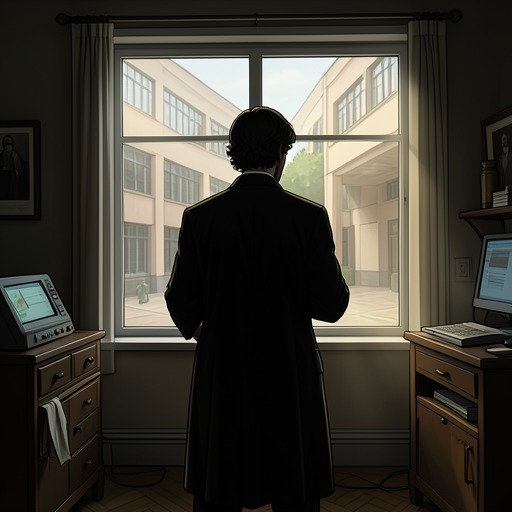
The clothes acquire a second function after Edgar returns to the hospital. The account of his escape is explicitly reconstructed rather than witnessed: the staff believe that, after lunch, he told John Archer that he was wanted in the chaplain’s garden and then went off alone. He retrieved Max’s clothes from the place where he had hidden them in the woods at the end of the Raphaels’ garden. Wearing them, he left the estate, keeping away from the road until he was clear; from there, he made his way to London by an uncertain combination of hitchhiking, bus, or train.
The disguise makes clothing do practical work in the plot. The stolen garments carry Edgar from the hidden edge of the family garden into the hospital grounds and enable him to leave wearing someone else’s clothes. Their route also exposes a lapse in the hospital’s security: Edgar could retrieve the bundle he had concealed outside, while the work parties were insufficiently monitored. Max’s clothes are thus not merely the means of escape; their absence becomes evidence that something has happened, although it does not immediately reveal where Edgar is.
The Delay and Its Cost
When the clothes go missing, the hospital searches Edgar’s room and then the ward, but finds nothing. Max does not promptly establish Edgar’s whereabouts in the chaplain’s garden. Instead, after returning to the hospital and checking with staff in Block 3, he goes to his office and waits another half hour before calling Jack Straffen. By then the working parties are due back, and John Archer has already discovered that Edgar is missing. The clothes turn a private theft into a problem of institutional timing: their disappearance could have prompted an earlier search, but Max’s delay leaves Edgar more time to get away.
The narrator suggests that Max was determined to understand what had happened before approaching Jack, and that this determination contributed to his mistakes. The most humiliating fact for Max was that the escaped patient was wearing his clothes. In the hospital’s account of the escape, the garments therefore expose both Edgar’s deception and Max’s intimate connection to the events. What had been taken quietly from Max’s cupboard at home returns as the unmistakable detail that makes the escape personal as well as procedural.
Recurrence in London
Later, as Stella leaves Edgar, she sees that he is wearing Max’s linen jacket and trousers, the latter cinched at the waist with a narrow leather belt. The sight makes her smile whenever she thinks of it. This later detail gives the stolen bundle a visible afterlife: Edgar is no longer only the fugitive who wore Max’s clothes out of the hospital, but a man still dressed in garments belonging to Stella’s husband. The clothes preserve the affair’s material overlap with the household Stella has left behind.
That recognition also contrasts the clothes’ two uses. At the hospital they serve as disguise, helping Edgar cross the boundary between institutional confinement and escape; in London they are a familiar, almost comic reminder of how the escape depended on Max’s wardrobe. Their movement from cupboard to garden hiding place, from the hospital grounds to Edgar’s fugitive life, makes an ordinary set of garments a compact record of concealment, risk, and the continuing entanglement of Stella’s two lives.