Housework and daily order as self-preservation
AsylumHousework and daily order are not merely background domestic details in Stella Raphael’s life: they are first the largely unacknowledged labor that keeps her household functioning, and later a structure she uses to endure its collapse. As the family’s security and affection weaken, routine becomes something Stella can still organize and hold together when she can no longer imagine a future.
Labor That Keeps the Household Running
During a summer of upheaval, Stella tells Max Raphael that while the household fuss was going on, the house stayed clean and meals appeared on time. She had managed both, she points out, not his mother. Max says he knows, but Stella stresses that this is the first time he has acknowledged what she did. Her complaint is not only about the work itself: she had seen how difficult the summer was for him, while he had not considered what the same period demanded of her. Domestic order has depended on her labor even as that labor remained easy for him to overlook.
Packing for the family’s move gives this work a different form. Stella wraps china and glassware, packs pictures, clothes, and bedding, and labels the boxes and crates. Mrs. Bain helps, though reluctantly. The tasks are repetitive and practical, but Stella understands their emotional premise: packing treats the family as a unit that can move together and remain coherent. She cannot conceive what binds them or what future makes the move meaningful, yet feels she has no alternative. The orderly packing of possessions thus gives physical form to an old family life even as its cohesion becomes uncertain.
Domestic Space and Fraying Relations
The household’s practical arrangements register the growing distance between Stella and Max. With the spare bed now in Charlie Raphael’s room, Max has to keep his suits in Stella’s room and take out at night the clothes he will need in the morning, because she does not want him entering early and waking her. He also lacks a satisfactory place to work: papers spread on the sitting-room table are disturbed whenever someone uses the stairs from the kitchen. These small accommodations turn shared rooms and routines into evidence of a relationship that no longer offers uncomplicated intimacy.
The persistence of domestic forms does not mean that the household is happy. Stella half expects to return from an outing to find the locks changed. She discusses this fear with Trevor Williams, who tells her that nobody can change the locks on the house but him; the assurance eases her mind to some extent. Meanwhile, the silent meals and widening gulf between family members continue. Housework and cooking do not repair those relations, but they preserve a daily framework within which Stella can keep functioning.
Routine as Self-Preservation
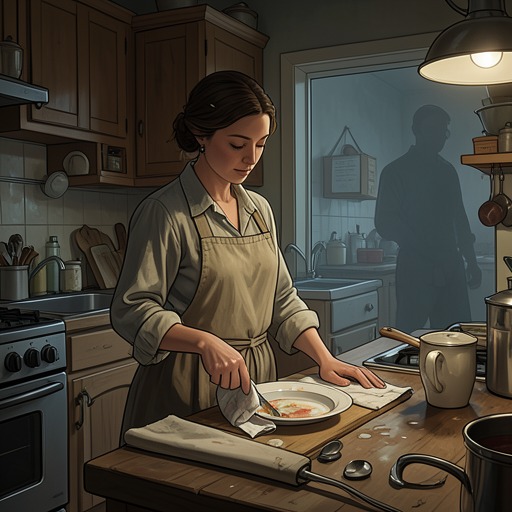
As despair arrives without warning, Stella holds to making the beds, doing the laundry, and cooking dinner. The narration distinguishes this labor from service to her family: she does it for herself. Silence, hatred, misery, and futility are things she can tolerate, but disorder and chaos are not. A clean house and meals made to plan provide a measure of order that she needs when little else feels dependable.
The evening routine narrows her horizon to a single day. After the silent meal, Max and Charlie may go for a walk if the weather is dry; Stella clears up, washes the dishes, has another drink, and watches the light fade. She measures success by getting through the next few hours and reaching sleep without going mad. The future has ceased to offer her a goal, so the repeated tasks of the present become a form of endurance: they do not resolve her isolation, but help her survive it one day at a time.