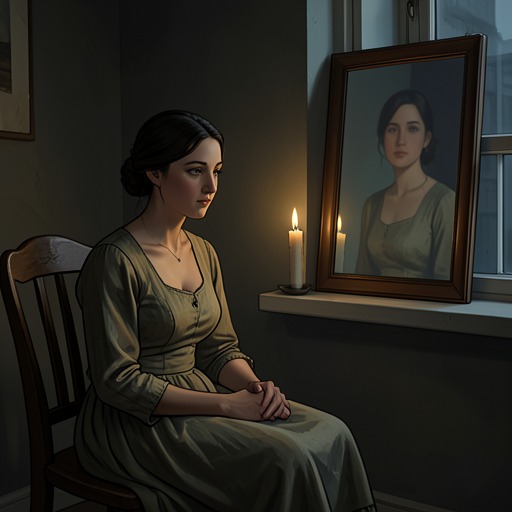
The woman of sorrows
AsylumThe woman of sorrows is the tragic identity Stella Raphael develops after Charlie Raphael’s death. It makes grief legible to other people as poise, dignity, and a carefully sustained air of sorrow. In the hospital, the role wins her respect and allows her to shape how others see her; to Peter Cleave, it can look like evidence of spiritual recovery. Yet the narrative gradually exposes the gap between that reassuring interpretation and Stella Raphael’s inward life. Her composure is neither simply false nor proof that she is healing: it is a performance built around genuine loss, under conditions in which being seen to behave well has practical consequences.
Origins and Meaning
The role takes shape after Stella Raphael’s life changes from that of a doctor’s wife to that of a patient. Charlie Raphael’s death on Cledwyn Heath is the grief around which the hospital’s—and Peter Cleave’s—understanding of her begins to organize itself. She presents herself as a woman marked by sorrow, and the narrative draws on the conventions of a Victorian melodrama: a dignified heroine whose visible suffering suggests an inward moral and spiritual ordeal.
This image also answers a problem of status. On the ward, Stella Raphael is aware of the humiliation of having become a patient and of the veiled contempt she senses from patients and staff. She has received special favor from the superintendent, which makes her position more conspicuous rather than less. The sorrowful persona offers a way to appear neither defiant nor abject. At the same time, its melodramatic shape gives her experience a story: suffering becomes an identity she can present and, to some degree, control.
Performance and Hospital Life
The role gains force through repetition and detail. As she becomes part of hospital life, Stella Raphael maintains some detachment without withdrawing into isolation. She dresses in somber blue, gray, and black, carries a book, and visits the hospital library. Her small, sad smile and composed manner become recognizable signs; staff and patients respond with respect, even deference. The image is not an isolated pose but a presence she sustains among other people.
That composure takes place inside an institution where appearances have consequences. A patient’s perspective on the ward system is that behavior accepted as ordinary in the admissions ward may be treated as evidence of improvement downstairs. The lower ward offers greater privacy and freedom of movement, but reaching it involves learning what conduct the institution recognizes as recovery. Stella Raphael’s performance therefore has a practical setting: calmness and self-command can help her navigate a system in which visible distress may be classified as illness. Her particular version of composure turns sorrow into something others can acknowledge without requiring her to display it openly.
Peter Cleave’s Interpretation
Peter Cleave reads Stella Raphael’s bearing as evidence that she is facing and accepting what happened on Cledwyn Heath. When he raises Charlie Raphael’s death, she gives him the impression that she thinks constantly about its horror and moral gravity. He imagines remorse transforming her, as though the hospital were a religious retreat and Stella Raphael a woman undergoing purification. His account makes her sorrow a sign of inward change.
The narrative complicates that account by showing the deliberate construction of her image. Stella Raphael imagines herself as a wounded figure whose grief might invite Peter Cleave to approach the wound, yet she also anticipates that he will not force the silence open. At the bookcase, she runs a finger along the spines, pauses, and returns to her chair without making the implied appeal explicit. The moment reveals both the force and the limits of the persona: it communicates pain, but it also controls how far another person may investigate it. Peter Cleave’s sympathy and hope do not give him full access to what she feels.
The Dance and the Farewell Image
The hospital dance brings the role into public view. At first Stella Raphael recoils from attending. To appear as the woman of sorrows at a dance would expose the contrast between the composed identity she has built and her changed, vulnerable position. She fears being seen not as a tragic heroine but as a fallen and pathetic woman. Yet she also weighs whether refusing to attend would seem like an act of nonconformity to Peter Cleave, who remains her psychiatrist. She decides that the dance is a final challenge in her short career as a mental patient and prepares her clothes, makeup, and hair with care.
The preparation has a darker counterpart: Peter Cleave later calculates that around this time she stopped swallowing her medication and hid the pills. His account is explicitly reconstructive, not a scene he claims to have witnessed. The contrast matters. Publicly, Stella Raphael is preparing a controlled appearance; privately, the concealed medication signals a crisis that her performance does not disclose.
At the dance, she appears in a black silk evening dress she had worn at the hospital dance a year earlier, with a loose black shawl over her shoulders. The women around her take pride in her beauty, and the scene casts her as the flower among her handmaidens. Peter Cleave recognizes the return of the dress and interprets her choice as a gesture of a spirit unbroken by shame. The moment fulfills the role’s public design, but it does not confirm his larger belief that her sorrow is leading to recovery. Instead, the carefully staged farewell appearance makes the difference between what the hospital can see and what Stella Raphael is concealing especially stark.
Narrative Significance
The woman of sorrows is both a way of being seen and a way of managing exposure. The persona earns respect and lets Stella Raphael preserve dignity in a place where behavior is observed and interpreted. Its conventions also shape Peter Cleave’s response: he sees an image of penitence and healing where the narrative shows calculated self-presentation alongside authentic grief and hidden danger.
The concept therefore resists a simple division between sincere feeling and deception. Stella Raphael’s grief is not disproved by her ability to perform it, and the role’s usefulness does not make it a full account of her inner state. Its tragedy lies partly in how effectively the image works: other people can recognize sorrow, admire composure, and believe in recovery, while the suffering that matters most remains beyond their view.