The hospital as refuge and confinement
AsylumThe hospital as refuge and confinement is a defining contradiction in Stella Raphael’s story: she comes to imagine the institution as a haven of order and safety, yet its walls, locked doors, ward classifications, and medical authority make it a place of enforced restriction. That contradiction follows her beyond the grounds. When she and Edgar Stark flee, Stella still longs for the security the hospital seemed to offer; when she is later brought back, the imagined refuge becomes a barred room and a locked door.
Architecture and Institutional Order
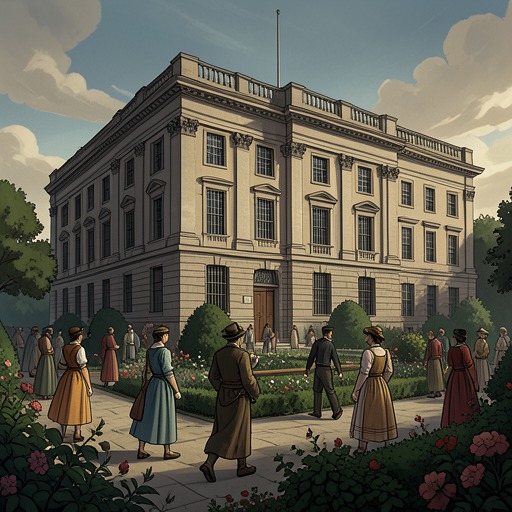
The hospital is a maximum-security complex set high above the surrounding country, with pine forest to the north and west and marshland to the south. Its Victorian plan radiates from the main blocks, giving the wards views across terraces toward the open country beyond the Wall. That prospect of openness is framed by a deliberately controlling design: windows are barred, doors open outward so they cannot be barricaded, and the buildings embody regularity, discipline, and organization. Terraces, trees, grassy banks, and flower gardens soften the setting without removing its carceral character.
The deputy superintendent’s house stands within this institutional landscape, about a hundred yards from the Main Gate. When Max Raphael takes the position, Stella and Max move into a large, dark house whose neglected garden and conservatory Max begins to restore. The grounds therefore combine domestic life and hospital operations rather than separating them. Edgar, a parole patient, is assigned to work in the garden; Stella encounters him while picking vegetables and flowers. The institution’s boundaries are present, but daily contact across them is possible—and becomes consequential.
The hospital also contains sharply different living conditions. Stella learns from Edgar about overcrowded wards, including a dormitory holding sixty men despite being meant for thirty, primitive plumbing, little privacy, bullying, and boredom. Edgar himself is in Block 3, where parole status has given him a room of his own, but that comparatively privileged arrangement does not dispel Stella’s indignation about the treatment of patients. Her new view challenges the psychiatric perspective she had previously known chiefly through Max’s work.
The Refuge Stella Imagines
As Stella’s attachment to Edgar develops, she increasingly identifies with his experience inside the hospital. She begins to regard his confinement less as a necessary response to illness than as an injustice, and is tempted to interpret his crime as an act of passion. Her changing judgment reveals how the hospital can look different from different positions: a place of management and treatment to its administrators, but an everyday world of indignity and uncertain release to its patients.
After Stella has left her family and is living with Edgar in a derelict warehouse on Horsey Street, the hospital recedes in her mind into an idealized place where the sun always shines, order prevails, everyone knows their place, and no one suffers want. She recognizes that this picture is an illusion, yet finds comfort in it. The reversal is pointed: she and Edgar have fled the place she now remembers as secure, while their new surroundings lack the warmth and plenty she associates with it. The refuge is less a destination than an image of safety that she carries with her.
That image has material roots in the orderly institution she knew, but it also depends on distance from its costs. The same system that provides structure and a sense of provision restricts movement and decides when a patient may leave. The hospital’s open-country views do not cancel its perimeter; its gardens are both cultivated spaces and part of a secure estate. Stella’s idealization holds these opposing truths together by emphasizing the order she longs for and muting the confinement she had once accepted as ordinary.
Escape and the Limits of Security
Edgar’s escape exposes a vulnerability in the hospital’s control of its grounds. While working with an outside party, he leaves the group, retrieves Max’s clothes from the woods at the end of the Raphaels’ garden, and uses them as a disguise. He keeps away from the road until clear of the estate, then makes his way toward London. The account identifies lax supervision of the work parties as a serious security failure. It also shows that the institution’s boundaries could be crossed through an ordinary opportunity created by garden work and the concealment of clothing.
The escape has consequences inside the institution as well as beyond it. The hospital must answer for allowing a parole patient to work in its gardens, while the press renews attention to Edgar’s case and to his daily release from the grounds. His history makes the failure especially grave: he had killed Ruth Stark with a hammer, and the court had accepted an insanity defense after psychiatrists testified that he suffered from paranoid psychosis. Although he had regained his equilibrium and functioned at a high level, he remained fixed in the belief that the murder was justified. The hospital’s judgment that he was not ready for release had not prevented him from absconding.
Return, Treatment, and Confinement
After Charlie Raphael drowns, the public interpretation of Stella’s stillness at the water turns sharply against her. Hugh Griffin says that she stood smoking while Charlie was in trouble and did not raise an alarm; whether a shout could have saved him is later disputed, but the failure to react provokes condemnation. Stella is remanded, questioned, and held in a police cell. Her detachment is described as a state in which she watches herself endure events, as if from a barricaded place within her own mind.
Peter Cleave tells Stella that she will go to his hospital because she has been ill and he wants to treat her. He considers himself best qualified to do so and uses his position to arrange her return, despite recognizing that bringing her back may appear dangerous or unorthodox. The return is therefore both a proposed course of treatment and an exercise of institutional power. Stella agrees to be treated, but the decision takes place amid police custody, her dependence on Peter, and his insistence that she also make peace with Max.
Her admission makes the contrast between refuge and confinement physical. She arrives by police car with three suitcases, including most of her evening clothes and her black silk dress, and enters through the gate of the female wing rather than the Main Gate. After a formal interview and examination, she is bathed, dressed in a cotton shift, and taken to a room with a barred window, a barred grate in the door, a bed, a toilet, and a basin. She wants to ask the staff not to leave or lock her in, but cannot bring herself to say it. The door shuts and Mary Flynn turns the key; later, Stella is given tea and pills prescribed by Peter.
The hospital’s ward system makes release and restriction more graduated, not absolute. Stella learns that patients moved downstairs are expected to display self-control and behave as though they accept confinement. From her perspective, appearing to accept conditions is what marks a patient as improving; from the medical perspective reported by Peter, the effort of self-control is a first step toward recovery. Downstairs brings greater privacy and freedom of movement, and patients can wear their own clothes, but distress remains liable to be interpreted as illness and treated with drugs. The hospital can thus offer care, routine, and limited autonomy while also regulating behavior and access to freedom.
Stella’s changing relation to the hospital gives its dual meaning its force. It is the ordered haven she remembers when life outside becomes precarious, the institution whose deficiencies she glimpses through Edgar’s account, and the secure system that fails to prevent his escape. After Charlie’s death, it again becomes a place where she is cared for—but also locked in, observed, medicated, and classified. Neither refuge nor prison alone accounts for it; the story makes its shelter inseparable from the authority that confines its patients.