Separating a person from his illness
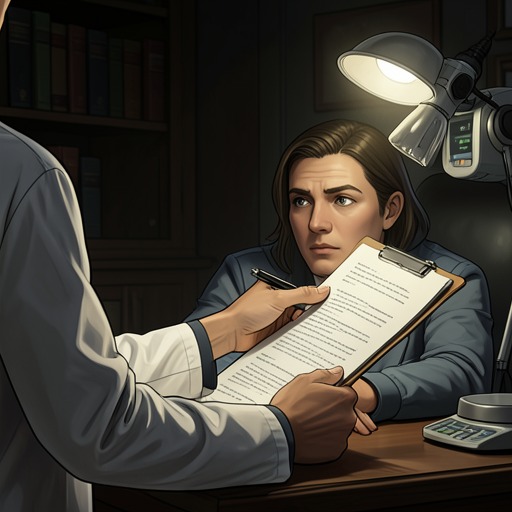
AsylumSeparating a person from his illness is a fragile distinction in the novel: Stella uses it to preserve her love for Edgar, while Peter Cleave uses a related clinical argument to urge care rather than punishment for Stella. The idea offers a way to recognize that illness shapes behavior without making a person identical to it. Yet the story keeps testing its limits. Edgar’s delusions do not remain safely separable from his violence, and Stella’s effort to imagine him as recoverable helps sustain a relationship that becomes dangerous. After Charlie’s death, the same language of illness also enters the family’s debate over Stella’s responsibility and future.
The clinical and moral premise
Peter’s account of Edgar establishes the problem in stark terms. Edgar had killed his wife, Ruth Stark, with a hammer after becoming convinced that she was unfaithful. He later regained his equilibrium and took part in hospital activities, but he showed no insight into the delusions behind the murder and continued to insist that Ruth had driven him to it. His supposed evidence consisted of ordinary details to which he gave extravagant meanings. For Peter, apparent recovery in everyday functioning could not settle the question of whether Edgar remained dangerous: the justification of the murder persisted even when other aspects of his sanity seemed restored.
The legal and clinical judgments surrounding Edgar are related but not identical. Two psychiatrists testified that he suffered from a paranoid psychosis, and the court accepted the insanity defense. He was admitted to the hospital the following day. The verdict addressed his legal responsibility; it did not mean that the delusions had disappeared or that his insistence on the murder’s justification had been resolved. Peter’s account of the case thus makes separating a person from an illness more complicated than simply excusing a terrible act. The diagnosis helps explain the circumstances of the killing, while Edgar’s continuing beliefs remain consequential to decisions about his release and safety.
Stella’s effort to preserve Edgar
Stella’s clearest attempt to separate a person from an illness comes after she has fled Edgar and spent two days with Nick. She imagines Edgar in the grip of a mental storm, and insists to herself that the storm is not the man she loves: it will pass, and he will recover and become himself again. She has no practical account of how that future reunion might happen. The distinction is instead an act of emotional faith, allowing her to avoid Edgar while continuing to regard their relationship as intact.
That effort is tested when Edgar watches her eat an orange with visible hesitation. Stella recalls Peter telling her that Edgar had suspected Ruth of poisoning his food. Until then she has rationalized Edgar’s violence and explained his jealousy; the suspicion about the orange makes the pattern newly immediate. She fears that he may turn on her as he did on Ruth, and understands that she must get away. Significantly, she describes her fear as fear not of Edgar himself but of the madness in him. The distinction registers a genuine recognition of danger, but it cannot protect her from it: she believes she must conceal her terror lest Edgar detect it and become violent. Her understanding arrives inside the threat, not safely outside it.
From explanation to care
Peter later extends the language of illness to Stella’s conduct. After she has returned to her family in Wales, he urges Max to adopt a detached psychiatric perspective: Stella has suffered a hysterical illness, is burdened by guilt, and needs help. He argues that the affair with Edgar and its aftermath mean she is not wholly culpable and requires care rather than punishment. This is an interpretation advanced by Peter, not a neutral account that erases the harm Stella has caused or the anger Max feels. Max adopts the argument when speaking with Brenda, who is skeptical of its reach but agrees to the proposed family dinner.
The dinner becomes a practical test of this approach. Max wants to reverse Brenda’s exclusion of Stella and bring the family together; Stella agrees to try. She plans the meal, shops for the ingredients, and prepares kidneys, while Max reads her willingness to participate as a possible sign of improving morale. The domestic labor does not prove that she is well, but it gives the family a form through which care and reconciliation can be attempted. In Peter’s reasoning, treating illness as relevant to Stella’s behavior changes what the family should do next: offer patience and understanding, rather than treat her only as someone deserving punishment.
Charlie’s death and the limits of interpretation
The distinction reaches its gravest test when Charlie drowns. During an episode of numbness and dissociation, Stella watches him struggle in the water without calling out or moving to help. Hugh Griffin later insists that Charlie was screaming and that Stella stood smoking; he believes that an alarm might have saved the boy, though the possibility is disputed because of the distance. The other adults’ sympathy gives way to horror and condemnation. Stella is remanded on a manslaughter charge, and her detachment from her own actions is rendered as an experience of watching herself endure questioning from both within and from a point above and to the side.
Peter interprets the death through psychiatric concepts, describing Stella’s conduct in terms of a maternal pathology and a Medea complex. He further claims that, in the water, what she saw in extremity was Edgar rather than Charlie or Max. These are Peter’s clinical explanations of a disturbing scene, not facts that remove the event’s uncertainty or its consequence: Charlie is dead, and Stella did not summon help. The gap between what observers call evil and what Peter calls illness reveals the ethical pressure built into the concept. Explanation may make care possible, but it cannot restore the child or make the observed act disappear.
Recovery, performance, and delayed feeling
The hospital’s ward system makes improvement partly a matter of visible conduct. From a patient’s perspective, the women moved downstairs when they learned to behave as though confinement were acceptable; the self-control that appears to signal progress can therefore resemble a performance. Downstairs offers more privacy and freedom of movement, but grief may still be treated as a symptom and addressed with drugs that patients fear will dull their alertness. Stella, too, understands that she must appear calm and composed, while not knowing how long that performance must continue.
Peter nevertheless reads a later change as the beginning of recovery. Stella reports terrifying dreams that wake her in darkness with a sense of panic, screaming, and a throbbing headache. She tries to dismiss the dreams and asks for aspirin, but Peter believes that the sounds are those of a drowning child and that guilt is beginning to emerge after being repressed. He concludes that she has let go of Edgar and started to confront Charlie’s death. The distinction between person and illness thus remains unsettled at the novel’s close: Stella’s outward composure, her delayed emotional response, and Peter’s clinical account offer different ways of describing change, without making the loss or the unresolved responsibility less real.