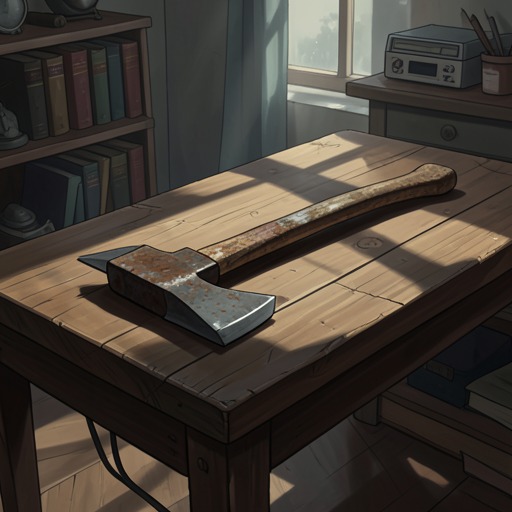
Axe
AuerhausThe Axe is a missing object bound to two moments that frame how the narrator remembers Frieder: the felling of the village Christmas tree and the search through Auerhaus after the funeral. Its significance lies not only in what it could do, but in the stories attached to it. For the narrator, the Axe recalls Frieder’s irreverent act in the village; after Frieder’s death, its disappearance leaves the people who shared the house looking for a way to handle an ending they cannot undo.
The Christmas Tree and Frieder’s Story
At the funeral, the police chief, Bogatzki, brings up the Christmas tree, observing that it had always mattered to the municipal workers. The remark points back to the public importance of the tree and the disruption caused when Frieder cut it down. The Axe is tied to that act, which remained vivid enough to become the narrator’s chosen opening when telling people about Auerhaus and Frieder.
The narrator could begin with the funeral instead. He refuses that as the first story, because it feels wrong to tell Frieder’s life by starting with its end, as if death were the most important thing about him. Beginning with the tree gives the memory a different point of entry: not a finality imposed by the funeral, but Frieder acting in the middle of village life. The Axe thus belongs to a remembered deed that keeps Frieder’s story from being reduced to his death.
The Missing Axe
Later, back at Auerhaus, Vera asks where the Axe is. The question makes its absence newly urgent. The front door is unlocked, and the bolt has been missing since the house search; the group has little sense of security as they begin looking through the house. Harry says he will not go inside, while Vera and the narrator search the stable, the hayloft, and the cellar. In a pit in the clay they find two partly decayed toads, but not the Axe.
They go upstairs. The narrator notices how worn the staircase is, its wooden hollows smoothed like stream pebbles. They search cupboards, spaces under the sloping roof, and behind the bathtub. At last they even try the windowless room, the darkroom, but when the narrator turns on the light, nothing happens. The widening search moves through familiar rooms and into the house’s less accessible corners without producing the object they have come to find.
Vera’s question is not answered by the search. The narrator asks whether she is joking, though he knows she is not. They leave without the Axe. The search therefore ends not in recovery but in absence: the object that once stood behind a conspicuous public act cannot be located in the former shared home.
A Tool, a Memory, and an Unresolved Ending
The narrator imagines what the group could do with the Axe if they found it. He wonders whether to take it to Berlin or put it in Frieder’s grave. Neither possibility offers a simple resolution. Laid on the coffin lid, it would be useless, he thinks; to smash the coffin, the Axe would have to be inside it. The imagined placement turns a practical tool into part of a desperate, impossible exchange with the dead: even possessing it would not make Frieder’s death reversible.
The Axe consequently links the narrator’s way of telling Frieder’s story to the survivors’ inability to close it. At the funeral, the narrator refuses to make death the first and defining fact. At Auerhaus, the friends search for the very object associated with an earlier act of destruction, only to leave without it. The remembered felling of the tree remains narratable; the absent Axe and the grave cannot be made into a return or repair. Its role is at once material and mnemonic: it anchors a specific memory of Frieder while giving physical form to what the group cannot recover.