Recruitment Notice Postcard
AuerhausThe conscription postcard is the state’s small, portable summons: a card that calls the narrator back into a system of examinations, files, and military classifications even after his conscription papers have been taken from him. When it arrives, he does not know why he is being summoned again. He carries it with him as he and Frieder set out, then crosses out the address and posts it back. The act is modest, but its destination is decisive: rather than answer the summons, he returns it to its sender.
The summons and the missing file
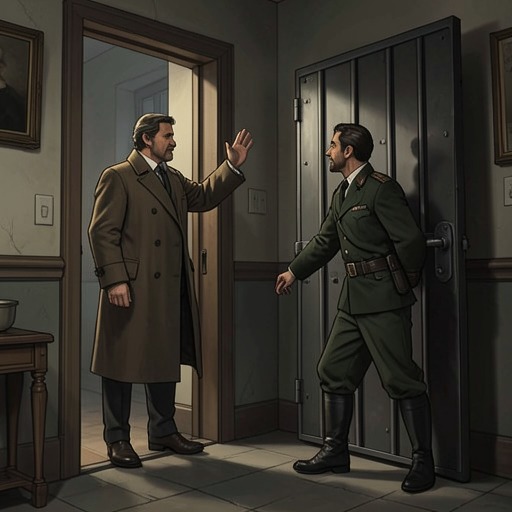
The postcard belongs to a longer encounter with conscription. Bogatzki shows the narrator an official document bearing a stamp and an emblem, ordering the police to collect him and take him for examination. Bogatzki insists that the narrator has already received two summonses and must attend; the narrator had expected a third. The bureaucracy’s demand is backed by police authority, not simply by a letter arriving at home.
At the examination office, the summons leads into a physical and documentary procedure. The narrator waits among other young men while Vera is the only woman present. A doctor examines the file before asking him to undress, and the examination commission ultimately classifies him as fully fit for service, including the possibility of assignment to the guards battalion or paratroopers. The postcard therefore represents more than attendance at an appointment: it opens onto a process that converts a person into a medical record and a category of military usefulness.
That process is disrupted when Frieder takes the narrator’s examination file. Later, while looking through the papers, the prosecutor identifies allegations including theft and suppression of documents; the file’s pages bear official eagles that Frieder has crossed out and turned into images of spits and small campfires. The narrator’s subsequent uncertainty about the new postcard is shaped by this history. He cannot tell whether the file is still with the prosecutor or whether the authorities simply enjoy examining people who have nothing wrong with them.
Carried on the journey
When the postcard arrives, it falls from a mailbox Harry has painted pink. Its physical condition makes the attempted retrieval awkward: it has slipped through the torn lining of the narrator’s jacket, so he has to fish it out from inside the lining. The damaged jacket briefly makes the postcard seem almost lost, but the narrator keeps it. He says it comes in useful, without yet explaining what he intends to do with it.
The card travels with the narrator and Frieder as they leave with a mattress and several boxes in Gluckgluck, which Harry has lent them. Their destination is Berlin, and before entering the pedestrian zone they stop because neither can find the way without a street map. In this departure scene, the postcard is one more object carried into an uncertain next stage: at first it appears to be merely practical, useful to the narrator for a reason he has not disclosed.
Return rather than reply
The reason becomes clear when the narrator takes the postcard from his pocket in the city. He regrets that he cannot keep it as the third card for his Bummbumm folder. Instead, he crosses out the address and writes, “Retour! Unbek. verz.!” He lifts the flap of a mailbox and drops the card inside. This is not an answer to the summons or an attempt to obtain another appointment; it is a direct rejection of the address and the demand attached to it.
The postcard’s return also closes a small suspense created by the narrator’s earlier uncertainty. He has wondered whether the authorities still possess his file or merely want to keep examining him, but the text does not establish which explanation is correct. What it does show is that his response no longer depends on solving that mystery. He returns the card even without knowing why it came, making the act of refusal more important than the institution’s rationale.
Bureaucratic classification and a quiet refusal
The card gathers the book’s examination imagery into a single object. Officials inspect the narrator, read his papers, and assign him a category; his repeated complaint is that they examine people who have nothing wrong with them, then sort them into military roles. Against that machinery, the postcard is both evidence of the system’s persistence and something the narrator can physically handle: he can carry it, cross out its address, and send it back.
Its ending is deliberately smaller than the official process that produced it. No account is given of what the authorities do after receiving the card, and the narrator’s return does not erase the earlier examination or the stolen file. But the sequence marks a change in his relation to the summons. What first appeared to be an unexplained demand that might require another appearance becomes an object he chooses not to obey. The postcard’s final movement is away from the narrator, back into the mailbox, while he and Frieder continue on their way.