Der nackte Russe
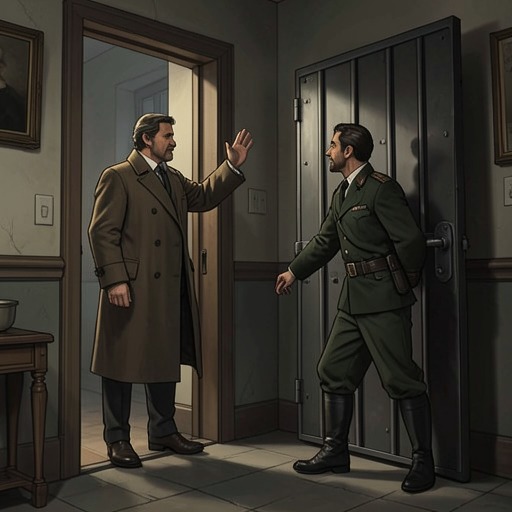
AuerhausDer nackte Russe is the absurd hypothetical at the center of the conscientious-objection examination as the narrator understands it: a naked Russian jumps from the bushes and threatens a candidate’s girlfriend, while the candidate happens to have a rocket launcher. The scenario turns a question about military service into a grotesque test of moral performance. Its recurrence exposes the gap between the answer the authorities expect and the narrator’s refusal to pretend that violence or conscience can be made into a convincing examination script.
The Examination’s Moral Trap
The narrator describes the examination as an oral test of conscience for anyone who does not want to serve in the Bundeswehr. Its examiners pose the nighttime park scenario and expect the candidate to treat it as an impossible choice between two lives. The candidate is supposed to insist that he cannot weigh one person’s life against another’s and is already despairing at the prospect of having to decide.
The prescribed answer makes conscience sound less like a principle than a disabling condition. A successful candidate must claim to carry a weight so immense that ordinary life becomes almost unmanageable: it clings to his shoulders like a sack of potatoes, hindering him at every step. The narrator’s comic exaggeration makes the test’s demand visible. To qualify for civilian service, a young man must not merely reject military service; he must present himself as morally incapacitated by the possibility of violence.
The scenario offers only two guilty outcomes. If the candidate does nothing, his girlfriend is raped and he must live with having failed to intervene; if he fires the rocket launcher, he has killed the Russian. The examination’s solution is to say that, overcome by despair, he would shoot himself with the weapon because he has nothing else. That answer permits him to avoid the Bundeswehr and do civilian service caring for elderly people, but it also requires him to stage his own destruction as proof of conscience.
The Narrator’s Refusal to Perform
The narrator sees the script as something one must pretend: the candidate must act as though he possesses a conscience so burdensome that it makes a normal life impossible. He cannot honestly give that performance. His answer is that he would shoot the naked Russian, but only for as long as nobody ordered him to do so. The qualification does not make him an uncomplicated defender of violence. It draws a line between acting on his own decision and obeying a command, while refusing the examiners’ expected display of helpless moral anguish.
That honesty has a practical consequence. The narrator believes that he would fail the examination and be required to join the Bundeswehr; refusing to go would mean prison. The absurdity of the hypothetical is therefore joined to a coercive choice in his own life. What sounds like a tasteless joke in the examination room is not detached from real consequences: the answer determines whether he can avoid military service.
A Repeated Scenario in the Musterung
The naked-Russian story returns during the narrator’s Musterung. When an official points out that he has not cooperated and asks whether he wants to apply for recognition as a conscientious objector, the narrator replies that he cannot, because he has a problem with naked Russians jumping out of bushes at night. His answer imports the examination’s bizarre example into the official encounter, where it draws everyone’s attention. Their stare makes him uncertain whether the story about being asked that question was true at all.
That moment gives the expression a second function. It is both a remembered test and a joke that the narrator uses to answer an official question without offering a conventional explanation. But the joke is unstable: confronted by the officials’ reaction, he wonders whether he has repeated a genuine examination question or a story he has come to believe. The uncertainty does not erase the dilemma; it shows how the formula has taken over his account of the choices before him.
Orders, Conscience, and the Last Contrast
The narrator later meets a soldier who says he has served for twelve years. In his thought, the soldier becomes the opposite pole of the imagined conscientious objector: someone who could shoot naked Russians without remorse, even on command. The contrast sharpens the expression’s central distinction. The hypothetical asks what a person would do; the narrator’s answer insists that whether the act is ordered matters as much as the act itself.
Across the examination, the Musterung, and this later comparison, Der nackte Russe remains less a realistic danger than a compact story about the language institutions demand from young men. Its crude absurdity lays bare a system in which refusal must be translated into an approved performance of moral suffering. The narrator’s defiant answer does not offer an easy escape from that system: it leaves him facing conscription and possible imprisonment, while making his unwillingness to invent the required conscience impossible to mistake.